Prevailing wage is the minimum hourly rate plus fringe benefit contribution that contractors must pay on public works projects. The wage itself is rarely the problem. The administrative burden of certified payroll, fringe classification, and reporting is real, recurring, and almost never priced into the bid.
What prevailing wage actually obligates
Two components, and contractors routinely price only one.
The base rate is published in a wage determination for each trade classification in each locality. That part is straightforward to look up and straightforward to pay.
The fringe benefit portion is where firms get caught. It can be paid into bona fide benefit plans or added to the hourly cash rate. The choice carries payroll tax consequences that differ meaningfully between the two. A contractor paying fringes as cash pays payroll tax on the full amount. One paying into a qualified plan does not.
The third obligation is not money at all. It is proof submitted weekly in a prescribed format for every worker on the job.
Certified payroll is a process, not a report
Certified payroll is a weekly statement listing every worker, classification, hours by day, rate, fringes, and deductions, signed under penalty of perjury.
The word weekly is the operative one. This is not a month-end task. It is a recurring obligation that runs the length of the project and cannot be caught up later.
The classification field is where most findings originate. A worker performing two trades in one week must be split by hours at each classification. An apprentice must be registered and reported at the correct ratio. Neither is difficult. Both are easy to get wrong quietly, for months.
The market is not small. The Bureau of Labor Statistics counted 550,300 construction manager jobs in 2024 and projects 9 percent growth through 2034. Public work is a permanent share of that, and the administrative requirement is a permanent share of public work.
A worked example, run through a real tool
The company described below is fictional. It was invented for this article and run through two free assessment tools to show what the output looks like. No real client, company or person is described. The figures are tool output on invented inputs, not market data or benchmarks.
The simulated profile is a commercial electrical and specialty trade contractor. Revenue between eight and fifteen million, thirty-one to sixty staff, ten to twenty years in business, roughly a third of work on public prevailing wage projects.
The weaknesses entered describe a firm whose field execution is sound and whose measurement is not. Job costs are known only after close, change orders are approved verbally, and there is no work-in-progress schedule.
What the assessment returned
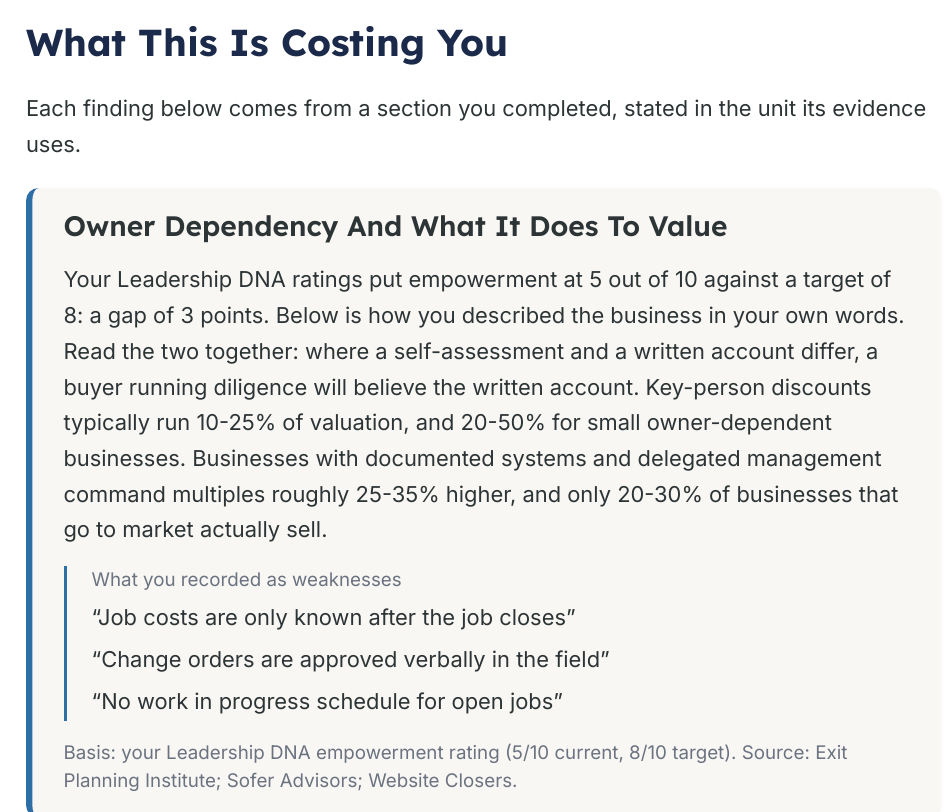
The briefing converts those inputs into a cost narrative rather than a score and states its basis next to each finding.
What matters for prevailing-wage work is compounding. A contractor who cannot separate public from private job costs cannot tell which one carries the administrative load. That means they cannot tell whether public work is subsidizing or draining the private sector.

The same briefing returns three headline figures for this profile. Execution to Ambition Ratio 0.61, meaning execution capacity falls short of stated ambitions. Founder Dependency Index 2.6 out of 10, moderate, with the business holding together without daily owner involvement. Organizational Readiness 51 out of 100.
That combination is the useful one. Delegation is healthy, and the people are capable. What is missing is measurement. Prevailing-wage work is where that gap costs the most, because the difference between public and private labor is entirely administrative and therefore invisible in a blended report.
Wage determination timing
A determination is locked at a point in the procurement process rather than at the moment work begins, and the lock point depends on the contract type.
That matters on long projects. A firm that bids against one determination and staffs against a later one has a gap it never priced. On a job spanning a determination update, the difference per hour is small but large per project.
The practice that prevents it is simply recording the governing determination number and date in the job file at bid time. Not a system, a field. Firms that skip it discover the problem during reconciliation, after the labor has been spent.
Pricing the administrative load
Most contractors bid prevailing wage work at the published rate plus their standard overhead percentage. That understates it.
The additional cost is a defined set of activities. Weekly certified payroll preparation and submission. Wage determination review at bid time and again if the project spans a determination update. Classification decisions and their documentation. Apprentice ratio tracking. Responding to any compliance inquiry consumes senior time rather than clerical time.
Estimate those hours once, convert them to a percentage of prevailing wage labor, and carry them as a line in the bid. A firm that has never measured it is usually surprised by the number, which is the point.
Contractors working through a margin structure generally should read construction company profit margins.
Not sure whether your public work is actually profitable? Sales Roadmaps separates the cost, so the bid reflects it. Start with the operations roadmap.
Fringe benefit classification is the common finding
The single most frequent compliance issue is the incorrect payment or crediting of fringe benefits.
Annualization catches firms out. Credit taken for a benefit plan must generally be calculated across all hours worked, not only prevailing wage hours. A contractor with mixed work cannot simply divide the plan cost by public hours.
The second recurring issue is crediting items that do not qualify. Not every payment a contractor considers a benefit counts toward the fringe obligation. Discovering that during an investigation is expensive in back wages rather than in fines.
Both are decided at setup and repeated automatically thereafter. That is what makes them dangerous. A single wrong decision propagates through every payroll until someone looks.
Separating public and private job costs
The structural fix is one accounting decision.
Public work needs its own cost coding, its own labor burden rate reflecting the fringe treatment actually used, and its own margin review. Blended into a single burden rate, prevailing wage labor looks identical to private labor on every report, and the difference in administrative cost stays invisible permanently.
Once separated, the questions become answerable. Whether public work carries an acceptable margin after its true burden, whether the compliance function is staffed or improvised, and whether the firm should pursue more of it or less.
Apprentice ratios and the quiet exposure
Apprentices may be paid below the journeyman rate only when properly registered and within permitted ratios on-site.
Both halves fail independently. An unregistered apprentice paid at apprentice rate creates back-wage exposure for every hour worked. A registered apprentice working outside the allowed ratio creates the same exposure to excess hours, even though each individual worker was paid correctly.
The ratio is a site condition rather than a payroll condition, which is why payroll software rarely catches it. The foreman controls it, and the payroll clerk reports it, and neither has the whole picture unless someone connects them.
The practical control is a weekly headcount check against the ratio at the same moment certified payroll is prepared. It takes minutes and closes the most common finding after fringe classification.
The sixty-second version
The same situation was typed, in plain language, into a second free tool that returns a written diagnosis rather than scores.
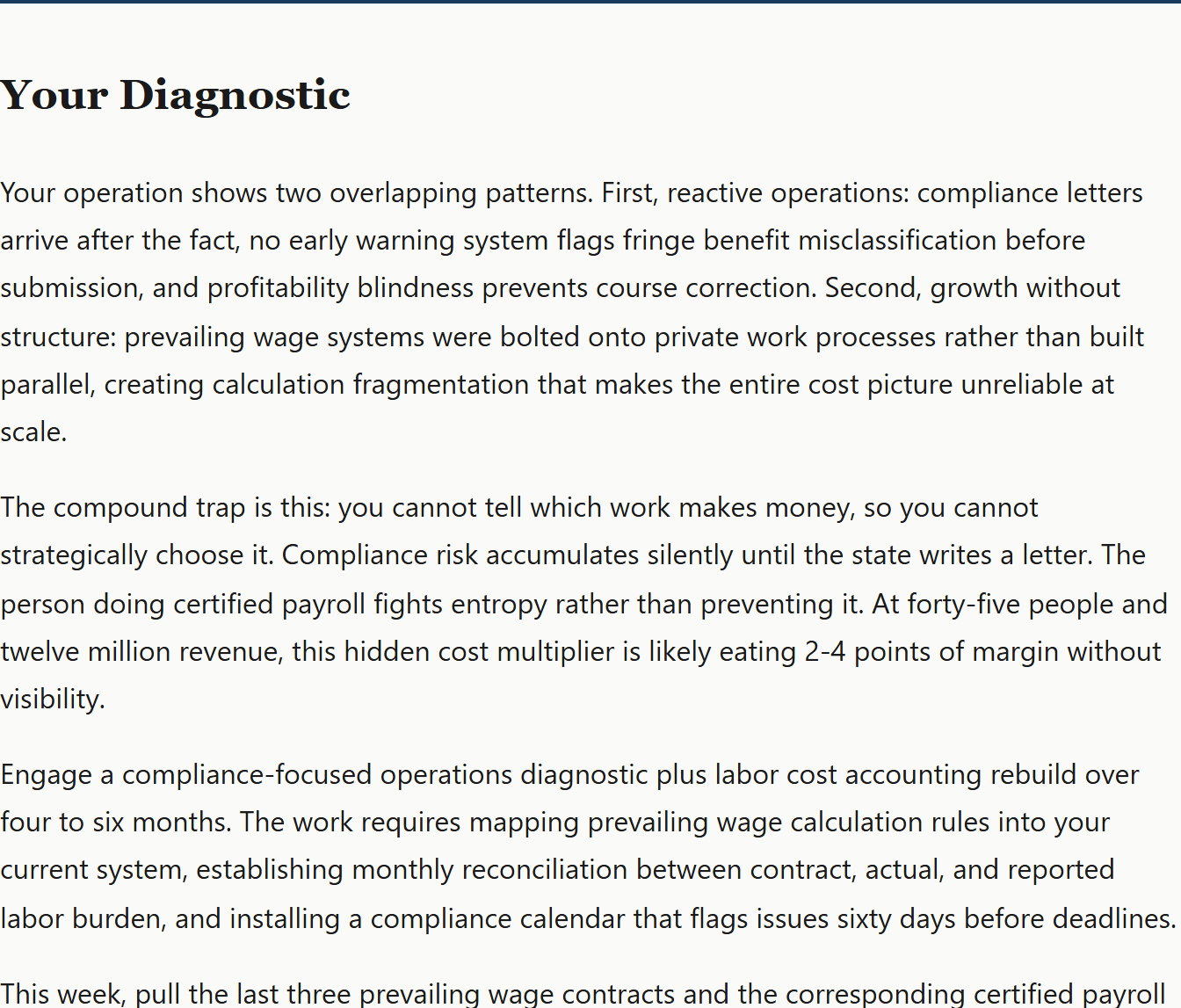
It identified two overlapping patterns and precisely named the mechanism. Compliance letters arrive after the fact, with no early warning system flagging misclassification before submission.
That framing is a useful correction. Prevailing wage compliance is usually treated as a paperwork obligation. It behaves like an operational control, and controls that only report after the fact are not controls.
Where this is not the constraint
If a firm does very little public work, the administrative load is real but small, and building a compliance system around it is disproportionate. The threshold is roughly when one person spends a meaningful share of a week on it.
If the firm cannot accurately cost any job, prevailing wage separation will not help. General job costing comes first, because separating public from private is only useful once either number is trustworthy.
Both tools used here are free. The written one is at businessconsultant.services, and the scored briefing is at vwcg.app. Operational context sits in construction company management.
The short version
Prevailing wage is not primarily a wage problem. It is an administrative obligation with a real recurring cost that most contractors absorb into overhead and never see again.
Measure the hours, price them into public bids, code public work separately, and decide fringe treatment deliberately rather than by default.
Want the public work priced with its real cost? Sales Roadmaps builds the separation and the bid line. Book a working session.
Frequently Asked Questions
What is prevailing wage?
Prevailing wage is the minimum hourly rate plus fringe benefit contribution that contractors must pay workers on public works projects. Rates are published in wage determinations by trade classification and locality, and compliance is evidenced through weekly certified payroll submissions.
What is certified payroll?
Certified payroll is a weekly statement listing every worker on a public project, with classification, daily hours, rate, fringes, and deductions, and is signed under penalty of perjury. It is a recurring obligation for the life of the project rather than a month-end report.
How should contractors price prevailing wage administration?
Estimate the recurring hours for payroll preparation, wage determination review, classification decisions, and apprentice tracking. Convert those to a percentage of prevailing-wage labor and carry them as a bid line rather than absorbing them into general overhead.
What is the most common prevailing wage compliance error?
Incorrect fringe benefit crediting. Annualization requires the benefit plan credit to be calculated across all hours worked rather than only public hours. Some payments contractors treat as benefits do not qualify toward the obligation at all.
Should public and private work be costed separately?
Yes. Public work needs its own cost coding, its own labor burden reflecting actual fringe treatment, and its own margin review. Blended into a single burden rate, the administrative cost difference remains permanently invisible.
When is prevailing wage compliance not worth systematizing?
When public work is a small share of revenue, and administration consumes less than a meaningful part of one person’s week. Below that threshold, the effort of building a system exceeds the exposure it removes.