Cargo insurance covers freight in the care of the carrier against loss or damage. For most small fleets, it is among the highest costs after fuel and equipment, and it is the one negotiated with the least preparation. Carriers arrive at renewal with whatever the broker presents and no independent view of their own risk.
The renewal is decided by the data the carrier already has
An underwriter prices a carrier on loss history, exposure, and operating profile. All three come from records the carrier owns.
Loss runs list every claim over the policy period with paid amounts, reserves, and status. Exposure is miles, units, and commodity mix. The operating profile includes safety performance, driver tenure, and equipment age.
A carrier that has never reviewed its own loss runs cannot tell whether its premium reflects reality or reserves that were never closed out. Open reserves on claims that resolved for far less are common, and they inflate the picture an underwriter sees until someone asks for a review.
The industry is large, and premiums have been rising. The Bureau of Labor Statistics counted about 2.2 million heavy and tractor-trailer driver jobs in 2024, with 4 percent growth projected through 2034. Fleet cost pressure is broad, which makes carrier-specific evidence more valuable, not less.
Frequency and severity are different arguments
Underwriters read two patterns, and carriers usually address neither specifically.
Frequency is how often claims occur. High frequency with low severity suggests a process problem: loading practices, securement, trailer condition, or a recurring issue on the lane. It is the pattern most within a carrier’s control and the one that responds fastest to operational change.
Severity is how expensive claims become when they occur. High severity with low frequency suggests exposure concentration rather than sloppiness, and it argues for different deductible and limit structures rather than for operational change.
Presenting the distinction, with the operational response already underway, is a materially stronger renewal position than presenting a request for a lower rate.
A worked example, run through a real tool
The company described below is fictional. It was invented for this article and run through two free assessment tools to show what the output looks like. No real client, company, or person is described. The figures are tool output on invented inputs, not market data or benchmarks.
The simulated profile is a regional trucking and freight company. Revenue between three and eight million, sixteen to thirty staff, ten to twenty years in business, owner working sixty to seventy hours a week.
The weaknesses entered describe measurement concentrated in one person: every load plan depends on the owner, settlements are calculated by hand, and there is no cost per mile by lane or truck.
What the assessment returned
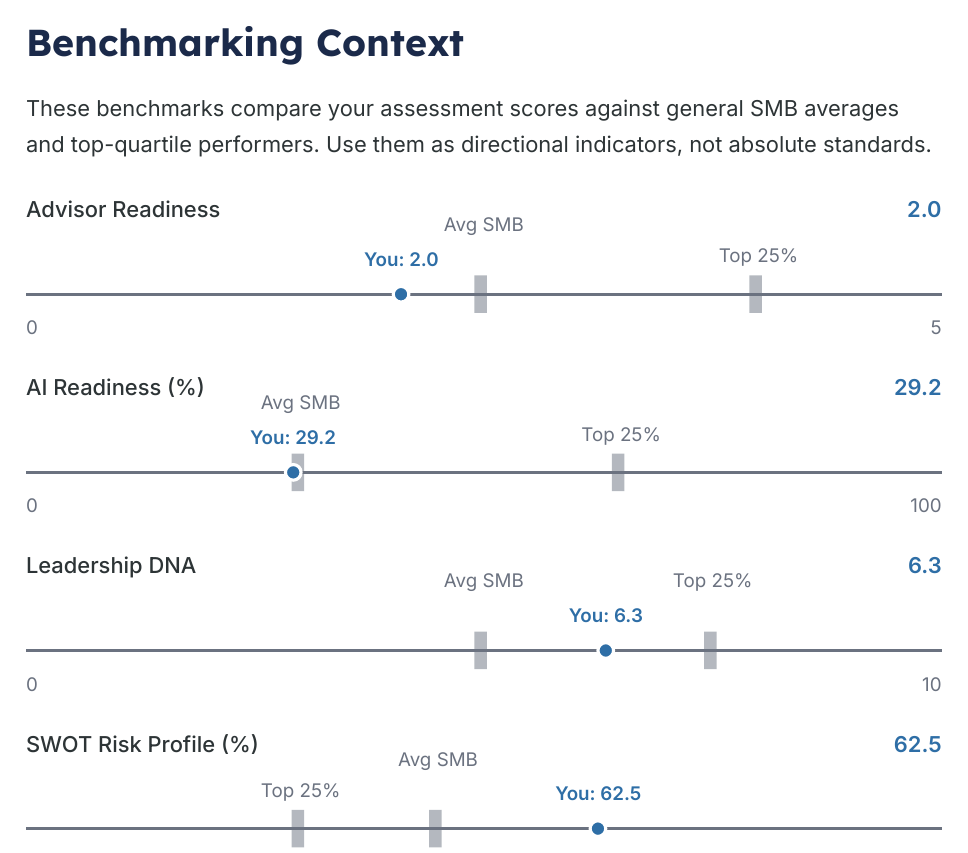
The briefing benchmarks the profile against general SMB averages and top quartile performers, stating on the page that the comparison is directional rather than absolute.
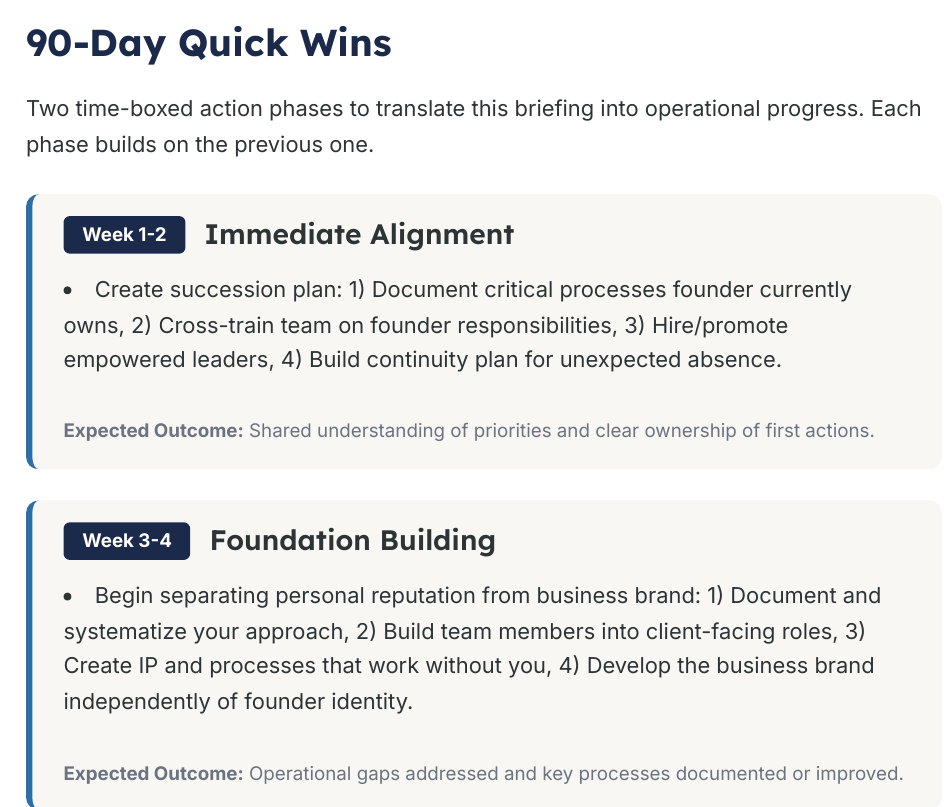
Founder Dependency Index: 5.9 out of 10, substantial single-person risk with the owner remaining the decision point for work, the business cannot reroute. Execution to Ambition Ratio: 0.65, capacity falling short of ambition. Organizational Readiness: 42 out of 100.
For insurance purposes, the relevant reading is the second. A carrier without spare capacity does not analyze loss runs, contest reserves, or prepare a renewal case. Those are exactly the tasks daily operations displace.
Reserves are negotiable in a way premiums are not
The most immediately available saving is not a rate discussion at all.
Reserves are the insurer’s estimate of what an open claim will ultimately cost. They sit on the loss run and influence pricing until the claim closes. A claim reserved at a high figure that will clearly resolve for much less is inflating the apparent loss history for the carrier every day it stays open.
Requesting a reserve review on open claims, with evidence about likely resolution held by the carrier, is an ordinary request that most small fleets never make. It costs a letter.
The timing matters. This has to happen well before renewal, because the loss run the underwriter reads is a snapshot. A reserve corrected the week after quoting does not help the quote.
Carriers reviewing coverage requirements should start with cargo insurance requirements.
Do you know what your own loss runs say? Sales Roadmaps builds the renewal case before the broker builds theirs. Start with the operations roadmap.
Claims nobody should have paid
Carriers frequently absorb claims that were not theirs to absorb.
Damage present at pickup but not noted on the bill of lading. Loss occurring in a consignee yard after delivery. Shortage attributable to a count someone else performed. Temperature excursions where the equipment recorded within range.
Each of those is defensible with documentation captured at the time and indefensible without it. The determining factor is almost never the merits. It is whether the driver photographed the load, whether the exception was noted, and whether the record can be found six months later.
That makes claims defense a documentation discipline that lives with drivers and dispatch rather than with the office. A phone photograph at pickup and delivery, filed against the load number, resolves most disputes before they become claims.
Deductible strategy follows the frequency pattern
The deductible decision should be based on data the carrier already holds, not on an appetite for risk.
A fleet with frequent small claims and a low deductible is effectively prepaying those claims through the premium, with the insurer’s expense load added. Raising the deductible and retaining the small claims is usually cheaper, provided the cash position can absorb the variance.
A fleet with rare but severe claims has the opposite profile. The deductible matters less than the limit, and the money is better spent on coverage depth than on trading deductible for premium.
Getting this backward is common because the decision is made from a quote sheet rather than from loss history.
Driver turnover is priced even when it is not discussed
Underwriters read driver tenure, and small carriers rarely present it deliberately.
A fleet where most drivers have several years of service looks materially different from one cycling through new hires, even at identical claim histories. At small sample sizes, tenure predicts future claims better than past claims do.
That gives a carrier with good retention an argument it usually fails to make. Tenure distribution, average years of service, and turnover trend are all available from payroll and are all relevant to pricing.
It also means a retention problem is an insurance problem with a delay attached. The premium consequence of a bad year for turnover arrives at the following renewal, well after the operational cause has been forgotten.
Preparing the renewal file
The carrier that negotiates well arrives with a file rather than a request.
Loss runs for the full experience period with open reserves identified and challenged where appropriate. A frequency and severity breakdown showing which pattern applies. Operational changes made since the last renewal with dates, so improvement is evidenced rather than asserted. Exposure data, including miles, units, and commodity mix. And driver tenure distribution.
That file takes a few hours to assemble from records already held. It changes the conversation from a request for a discount into a presentation of a risk.
Start ninety days before renewal. Reserve challenges and operational evidence both need time to appear in the record for the underwriter to read.
The sixty-second version
The same situation was typed, in plain language, into a second free tool that returns a written diagnosis rather than scores.
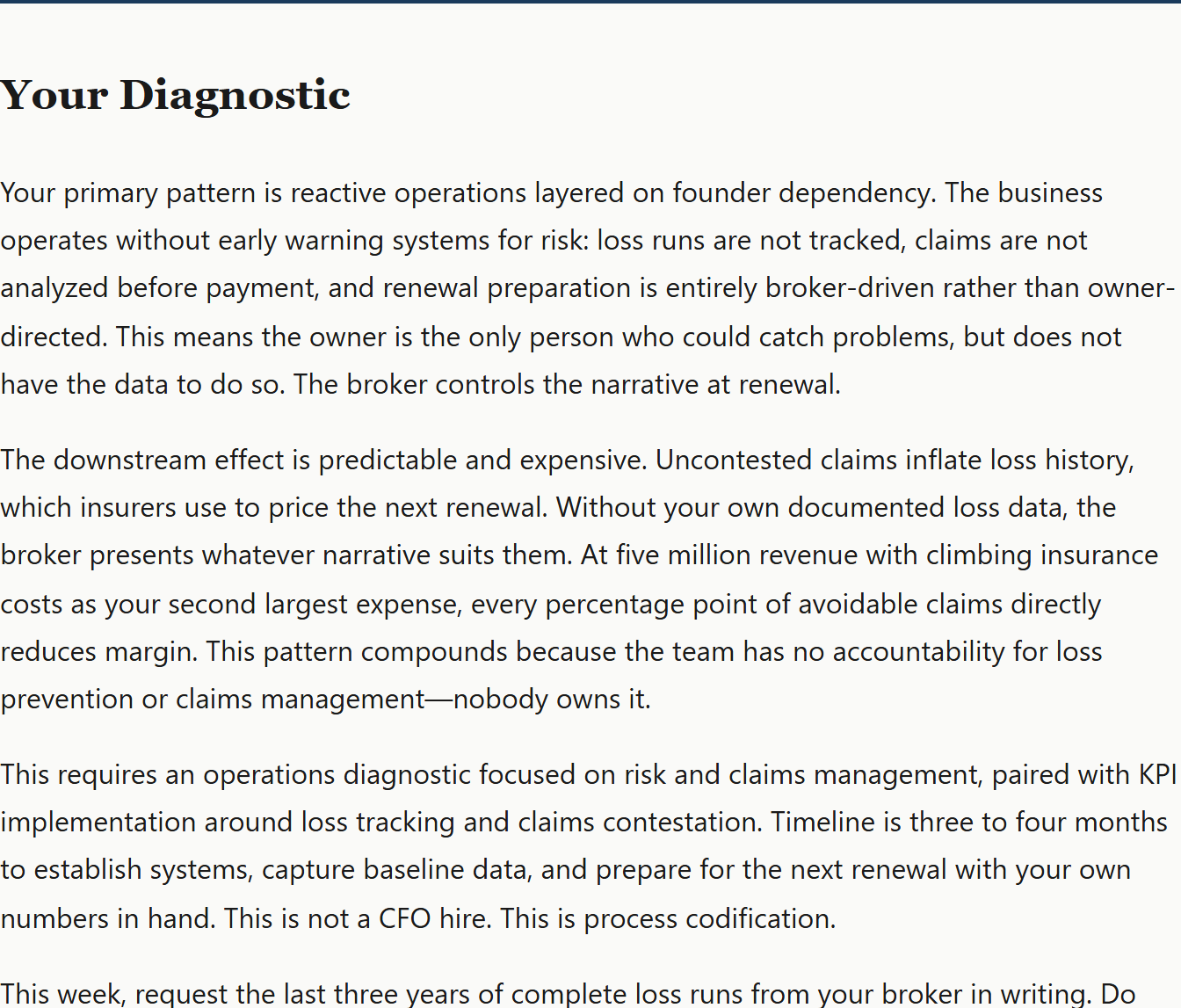
It is named “reactive operations layered on founder dependency” and identifies the mechanism as a business operating without early-warning risk systems, with loss runs untracked.
Early warning is the right frame. Insurance cost is a lagging indicator of operational conditions that were visible months earlier in claims frequency, driver turnover, and maintenance records. By renewal, the evidence is already written.
Where this is not the constraint
If the carrier has a minimal claims history and premiums are rising with the market, the lever is limited, and shopping the market is a reasonable response.
If safety performance is genuinely poor, presentation will not fix pricing. The operational work has to come first and be visible for a period before it changes an underwriter’s view.
Both tools used here are free. The written one is at businessconsultant.services, and the scored briefing is at vwcg.app. New carriers should review motor carrier insurance requirements.
The short version
Insurance renewal is priced on evidence the carrier already owns and rarely reads. Loss runs, frequency versus severity, and open reserves are all available months in advance.
Review loss runs quarterly, contest stale reserves early, photograph loads at pickup and delivery, and set the deductible based on the claims pattern rather than the quote sheet.
Renewal coming and no case prepared? Sales Roadmaps assembles the numbers before the broker does. Book a working session.
Frequently Asked Questions
What are loss runs?
Loss runs are the insurer’s record of every claim over a policy period, showing paid amounts, open reserves, and status. They are the primary evidence an underwriter uses to price a renewal, and carriers can request them from their broker at any time.
Why do open reserves matter at renewal?
A reserve is an insurer’s estimate of a claim’s ultimate cost, and it inflates the apparent loss history while the claim remains open. A claim reserved far above its likely resolution should be reviewed well before quoting, because the underwriter reads a snapshot.
What is the difference between frequency and severity?
Frequency is how often claims occur and usually indicates a process issue such as loading, securement, or equipment condition. Severity is how costly claims become and usually indicates the concentration of exposure. They call for different responses.
How should a carrier defend cargo claims?
With documentation captured at the time. Damage present at pickup, loss after delivery, and disputed counts are all defensible with photographs and noted exceptions filed against the load number. Without them, they are largely indefensible.
How should a deductible be chosen?
From the carrier’s own claims pattern. Frequent small claims under a low deductible mean paying for them through the premium plus the insurer’s expense load. A higher deductible is usually cheaper where cash flow can absorb the variance.
When can a presentation not improve a renewal?
When safety performance is genuinely poor. Preparation improves pricing where the record supports it. Where the record is weak, operational change has to come first and be demonstrable for a period before an underwriter revises their view.