A contingency fee pays the firm a share of recovery and nothing otherwise. The arrangement shifts the entire risk of the matter onto the firm, making case selection the primary financial decision a contingency practice makes. Most such firms select cases on instinct and discover the economics afterward.
The firm is a lender before it is a law firm
Every contingency matter has two financial dimensions, and firms usually track only one.
The fee is the visible half: a share of recovery, realized at resolution. The cost advance is the invisible half: filing fees, expert retainers, records, depositions, and medical funding, paid by the firm months or years before any recovery exists.
A firm carrying substantial advances is extending credit at zero interest against an uncertain repayment date. That is a lending business operating inside a law firm, and it is usually run without any of the controls a lender would consider basic.
The profession is large, and the economics are unforgiving. The Bureau of Labor Statistics counted 864,800 lawyer jobs in 2024, with 4 percent growth projected through 2034. Competition for the same cases makes selection discipline more valuable, not less.
The fee per case is the wrong number alone
Firms that do measure tend to measure average fee, which conceals more than it reveals.
Average fee per case says nothing about how long the money took to arrive, how much the firm advanced to get it, or how much attorney time it consumed. Two case types with identical average fees can have completely different returns once the carry period and cost advance are attributed.
The figure that changes decisions is the net of advanced costs, divided by the number of months from intake to resolution. That produces a monthly return per case type. It usually reorders how a practice understands its own case mix, and it does so immediately rather than over a planning cycle.
A worked example, run through a real tool
The company described below is fictional. It was invented for this article and run through two free assessment tools to show what the output looks like. No real client, firm, or person is described. The figures are tool output on invented inputs, not market data or benchmarks.
The simulated profile is a personal injury and civil litigation practice. Revenue between three and eight million, sixteen to thirty staff, managing partner working sixty to seventy hours a week.
The strengths entered describe genuine standing: a trial reputation that drives referrals from other attorneys, and settlement results that support the reputation.
What the assessment returned
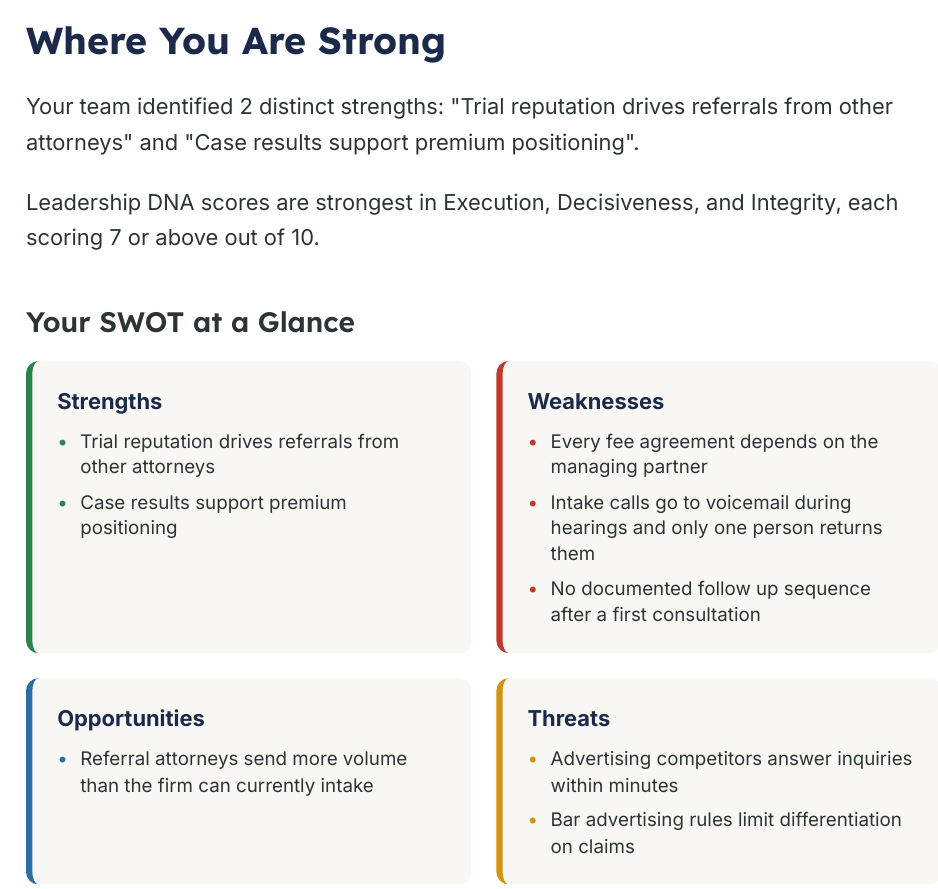
The briefing records the strengths in the owner’s wording and treats them as assets to protect, not as evidence that the practice is financially sound.
The distinction matters for a contingency firm. Reputation determines what cases arrive. It does not determine which of those cases the firm should accept, and the two questions are routinely conflated.
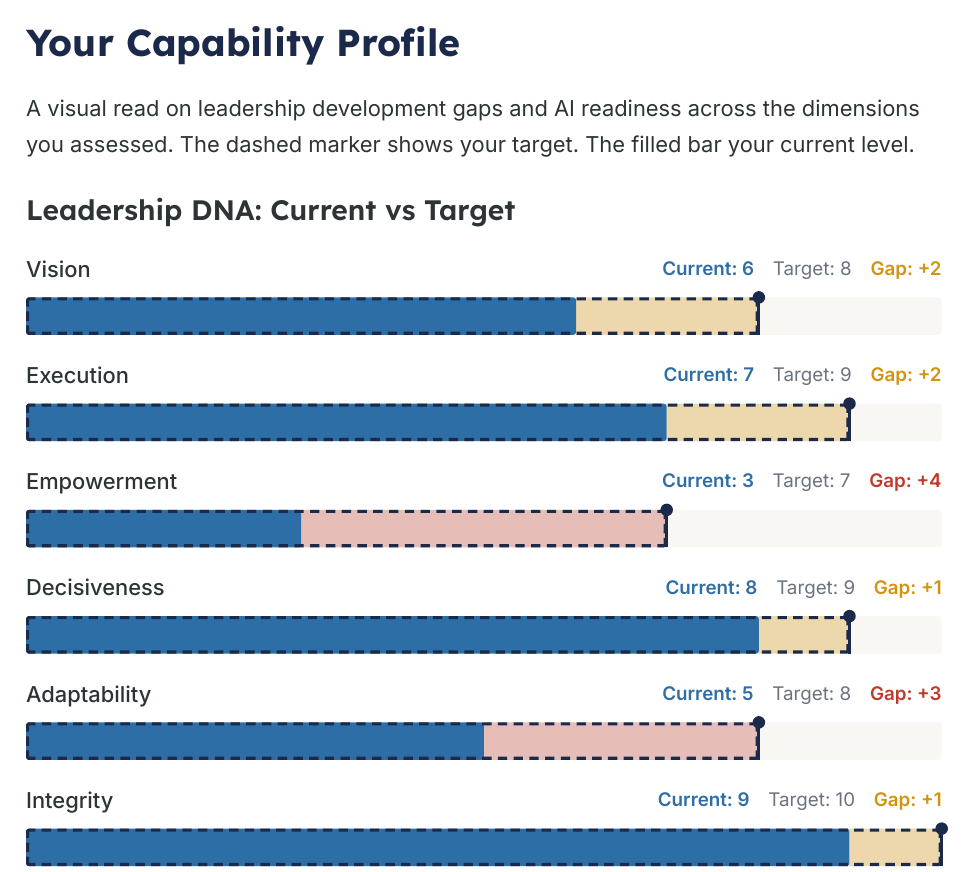
Founder Dependency Index: 7.1 out of 10, which the briefing describes as a critical vulnerability. Execution to Ambition Ratio: 0.68. Organizational Readiness: 44 out of 100.
Critical dependency and contingency economics interact badly. Where one person decides which cases to take, which costs to advance, and when to settle, none of those decisions leave a reviewable record.
Cost advances need a threshold and a gate
The control most contingency firms lack is the simplest one available.
Advancing costs without an approval threshold means the decision to commit firm capital is made on a case-by-case basis by whoever happens to be handling the matter. Nobody compares the commitment against the expected recovery. That is not a judgment problem. It is an absent process.
A written threshold changes it. Above a defined figure, an advance requires partner approval and a short note on expected recovery. Below it, the handling attorney proceeds. The number matters less than the existence of the line.
The second control is a review at defined points. A matter that has consumed a defined share of the expected recovery in advanced costs should be reviewed rather than automatically continued. That review works best when it is scheduled in advance rather than triggered by an alarm.
Firms working through the financial picture should read law firm profitability.
Do you know your cost per case type? Sales Roadmaps builds the case economics before the next intake decision. Start with the operations roadmap.
Aging is the metric that predicts everything
The single most useful report a contingency firm can build takes an afternoon.
List every open matter by age, with advanced costs to date and expected recovery. Sort by age. The bottom of that list is where firm capital sits, and most practices have never seen it assembled in one place.
Old matters are not automatically bad matters. Some are old because the injury has not resolved medically, which is correct and unavoidable. Others are old because nobody has looked at them, and those are the ones the report finds.
The pattern that should prompt action is an old matter that carries high advanced costs and has not seen substantive activity for months. That combination is capital being consumed without progress, and it is invisible in any report organized by attorney or by practice area.
Intake is where the economics are decided
Every downstream financial decision inherits a choice made in the first conversation.
An intake process that accepts anything with a plausible claim commits firm capital before anyone has estimated recovery, liability, or the likely cost of proving either. The matter then consumes advances for months before the economics become visible, at which point the sunk cost argues for continuing.
A short intake standard changes the profile of the whole practice. Estimated recovery range, apparent liability position, insurance coverage available, and whether the injury has resolved medically enough to be valued. Four questions are asked before the file opens.
Firms that adopt one usually decline more matters in the first quarter and report better cash within two. That is the sequence to expect, rather than a sign that the standard was set too strictly.
Case selection is a portfolio decision
Contingency practice is portfolio management, and firms tend to run it as a series of individual judgments.
Each case has an expected value, a variance, a cost to carry, and a time to resolution. A practice loaded with cases that share a resolution timeline has a cash flow problem waiting to arrive. A practice loaded with high-variance cases has a different problem, which is that a bad year is genuinely possible rather than merely unlucky.
Balance is the objective rather than maximizing any single case. A mix that includes matters resolving quickly at modest fees alongside longer, higher-value matters funds the practice while the larger cases mature.
That reasoning is only available once cases are classified by type and the type has measured economics. Without it, balance is asserted rather than managed.
Settlement decisions need a number attached
The decision to accept or reject an offer is where opinion most often substitutes for arithmetic.
The relevant comparison is the offer against the expected value at resolution, discounted for time, additional cost advance, and probability. All four inputs are estimable. None of them is usually written down.
Writing them down does not remove judgment. It records the reasoning at the moment it is made. That allows a look back across a full year of settlement decisions, to see whether the practice settles too early or holds too long as a habit.
Practices frequently discover a consistent bias in one direction. That is correctable information, and it is only visible in aggregate.
Operational structure sits in law firm operations consultant.
The sixty-second version
The same situation was typed, in plain language, into a second free tool that returns a written diagnosis rather than scores.
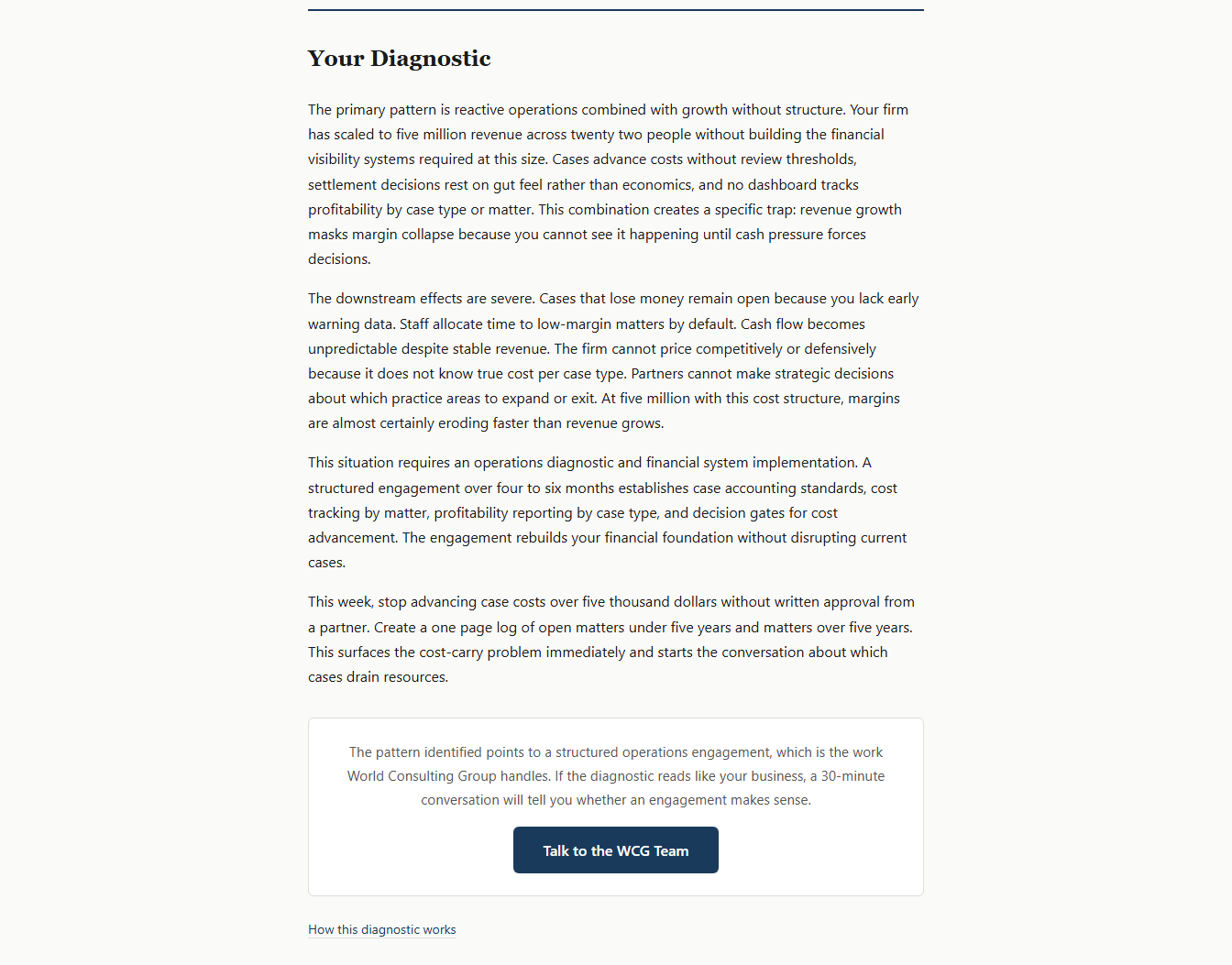
It is named reactive operations combined with growth without structure. Then it stated the trap directly: revenue growth masks a margin collapse because nobody sees it until cash pressure forces a decision.
Cash pressure forcing decisions is the failure mode specific to contingency work. A firm that settles a matter because it needs the money has let its balance sheet make a legal judgment.
Where this is not the constraint
If the practice is predominantly hourly, cost carry is a smaller factor, and realization and capture matter more.
If case volume is the binding constraint rather than case quality, intake and marketing precede this work. Selection discipline only helps a firm that has more cases available than it can handle.
Both tools used here are free. The written one is at businessconsultant.services, and the scored briefing is at vwcg.app.
The short version
A contingency practice includes a lender, a portfolio manager, and a law firm, and most measure none of it. The average fee per case conceals the carry period and advanced cost, which actually determine the return.
Set an approval threshold for cost advances. Build the aging report with advances and expected recovery on it. Classify cases by type and measure the economics of each type. Write down the reasoning behind settlement decisions, so the pattern becomes visible.
Advancing costs without a threshold? Sales Roadmaps puts the gate in place. Book a working session.
Frequently Asked Questions
What makes contingency economics different?
The firm bears the entire risk and funds the matter before any recovery is available. Filing fees, experts, records, and depositions are advanced months or years in advance of payment, so the practice is extending interest-free credit against an uncertain payment date.
Why is the average fee per case insufficient?
Because it says nothing about carry period, advanced cost, or attorney time consumed. Two case types with identical average fees can have entirely different returns once those are attributed. Fee net of advances divided by months to resolution is the figure that changes decisions.
What control do most contingency firms lack?
An approval threshold on cost advances. Without one, the decision to commit firm capital is made on a case-by-case basis, with no comparison to expected recovery. The specific number matters less than the existence of a defined line.
What does a case aging report show?
Every open matter by age with advanced costs and expected recovery. The bottom of that list is where firm capital sits. The pattern to act on is an old matter that has seen meaningful advances but has had no substantive activity in months.
Why is case selection a portfolio decision?
Because each matter has an expected value, a variance, a carrying cost, and a resolution timeline. A practice loaded with cases sharing a single timeline faces a cash-flow problem, and one loaded with high-variance cases can have a genuinely bad year.
How should settlement decisions be recorded?
By writing down the offer against expected value at resolution, discounted for time, further cost advance, and probability. Recording the reasoning allows the firm to review a year of decisions and detect a systematic bias toward settling early or holding too long.