Progress billing invoices a project in stages against work completed, rather than at the end. It exists because construction consumes cash long before it produces any. When it drifts behind the work, a contractor experiences a cash crisis on jobs that are making money, which is the most confusing failure mode in the business.
Underbilling is a loss to the customer
The gap between work performed and work invoiced has a name and a cost.
Underbilling means the contractor has completed work it has not yet invoiced. That work has already been paid for in wages, materials, and equipment. The contractor is funding a customer project from its own balance sheet, without interest, for as long as the gap persists.
Contractors rarely describe it that way, which is why it is tolerated. Described accurately, most owners would decline the arrangement immediately if a bank proposed it.
The market is substantial. The Bureau of Labor Statistics counted 550,300 construction manager jobs in 2024, with 9 percent growth projected through 2034. Billing discipline is available to every firm and practiced by a minority.
The schedule of values decides the cash curve
Most of the outcome is determined before the first invoice.
A schedule of values allocates the contract price across line items. Those allocations determine what can be billed at each stage. A schedule weighted toward late line items produces a project that consumes cash for months, regardless of how well the work is executed.
Weighting earlier line items appropriately, particularly mobilization, submittals, and procurement, aligns billing with the point at which the contractor actually spends. That is a negotiation at contract signing, and it is the single most valuable hour in the entire billing process.
There is a line between appropriate weighting and front-loading beyond the value of work performed. The first is prudent. The second creates a dispute later and damages a relationship that took years to build.
A worked example, run through a real tool
The company described below is fictional. It was invented for this article and run through two free assessment tools to show what the output looks like. No real client, company, or person is described. The figures are tool output on invented inputs, not market data or benchmarks.
The simulated profile is a commercial electrical and specialty trade contractor. Revenue between eight and fifteen million, thirty-one to sixty staff, ten to twenty years in business.
The weaknesses entered describe the absence of measurement rather than the absence of skill: job costs known only after close, change orders approved verbally, and no work-in-progress schedule.
What the assessment returned
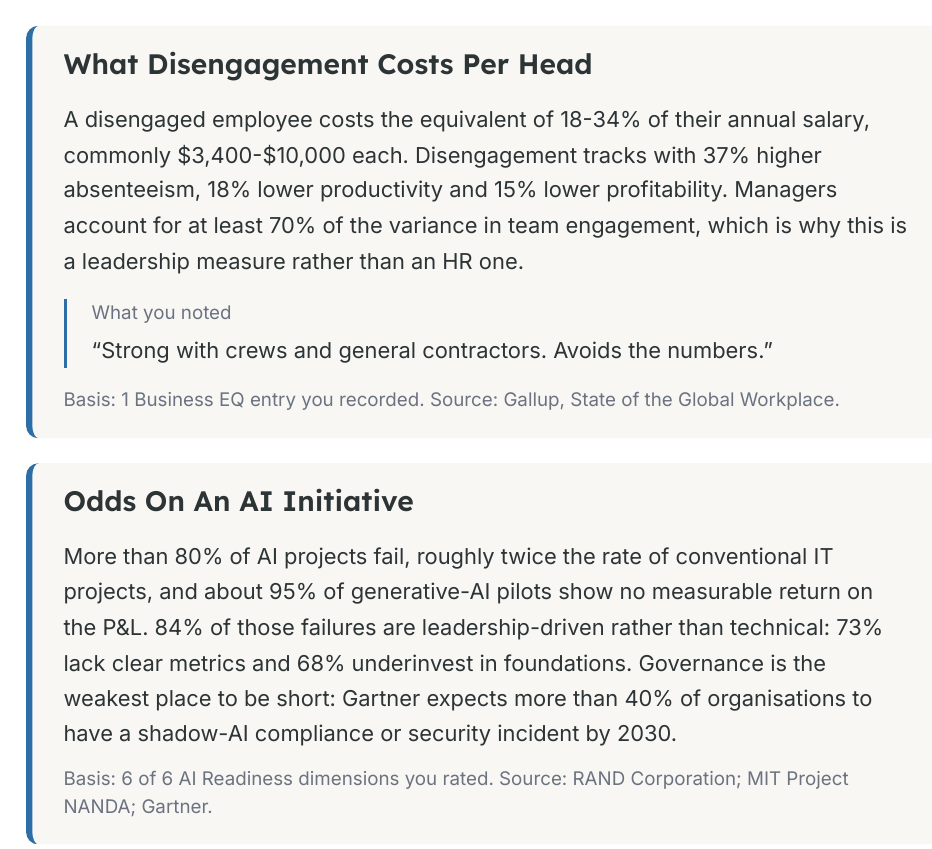
The briefing pairs published benchmark figures with what the owner actually typed, and names the source under each block rather than presenting the numbers as its own research. The quoted line for this profile reads “Strong with crews and general contractors. Avoids the numbers.”
Avoiding the numbers is the trait that produces underbilling. A contractor who is confident in the field and uncomfortable with the billing arithmetic will keep building and defer invoicing, which is the exact mechanism described in this article.
Execution to Ambition Ratio: 0.61. Founder Dependency Index: 2.6 out of 10, moderate. Organizational Readiness: 51 out of 100.
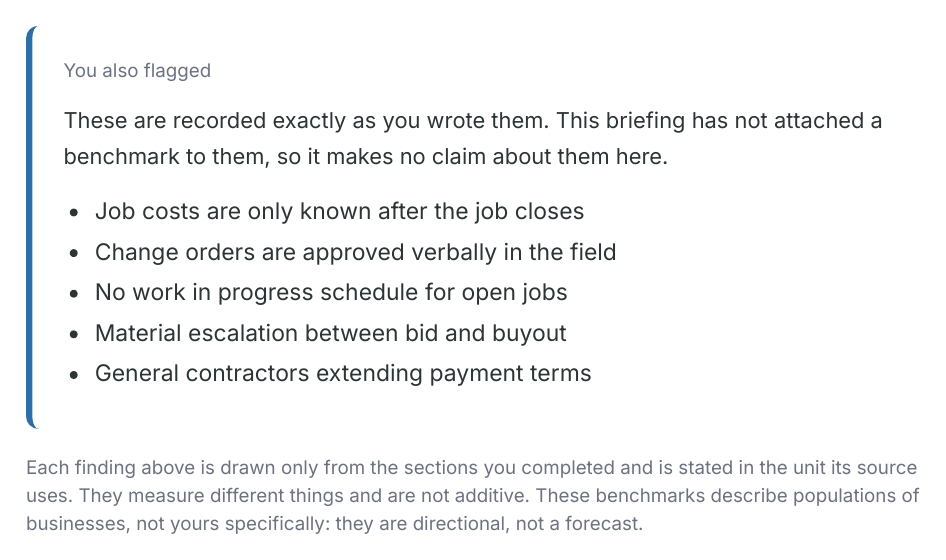
The briefing reproduces the weaknesses verbatim and explicitly declines to attach a cost to them, which is the correct treatment. No missing work-in-progress schedule is a fact. What it costs depends on the contract mix, and inventing a figure would be worse than leaving the space empty.
The work-in-progress schedule is the instrument
One report answers the question that a contractor cannot otherwise answer.
A work-in-progress schedule lists every open project with contract value, costs to date, estimated cost to complete, percentage complete, amount billed, and the resulting over- or under-billing. It is a page of arithmetic, and most firms under twenty million do not maintain one.
Without it, a contractor knows revenue and knows the bank balance, but cannot connect them. Profitable jobs and cash pressure coexist without a visible explanation, producing exactly the wrong management response.
With it, the underbilled projects are named. Each one is a specific invoice that has not been raised, and the correction is an action rather than a strategy.
Monthly is the minimum useful frequency. A quarterly schedule reports a problem that has already consumed a quarter of cash.
Contractors reviewing margin should read construction company profit margins.
Do you know if you are overbilled or underbilled right now? Sales Roadmaps builds the work-in-progress schedule. Start with the operations roadmap.
Rejection is a documentation problem
Pay applications get rejected for form far more often than for substance.
Missing lien waivers from lower-tier subcontractors. Percentages that do not reconcile to the previous application. Change orders billed before formal execution. Certified payroll absent from public work. Stored materials without the required documentation.
None of those are disagreements about the work. Each restart of the payment clock resets it, and on a monthly cycle, a single rejection costs a full period.
The correction is a per-customer checklist because requirements differ by owner and general contractor. Built once from the last three rejections, applied before submission, it removes the most expensive category of delay in the process.
Verbal change orders never bill
The most common cause of a large underbilling is work performed on a conversation.
A field instruction is given, the crew performs, and everyone intends to file the paperwork later. Later arrives at closeout, by which time the person who gave the instruction has moved on, and the only record is what one side remembers.
The rule that solves it is unpopular and works. No change work starts without written authorization, even if the written authorization is a short message confirming the conversation. Firms adopting it report friction for a month, followed by improved cash flow permanently.
The billing consequence is direct. Unauthorized change work cannot be included in a pay application, so every verbal instruction is an interest-free advance with a dispute attached to the end of it.
The operational structure falls under the construction company’s management.
Percentage complete has to come from cost, not opinion
The percentage entered on a pay application is frequently an estimate by the person who performed the work.
Estimated by eye, that figure is optimistic early and pessimistic late, which is exactly the pattern that produces underbilling in the first half of a project. It also cannot be reconciled with anything, so a rejection of the number has no evidence to support it.
The cost to date, divided by the total estimated cost, yields a defensible figure. It requires job costing that is current rather than closed out, which is the reason most firms do not use it and the reason they should.
The secondary benefit is early warning. A project where the cost percentage runs ahead of physical progress is losing money, and that divergence is visible months before the final numbers arrive.
Cycle timing compounds quietly
The billing calendar is negotiated once and then obeyed forever, usually without anyone calculating its cost.
A cutoff on the twenty-fifth, with submission on the first and payment thirty days after approval, means work performed on the twenty-sixth is paid roughly seventy days later. Moving the cutoff to month-end can eliminate a week of carryover across every project simultaneously.
That is a contract negotiation rather than an operational change, and it is available at the point when most contractors are focused entirely on price.
The same applies to approval periods and to the retainage percentage. All three are terms. All three are routinely accepted as given.
The sixty-second version
The same situation was typed, in plain language, into a second free tool that returns a written diagnosis rather than scores.
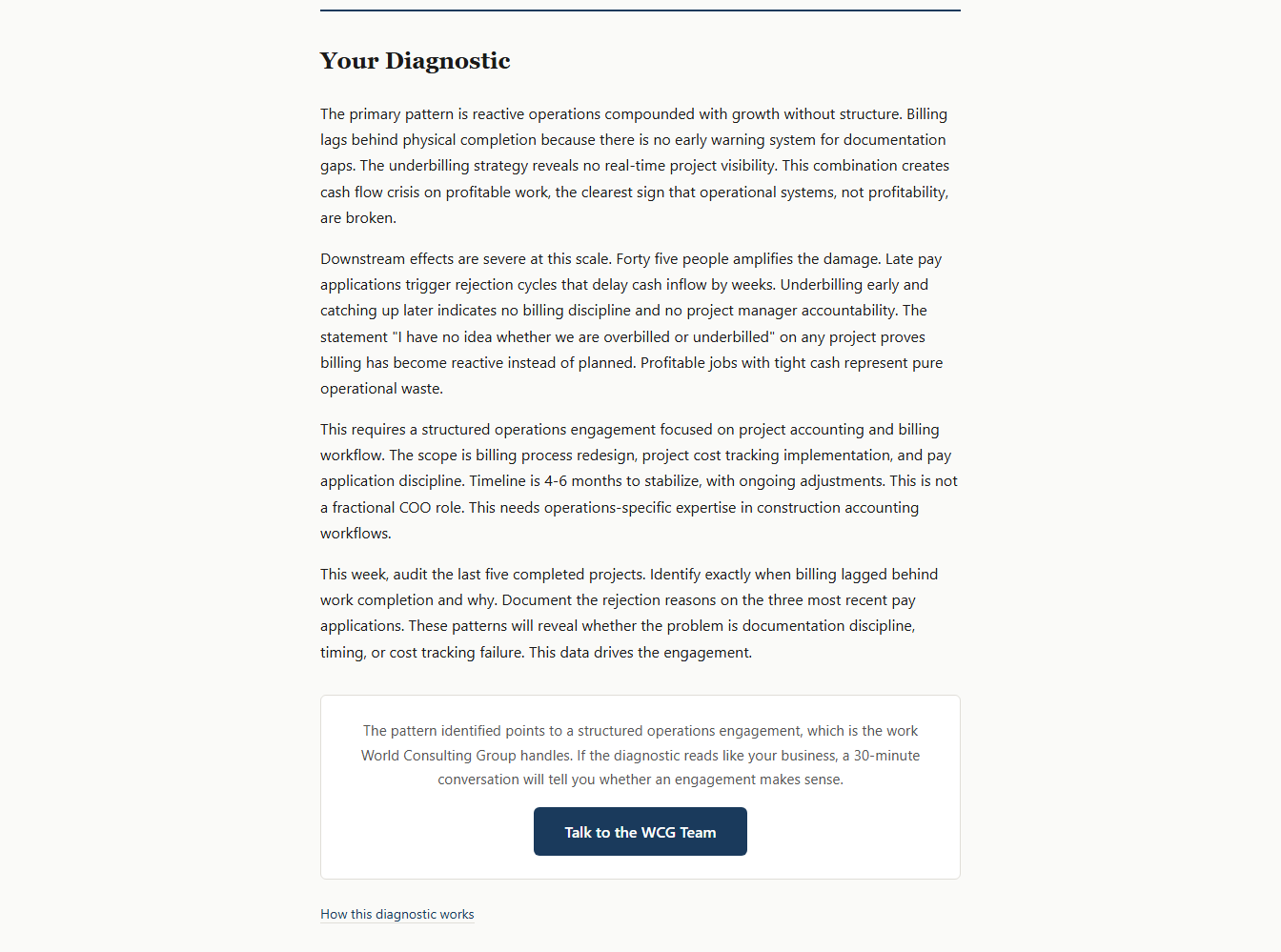
It is named reactive operations compounded with growth without structure. Then it identified the exact signature described here. A cash flow crisis on profitable work is the clearest evidence that operational systems, rather than profitability, are broken.
That sentence is the diagnostic test worth remembering. Profitable jobs plus tight cash are not a margin problem and should not be treated as one.
Where this is not the constraint
If the work is of short duration and paid upon completion, the mechanics of progress billing matter less, and collection speed matters more.
If job costs are unknown until close, that comes first. The percentage complete cannot be calculated from costs nobody has.
Both tools used here are free. The written one is at businessconsultant.services, and the scored briefing is at vwcg.app.
The short version
Underbilling is an interest-free loan to the customer, and most contractors cannot say whether they are making one right now. The work-in-progress schedule is the instrument that answers it.
Negotiate the schedule of values to match the spending curve. Maintain a monthly work-in-progress schedule. Keep a rejection checklist per customer. Refuse to start change work without written authorization, and treat billing cutoff dates as negotiable terms rather than fixed conditions.
Cash tight on profitable jobs? Sales Roadmaps finds where the billing sits. Book a working session.
Frequently Asked Questions
What is underbilling?
Work completed but not yet invoiced. The contractor has already paid for it in wages, materials, and equipment. The gap is therefore an interest-free loan to the customer, funded from the contractor’s own balance sheet until it closes.
Why does the schedule of values matter so much?
Because it allocates the contract price across line items, thereby determining what can be billed at each stage. A schedule weighted toward late items results in a project that consumes cash for months, regardless of execution quality.
What is a work-in-progress schedule?
A report listing every open project with contract value, costs to date, estimated cost to complete, percentage complete, amount billed, and the resulting over- or under-billing. It is the only report that connects revenue to the bank balance.
Why do pay applications get rejected?
Usually, for form rather than substance. Missing lower-tier lien waivers, percentages that do not reconcile to the prior application, or change orders billed before execution. Also absent certified payroll and stored materials without documentation. Each restarts the payment clock.
What is the cost of a verbal change order?
Unauthorized change work cannot be included in a pay application. Every verbal instruction therefore becomes an interest free advance with a dispute waiting at closeout, by which time the only record is what one side remembers.
Is a cash crisis on profitable jobs a margin problem?
No. Profitable work combined with tight cash is the clearest available signal that billing and documentation systems are failing, rather than that pricing is wrong. Treating it as a margin problem produces the wrong response.