Lead scoring ranks incoming inquiries, so effort goes where it will produce revenue. Most firms skip it and work leads by recency, which means the newest inquiry always outranks the best one. The result is a team that is busy, responsive, and systematically working the wrong list.
Recency is the default ranking, and it is arbitrary
When nothing ranks leads, something still does.
The thing at the top of the inbox gets attention. A person who called this morning gets called back before a person who submitted a detailed inquiry on Tuesday. That ordering has no relationship to value, and everyone follows it because it requires no decision.
The cost is not the poor leads that get worked. It is the good ones that go cold while someone is occupied. A strong inquiry that waits four days has usually spoken to somebody else by then, and the firm never learns it lost.
The occupation is substantial. The Bureau of Labor Statistics counted about 1.6 million wholesale and manufacturing sales representative jobs in 2024, with 1 percent growth projected through 2034. Very few of those teams rank what they work.
Fit and intent are different axes
The common mistake is to build one score from two unrelated things.
Fit is whether this organization is the kind of firm that serves the firm well: its size, sector, geography, and the problem it has. Fit is stable and knowable before any conversation happens.
Intent is whether they are moving now: what they asked for, how specific it was, whether a timeline was mentioned, and whether they returned. Intent is volatile and says nothing about whether the firm should want them.
Collapsed into one number, the two cancel out. A perfect fit browsing casually and a poor fit in a hurry can produce the same score and need completely different treatment. Kept separate, the grid tells the team what to do. High fit with high intent gets called immediately. High fit with low intent gets nurtured. Low fit with high intent gets qualified quickly or declined.
A worked example, run through a real tool
The company described below is fictional. It was invented for this article and run through two free assessment tools to show what the output looks like. No real client, company, or person is described. The figures are tool output on invented inputs, not market data or benchmarks.
The simulated profile is a business-to-business commercial services firm. Revenue between eight and fifteen million, thirty-one to sixty staff, ten to twenty years in business.
The weaknesses described are an absence of measurement, not an absence of effort. There is no definition of a qualified opportunity. The forecast rests on individual confidence, and results are never measured by representative or by source.
What the assessment returned
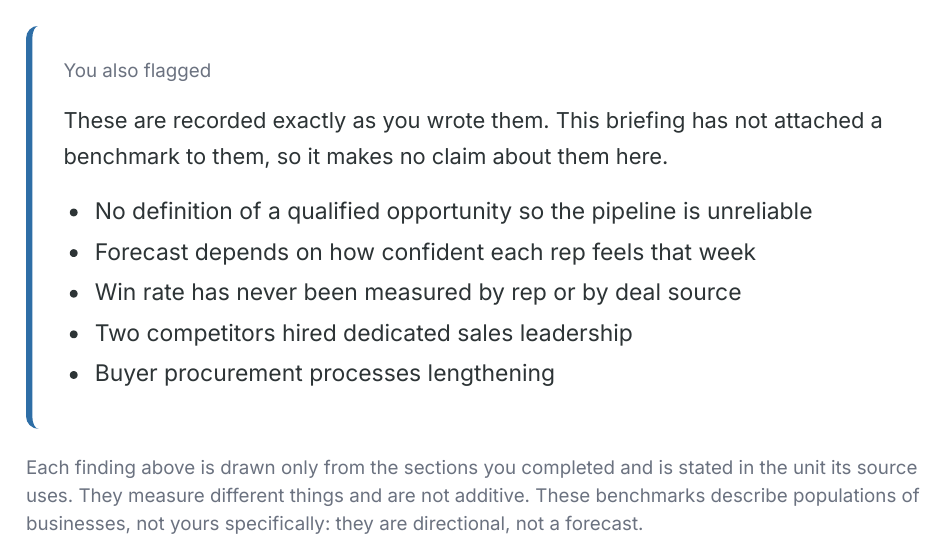
The briefing reproduces the flagged weaknesses verbatim and declines to attach a cost figure to them, which is the correct treatment. That no qualification standard exists is a fact. The cost depends on lead volume and deal size.
Execution to Ambition Ratio: 0.58. Founder Dependency Index: 4.0 out of 10. Organizational Readiness: 58 out of 100.
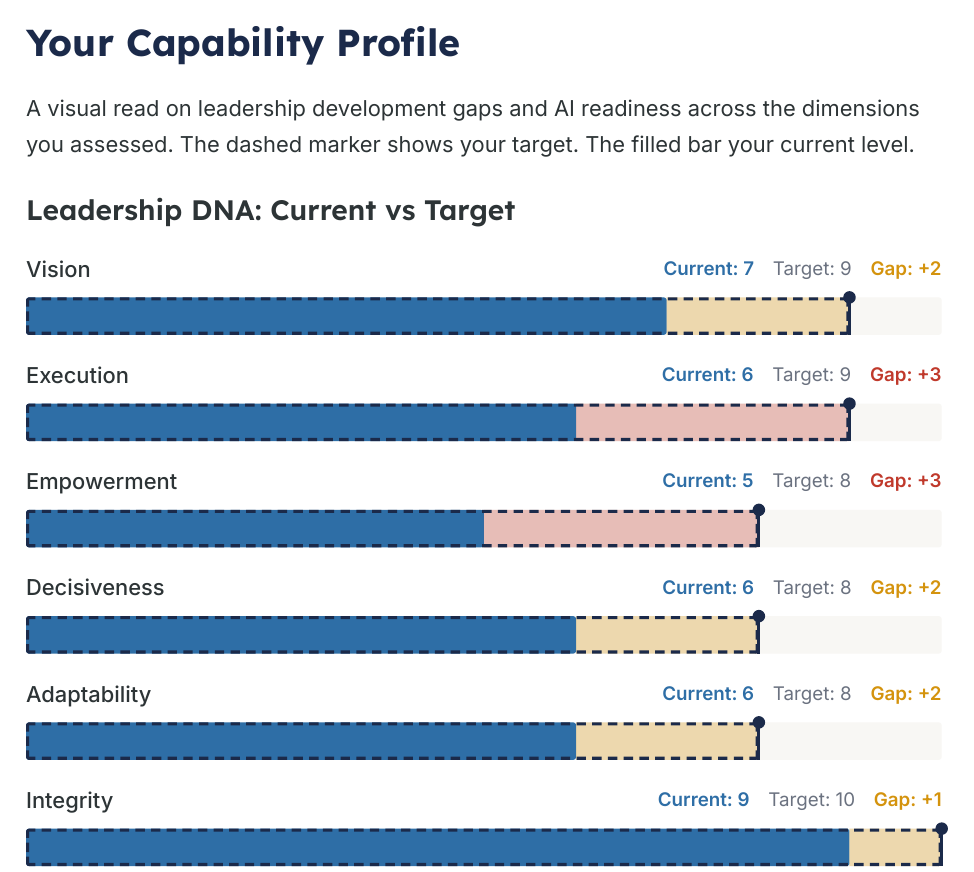
The capability profile reads leadership development and readiness across dimensions rather than reporting a single competence figure.
A readiness score in the high fifties is favorable for this particular change. Scoring leads is a small behavioral ask compared with restructuring a process, and it produces visible results within a month.
Build the model from a closed business
The mistake that makes scoring useless is inventing the criteria in a meeting.
The data required already exists. Take the last fifty or hundred closed deals, both won and lost, and look for what the won ones had in common at the moment of inquiry. Size band, sector, how they found the firm, what they asked for, and whether a specific problem was named.
Those attributes are the model. They are usually fewer and simpler than anyone expects, and they are frequently surprising. Firms regularly discover that a source they consider marginal produces their best work, and that a demographic they target heavily rarely closes.
Five or six weighted attributes is enough. A score with twenty inputs is not more accurate; it is just harder to maintain and impossible to explain to the person expected to act on it.
Firms restructuring the commercial function should read sales operations roadmap.
Working leads by whichever arrived last? Sales Roadmaps builds the ranking from your own closed business. Start with the operations roadmap.
Speed matters most at the top of the list
Response time is the single most reliable lever in inbound sales, and it should be spent selectively.
A high-fit, high-intent inquiry contacted within minutes converts at a materially different rate from the same inquiry contacted the next day. The reason is simple: the buyer is looking now and is contacting more than one firm.
That argues for routing rather than for a blanket speed target. Committing to call every inquiry within five minutes is a promise a team will break. Committing to calling the top tier within five minutes is achievable precisely because the tier is small.
The rest need a defined cadence rather than immediate attention. A sequence of contacts over a couple of weeks, with a defined stopping point, recovers a meaningful share of leads that would otherwise be touched once and forgotten.
Recheck the model against reality
A score built once and never revisited becomes confidently wrong.
The attributes that predicted good business two years ago reflect the market and the offering as they were then. Both move. A firm that expands its services, changes its pricing, or enters a new sector will find its model quietly misranking within a year.
Rechecking is the same exercise as building it. Take the most recent closed deals and ask whether the high-scoring ones actually won. Where the correlation has weakened, the weights need to be adjusted rather than abandoning the concept.
Twice a year is sufficient. The value of the check lies less in the adjustment than in maintaining the belief that the ranking reflects something real. A score nobody trusts is ignored within a fortnight.
Disqualification is the point
A scoring model that never rejects anything is a reporting exercise.
The value comes from what it removes. Inquiries that decisively fail the fit criteria should be declined quickly and politely rather than nurtured forever. A poor fit consumes the same hours as a good one and produces either nothing or a difficult client.
Teams resist this because a lead in the system feels like an asset. It is not. It is a claim on attention, and the attention is the scarce resource rather than the inquiries.
Making disqualification explicit also improves the data. A firm that records why something was declined learns which sources produce unusable volume, which is a marketing finding that never surfaces while everything is nurtured forever.
Scoring settles the argument with marketing
The recurring dispute between sales and marketing is about volume, and scoring reframes it.
Marketing reports leads delivered. Sales reports lead quality. Neither has evidence, so the conversation repeats every quarter with more heat and no resolution.
A score that both functions agreed to changes the unit of account. Marketing is then measured on high-scoring leads rather than on total leads. That changes what it optimizes for immediately, and usually reduces volume while increasing revenue.
It also surfaces the leads sales never touched. That number is frequently large, and it is a different problem from lead quality. Both sides tend to be partly right, and the score makes that visible rather than arguable.
Process design sits in sales process consultant.
The sixty-second version
The same situation was typed, in plain language, into a second free tool that returns a written diagnosis rather than scores.
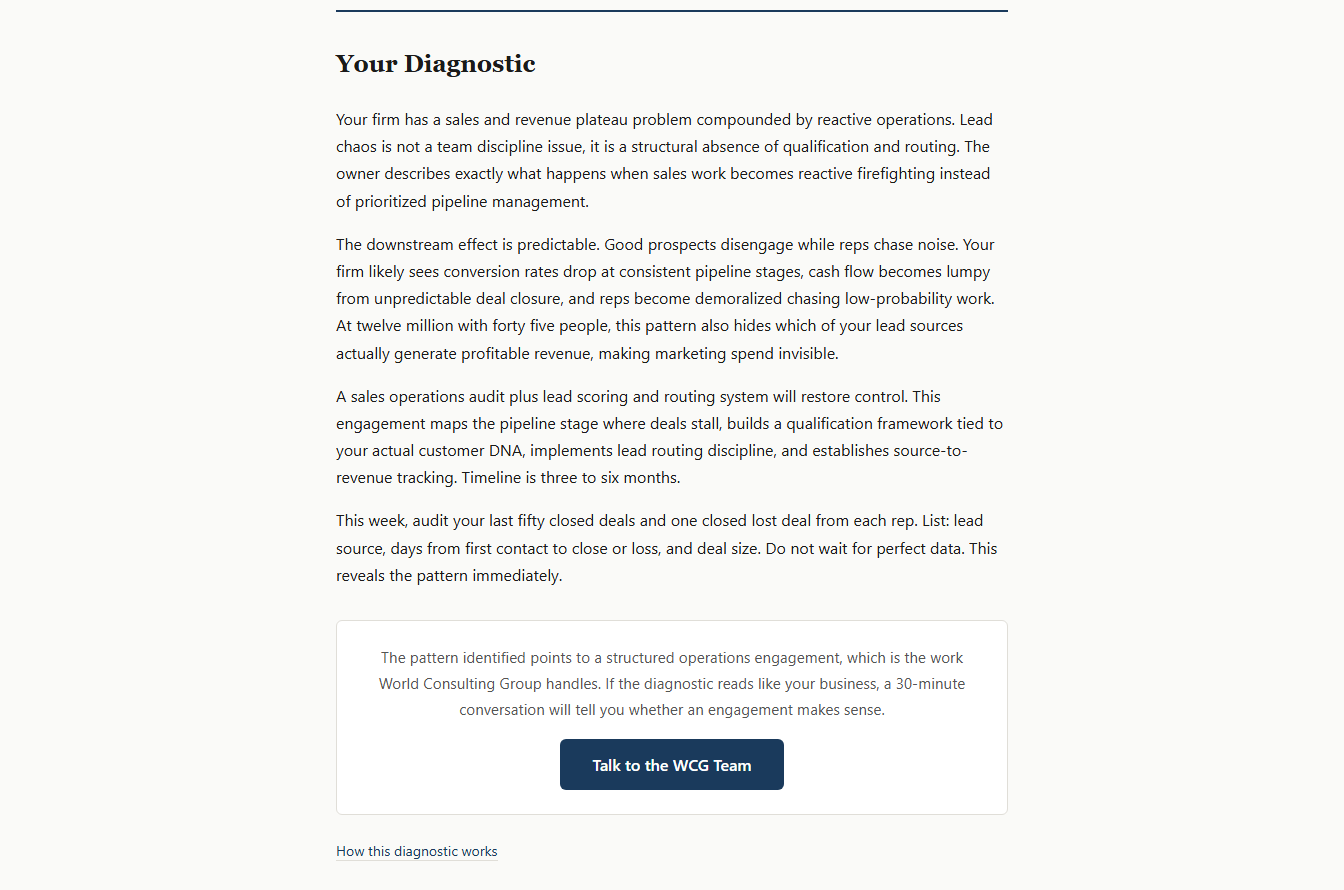
The diagnosis treats undifferentiated lead handling as an operational design gap rather than as a discipline failure, which is the reading that leads somewhere.
Design is the right frame. Telling a team to prioritize better without giving them a ranking asks each person to invent a private one. Private rankings are exactly what recency replaced.
Where this is not the constraint
If lead volume is low, everything can be worked, and the ranking adds administration without adding revenue.
If lead volume is the binding constraint rather than lead handling, demand generation precedes this. Scoring an empty funnel changes nothing.
Both tools used here are free. The written one is at businessconsultant.services, and the scored briefing is at vwcg.app.
The short version
Without a ranking, recency becomes the ranking, and recency has no relationship to value. Good leads go cold while people are occupied with new ones.
Score fit and intent separately and build the model from the last hundred closed deals rather than from opinion. Keep it to five or six attributes. Route the top tier for immediate contact and everything else to a defined cadence. Measure marketing on high-scoring leads rather than on volume.
Good leads going cold? Sales Roadmaps fixes the ordering. Book a working session.
Frequently Asked Questions
What is lead scoring?
Ranking incoming inquiries, so effort goes where it produces revenue. Without an explicit ranking, recency becomes the default one, and the newest inquiry always outranks the best one regardless of value.
Why separate fit from intent?
They are unrelated. Fit is whether the organization the firm serves well is stable. The intent is whether they are moving now, and it is volatile. When combined into a single number, they cancel out and yield identical scores for opposite situations.
Where should the scoring criteria come from?
From the last fifty to a hundred closed deals, won, and lost. The attributes the winners shared at the moment of inquiry are the model. Criteria invented in a meeting produce a score nobody trusts or acts on.
How many attributes should a score have?
Five or six weighted attributes. A model with twenty inputs is not more accurate, only harder to maintain, and impossible to explain to the person expected to act on it.
Should every lead be contacted immediately?
No. A blanket five-minute target is a promise that teams break. Commit to immediate contact for the top tier only. That is achievable because the tier is small. Put everything else on a defined cadence with a stopping point.
How does scoring resolve sales and marketing disputes?
By changing the unit of account. Marketing measured on high-scoring leads rather than total leads optimizes differently at once. The score also reveals how many leads sales never touched, which is a separate problem from quality.