Certified payroll is a weekly statement of every worker on a public project, with classification, daily hours, rate, fringes, and deductions, signed under penalty of perjury. Contractors treat it as a reporting task. It behaves like a production deadline, and the difference explains almost all the findings.
Why weekly changes everything
A monthly report can be assembled at the end of the month from records that were tidied afterward. A weekly submission cannot.
The data has to be correct as it is created, because there is no interval in which to reconcile it. Classification decisions made on Tuesday are submitted on Friday. An apprentice ratio breached on Wednesday is reported before anyone has reviewed the week.
That cadence is what makes certified payroll a process rather than a report. Contractors who staff it as an administrative task discover that the task cannot absorb a sick day, a holiday week, or a second concurrent public job.
The market is durable. The Bureau of Labor Statistics counted 550,300 construction manager jobs in 2024, with 9 percent growth projected through 2034. Public work is a permanent share of construction, and the reporting obligation is a permanent share of public work.
Classification is where findings originate
The arithmetic is rarely wrong. The label on the hours is frequently.
A worker performing two trades in a week must be split by hours at each classification. Each classification is paid at its own rate. A worker performing a task that falls outside their nominal trade is classified by the work performed rather than by their job title.
Both decisions are made in the field and reported in the office, by different people, often without a conversation. That gap is the single most common origin of a back-wage finding, and it is invisible until an investigator asks what someone was actually doing.
The control is a weekly classification note from the foreman, submitted alongside the timecard. Two lines, and it removes the guesswork that the payroll clerk would otherwise apply.
A worked example, run through a real tool
The company described below is fictional. It was invented for this article and run through two free assessment tools to show what the output looks like. No real client, company, or person is described. The figures are tool output on invented inputs, not market data or benchmarks.
The simulated profile is a commercial electrical and specialty trade contractor. Revenue between eight and fifteen million, thirty-one to sixty staff, ten to twenty years in business, with a meaningful share of work on public projects.
The weaknesses entered describe a firm with sound field execution and weak measurement: job costs known only after close, change orders approved verbally, and no work-in-progress schedule.
What the assessment returned
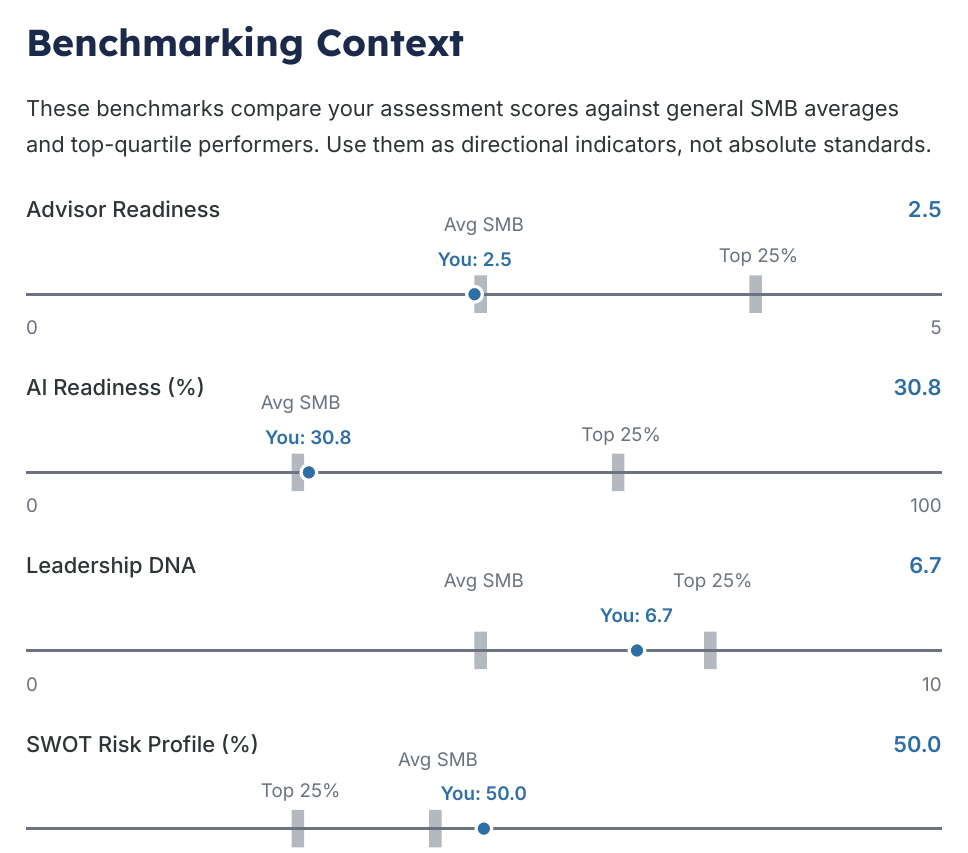
The briefing benchmarks the profile against general SMB averages and top-quartile performers and states on the page that these are directional indicators rather than absolute standards.
Execution to Ambition Ratio: 0.61, execution capacity falling short of stated ambitions. Founder Dependency Index: 2.6 out of 10, moderate, with the business holding together without daily owner involvement. Organizational Readiness: 51 out of 100.
Low dependency with low capacity is the signature of a firm whose people are capable and whose processes are absent. Certified payroll is precisely the kind of obligation that exposes that combination, because competence does not substitute for a documented procedure when the deadline is weekly.
Apprentice ratios are a site condition
The exposure contractors underestimate is the one payroll software cannot see.
Apprentices may be paid below the journeyman rate only when registered and only within permitted ratios on site. Both halves fail independently. An unregistered apprentice creates back-wage exposure for every hour. A registered apprentice working outside the allowed ratio creates the same exposure to excess hours, even though each individual was paid at the correct rate.
The ratio is determined by who is physically on the job, which the foreman controls, and the payroll clerk reports. Neither has the full picture unless someone deliberately connects them.
A weekly headcount check against the ratio, performed when the submission is prepared, is the second most common finding after fringe classification. It takes minutes.
Contractors reviewing a broader operational structure should read Construction Company Management.
Is certified payroll one person and a spreadsheet? Sales Roadmaps builds the weekly process and the backup. Start with the operations roadmap.
Corrections are worse than they look
A contractor who submits and then corrects has created a record of the correction.
That matters because investigators read patterns rather than individual documents. Repeated corrections in the same category indicate a process that produces errors systematically, which broadens the scope of any review from one project to the practice as a whole.
The instinct to submit on time and fix later is understandable and expensive. Late submission is a deadline problem. A pattern of corrections is a credibility problem, and the second is much harder to close out.
The practical rule is to verify classification and ratio before submitting rather than after, even at the cost of a day. One late submission with an explanation is cheaper than a quarter of amendments.
Staffing it, so one absence does not break it
The structural weakness in most contractors is that certified payroll has exactly one competent operator.
That person prepares submissions and resolves classification questions. They also track apprentice registrations and hold agency relationships. Their week off is a compliance event.
The minimum resilience has three parts. A documented procedure per recurring step. Wage determinations and registrations are held in a shared location rather than a personal one. And a second person who has actually prepared a submission at least once. Training that never touches a live deadline is not training.
That is the same pattern that appears in every function this series has examined. Work concentrated in one person fails quietly, and the failure is discovered by an outside party.
What an investigation actually looks at
Investigations follow a predictable path, which makes preparation tractable rather than open-ended.
They compare submitted classifications against the work actually performed, usually by interviewing workers directly. Fringe credit calculations get checked against the benefit plan documents, and apprentice registration and on-site ratios get tested. And they reconcile submitted hours against other records the contractor holds, such as daily reports and job cost.
That last one catches contractors who treat certified payroll as a standalone document. If the submission says thirty hours and the daily report says thirty-eight, the discrepancy is the finding, regardless of which figure was right.
The practical consequence is that certified payroll cannot be maintained in isolation from job records. It has to reconcile to the same source that the rest of the business uses.
Multiple concurrent public jobs break the informal system
The threshold where the informal process fails is not revenue. It is concurrency.
One public project at a time can be managed by a capable person who knows the job, the classifications, and the crew. Two concurrent projects with different wage determinations, different awarding agencies, and overlapping crews exceed what memory can reliably handle.
That is the moment to formalize, and it usually arrives before anyone plans for it. The signal is a week when submissions are late, or a classification question that takes a day to resolve because the answer varies across jobs.
Firms that formalize at the first concurrent project rather than at the third avoid the findings that accompany the second.
The sixty-second version
The same situation was typed, in plain language, into a second free tool that returns a written diagnosis rather than scores.
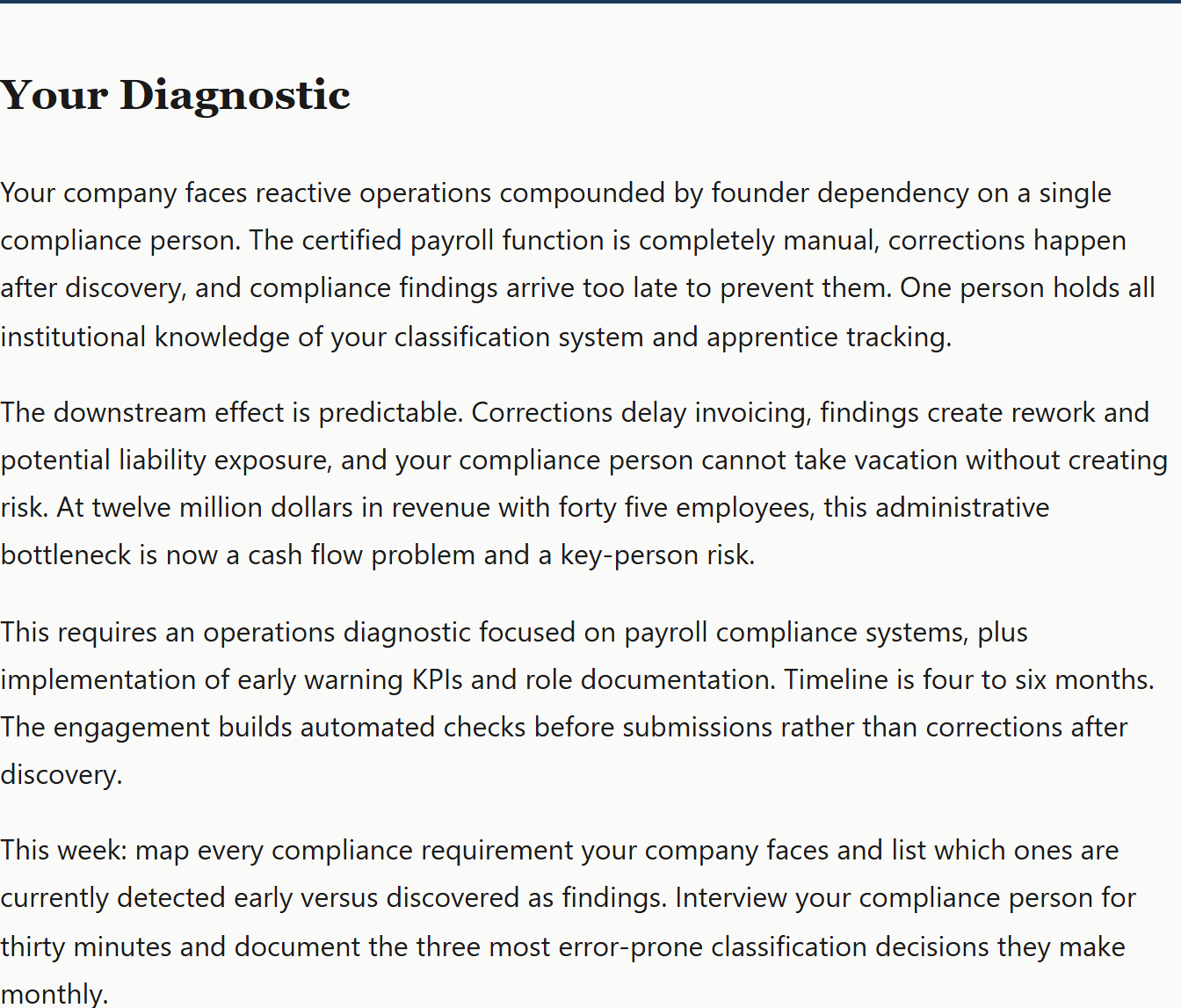
It is called reactive operations, compounded by the founder’s dependence on a single compliance person. It described the certified payroll function as completely manual, with corrections applied after the fact.
After the fact is the operative phrase. Every control in this article exists to move a check earlier than the submission, because a control that runs afterward is a correction rather than a control.
Where this is not the priority
If public work accounts for a small share of revenue and one person handles it comfortably within a normal week, the exposure is modest. Formalizing it would cost more than it saves.
If the firm cannot reliably estimate the cost of any job, general job costing precedes it. Separating public work is only useful once either figure can be trusted.
Both tools used here are free. The written one is at businessconsultant.services, and the scored briefing is at vwcg.app. Margin structure sits in construction company profit margins.
The short version
Certified payroll is a weekly production deadline that most contractors staff as an administrative report. The arithmetic is rarely the problem. Classification, apprentice ratios, and single-person staffing are.
Get a classification note from the field weekly, check the ratio before submitting rather than after, and make sure a second person has actually done it once.
Want the weekly process documented before the next finding? Sales Roadmaps builds it. Book a working session.
Frequently Asked Questions
What is certified payroll?
A weekly statement listing every worker on a public project with classification, daily hours, rate, fringes, and deductions, signed under penalty of perjury. It is a recurring production deadline rather than a periodic report, which is why it fails in the process.
What causes most certified payroll findings?
Classification errors and fringe benefit crediting, not arithmetic. A worker performing two trades must be split by hours at each classification, and classification follows the work performed rather than the job title. The field knows this, and the office reports it.
How do apprentice ratio violations happen?
Apprentices may be paid below the journeyman rate only when registered and only within permitted on-site ratios. A registered apprentice worked outside the ratio, creating back-wage exposure for excess hours, even when every individual was paid a correct rate.
Is it better to submit on time and correct later?
Usually not. Investigators read patterns, and repeated corrections in one category suggest a systematic error-producing process, which can broaden a review beyond a single project. One explained that late submission is cheaper than a quarter of amendments.
How should certified payroll be staffed?
With a documented procedure for each recurring step. Wage determinations and registrations are held in a shared rather than personal location. And a second person who has genuinely prepared a live submission at least once.
Why is weekly frequency significant?
Because there is no interval in which to reconcile. Data must be correct as it is created, so a decision made on Tuesday is submitted on Friday without a review cycle. That cadence is what turns reporting into a process obligation.