A freight broker arranges transportation between a shipper and a carrier and takes a margin for doing it. For a small fleet, that margin is the price of not having to sell. Whether it is worth paying depends on numbers most carriers have never assembled, which is why the decision is usually made by default.
Brokers sell access, and access has a price
The service is real, and it is worth something. The question is how much.
A broker provides freight without a sales function, absorbs credit risk on the shipper side, and handles volume during periods a carrier could not fill alone. A small fleet without a salesperson genuinely cannot replace that overnight.
The cost is the difference between what the shipper paid and what the carrier received. It also costs the direct relationship with the person whose freight it is. The first is a number. The second is a strategic position, and it compounds.
The sector is large. The Bureau of Labor Statistics counted about 2.2 million heavy and tractor-trailer driver jobs in 2024, with 4 percent growth projected through 2034. Access to freight is the constraint that defines the economics of small carriers.
Days to pay is part of the rate
Carriers compare brokers on rate and then absorb the difference in working capital without noticing.
A load paying well that settles in sixty days is not obviously better than a load paying slightly less that settles in fifteen. For a fleet funding fuel, wages, and maintenance weekly, payment timing is a real cost, and it is the cost most often traded away in a rate conversation.
Quick pay programs make this explicit by charging a percentage for early settlement. That percentage is the honest price of the delay, and it is worth comparing against factoring costs and internal delay costs.
Tracking days to pay per broker takes a column in a spreadsheet and produces a ranking most carriers find surprising. The broker offering the best rates is frequently not the broker producing the best cash.
A worked example, run through a real tool
The company described below is fictional. It was invented for this article and run through two free assessment tools to show what the output looks like. No real client, company, or person is described. The figures are tool output on invented inputs, not market data or benchmarks.
The simulated profile is a regional trucking and freight company. Revenue between three and eight million, sixteen to thirty staff, ten to twenty years in business, owner working sixty to seventy hours a week.
The weaknesses entered describe measurement concentrated in one person: every load plan depends on the owner, settlements are calculated by hand, and there is no cost per mile by lane or by truck.
What the assessment returned
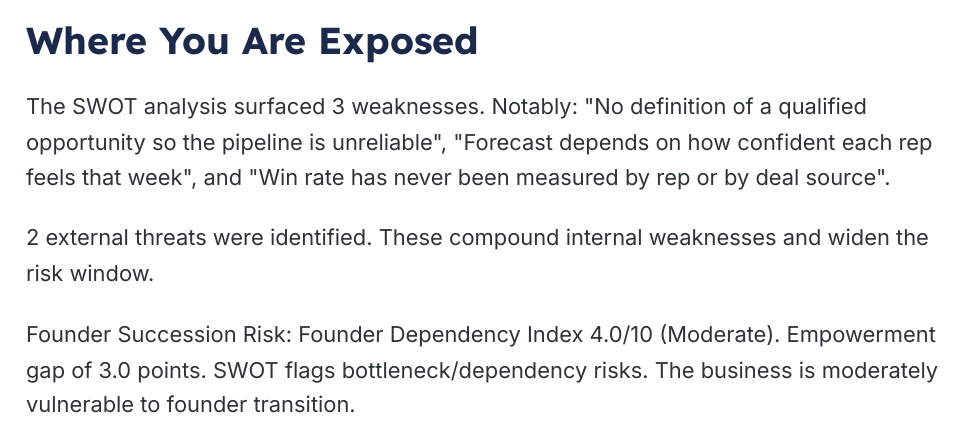
The briefing reproduces the flagged weaknesses in the words they were entered in and explicitly declines to attach a cost to them, which is the correct treatment. The fact that no cost per mile exists is a fact. The costs of the absence depend entirely on the freight mix.
Execution to Ambition Ratio: 0.65. Founder Dependency Index: 5.9 out of 10, substantial single-person risk. Organizational Readiness: 42 out of 100.

The recommendations are ordered by urgency rather than by ease. For a carrier weighing broker dependence, that ordering puts the cost work before the sales work, which is the correct sequence.
Without a cost per mile, a carrier cannot tell whether a broker rate is acceptable or ruinous, so every negotiation is conducted from a position of not knowing.
The transition is gradual, or it fails
Carriers who decide to reduce broker dependence usually attempt to do so by switching and losing money.
Direct shipper relationships take months to develop. A shipper has incumbent carriers, an approval process, insurance requirements, and a procurement cycle. None of that moves at the speed of a decision to change strategy.
The workable version runs in parallel. Keep broker volume running while pursuing a few direct targets chosen for lane fit rather than for size. Two or three shippers on lanes the fleet already runs well is a better first objective than a large account that would reshape the operation.
Each direct relationship then gradually replaces broker volume, and the fleet never faces a week with empty trucks and no fallback.
Carriers reviewing structure should read trucking business consultant.
Do you know which brokers actually pay? Sales Roadmaps builds the carrier scorecard. Start with the operations roadmap.
Score brokers rather than ranking rates
Once more than a handful of brokers are in use, judgment stops scaling, and a scorecard starts paying.
Four columns are enough. Average rate per mile on lanes actually run. Average days to pay. Detention frequency and whether detention is actually paid when claimed. And a count of loads that changed after the rate confirmation was issued.
That last column is the one carriers rarely track and most often complain about. A broker whose loads routinely change shape after commitment is imposing a cost that never appears in the rate.
Ranked on all four, the list usually reorders. Carriers concentrate volume with brokers who score well and stop spending time on those who look good only on the headline rate.
Credit risk sits with the carrier
The part of broker dependence carriers think about least is what happens when a broker fails.
A broker that stops paying leaves carriers as unsecured creditors on freight already delivered. Bond coverage exists and is frequently exhausted by the time a claim is filed, because every affected carrier is claiming against the same limited amount.
The practical defense is concentration and discipline. No single broker should represent so much of the receivable ledger that a failure would be existential, and credit reports on brokers are available and rarely consulted.
Aging the receivable by the broker makes the exposure visible. A broker whose days to pay drift upward month over month is signaling something. The carrier watching that column has time to reduce exposure before anyone else notices.
Rate confirmations are the contract
The document that governs a load is read carefully by exactly one party, and it is not usually the carrier.
A rate confirmation states the rate, the accessorial terms, the detention policy, and the conditions under which any of these may change. Carriers routinely accept it without reading, then discover at settlement that detention required notification within a window nobody observed, or that a layover was never covered.
Reading it once per broker is enough, because the terms are standard per broker rather than per load. That single review produces a note of what has to happen in the field for a claim to be payable.
Passing that note to drivers is what converts it into money. Detention gets paid when arrival and departure times are recorded, and notice is given. It gets refused when they were not, regardless of how long the truck actually sat.
Lane density beats rate per load
The strategic error is optimizing each load rather than the network.
A fleet running many loads on a few lanes builds knowledge, reduces empty miles, gets known at the docks, and prices with confidence. A fleet chasing the best available rate anywhere builds none of that and burns the difference in deadhead.
Density is the argument for accepting a slightly lower rate on a lane the fleet already serves. That decision looks wrong on a single load and right across a quarter, which is exactly the kind of decision that requires a number rather than an instinct.
It is also the strongest argument a carrier can make to a direct shipper. Consistent coverage on a specific lane is worth more to a shipper than a low quote from someone who may not be there next month.
Equipment and utilization sit in fleet management consultant.
The sixty-second version
The same situation was typed, in plain language, into a second free tool that returns a written diagnosis rather than scores.
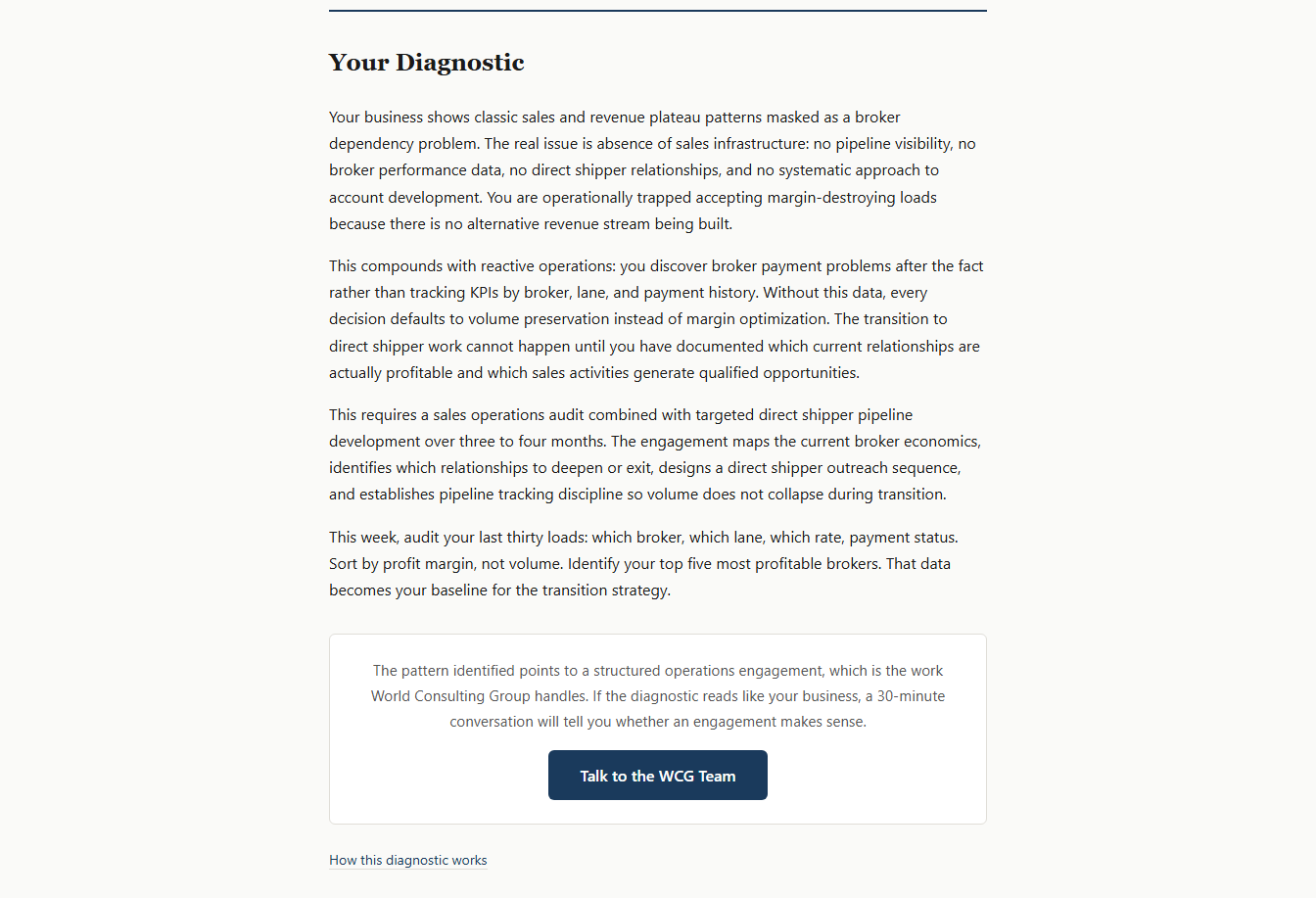
The diagnosis frames broker dependence as an operational visibility problem rather than a pricing grievance, which aligns with the assessment.
That framing is the useful one. A carrier that knows its cost per mile can negotiate with a broker. A carrier that does not accept numbers and calls it a market.
Where this is not the constraint
If the fleet is very small or newly established, brokers are the correct channel, and building direct relationships prematurely will starve it of volume.
If the cost per mile is unknown, that comes first. Every argument in this article depends on being able to tell a good rate from a bad one.
Both tools used here are free. The written one is at businessconsultant.services, and the scored briefing is at vwcg.app.
The short version
Broker margin is the price of not having a sales function, and it is worth paying until a carrier can measure what it is giving up. Days to pay, detention behavior, and post-confirmation changes are part of the rate and are almost never counted.
Score brokers on four columns rather than on rate alone. Build direct relationships in parallel rather than as a switch, targeting lanes the fleet already runs well. Optimize for density rather than the best available load.
Stuck taking whatever is posted? Sales Roadmaps builds the direct channel deliberately. Book a working session.
Frequently Asked Questions
What does a freight broker actually provide?
Freight without a sales function, credit risk absorbed on the shipper side, and volume during periods a carrier could not fill alone. For a small fleet with no salesperson, that is a real service, and the margin is its price.
Why do the days to pay belong in the rate comparison?
Because a fleet funds fuel, wages, and maintenance weekly. A high rate settling in sixty days can be worse than a lower rate settling in fifteen. Payment timing is the cost most often traded away without being counted.
How should brokers be scored?
On four columns. Average rate per mile on lanes actually run, and average days to pay. Detention frequency and whether detention is paid when claimed. And the count of loads that changed after the rate confirmation was issued.
Why do transitions away from brokers fail?
Because they are attempted as a switch. Shippers have incumbent carriers, approval processes, insurance requirements, and procurement cycles. Direct relationships must be built in parallel with the broker volume still running.
What is lane density, and why does it matter?
Running many loads across a few lanes rather than chasing the best rate anywhere. It reduces empty miles, builds familiarity with the dock, and supports confident pricing. It also justifies accepting slightly lower rates on established lanes.
When are brokers the right channel?
When the fleet is small or newly established. Building direct shipper relationships prematurely starves a carrier of volume, and brokers supply the freight that funds the eventual transition.