
A lien waiver is a signed release of the right to place a lien against a property in exchange for payment. Contractors treat waiver collection as closeout paperwork. It behaves like a payment control, and the difference is that a single missing signature from a supplier nobody hired can hold an entire final payment.
Conditional and unconditional are not interchangeable
The two forms do opposite things and are routinely swapped by people signing quickly.
A conditional waiver releases the lien right only once payment actually clears. It is the correct document to exchange when payment is being issued, but has not been settled. A contractor who holds conditional waivers is protected, and the signer is protected.
An unconditional waiver releases the right immediately, regardless of whether the money arrives. Signing one before payment clears means giving up the remedy while still being owed. Accepting one is the objective after payment has cleared, not before.
The practical rule is a sequence rather than a preference. Conditional on issue, unconditional on clearance. Contractors who run it the other way create exposure in one direction or the other on every cycle.
The sector is substantial. The Bureau of Labor Statistics counted 550,300 construction manager jobs in 2024, with 9 percent growth projected through 2034. Payment mechanics are a permanent feature of that market.
The exposure lives below the first tier
The subcontractor a contractor hired is rarely the one who files.
Lien rights typically extend to parties who supplied labor or material to the project, regardless of who engaged them. That includes a subcontractor of a subcontractor, and the supplier who delivered material to either. A general contractor can pay a first-tier sub in full and on time, yet still face a claim from a company it has never dealt with.
That is the scenario that holds the final payment, and it is invisible to a contractor tracking only its direct agreements. The information required is a list of who is below each first-tier party on the project.
Collecting it is a contract requirement rather than an investigation. One clause does the work. Require each subcontractor to identify its lower-tier parties and suppliers, and to furnish their waivers alongside its own. That moves the burden to the party that actually knows the answer.
A worked example, run through a real tool
The company described below is fictional. It was invented for this article and run through two free assessment tools to show what the output looks like. No real client, company, or person is described. The figures are tool output on invented inputs, not market data or benchmarks.
The simulated profile is a commercial general contracting company. Revenue between fifteen and forty million, thirty-one to sixty staff, more than twenty years in business, owner working sixty to seventy hours a week.
The weaknesses described the pattern precisely. Waivers are collected at closeout rather than at each pay cycle. Nobody tracks conditional payments against unconditional payments, and payment is released to subcontractors before documentation is verified.
What the assessment returned
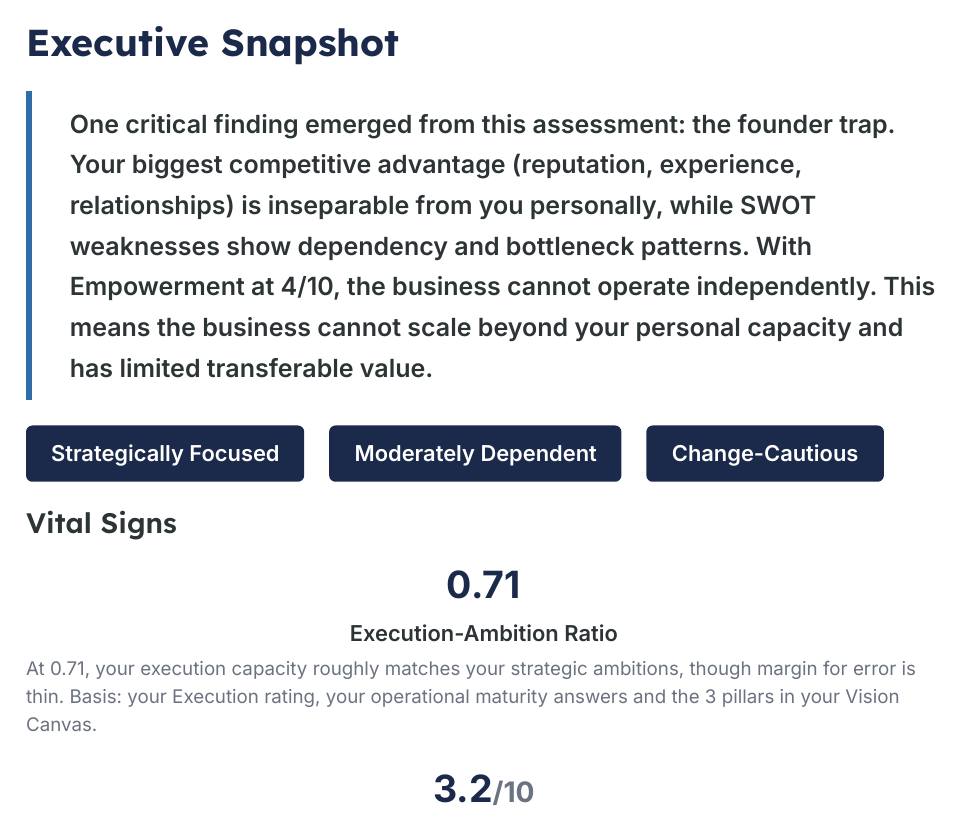
Execution to Ambition Ratio: 0.71, capacity falling short of stated ambitions. Founder Dependency Index: 3.2 out of 10, moderate. Organizational Readiness: 46 out of 100.
The briefing states the basis for each figure on the page rather than presenting the scores as opaque outputs.
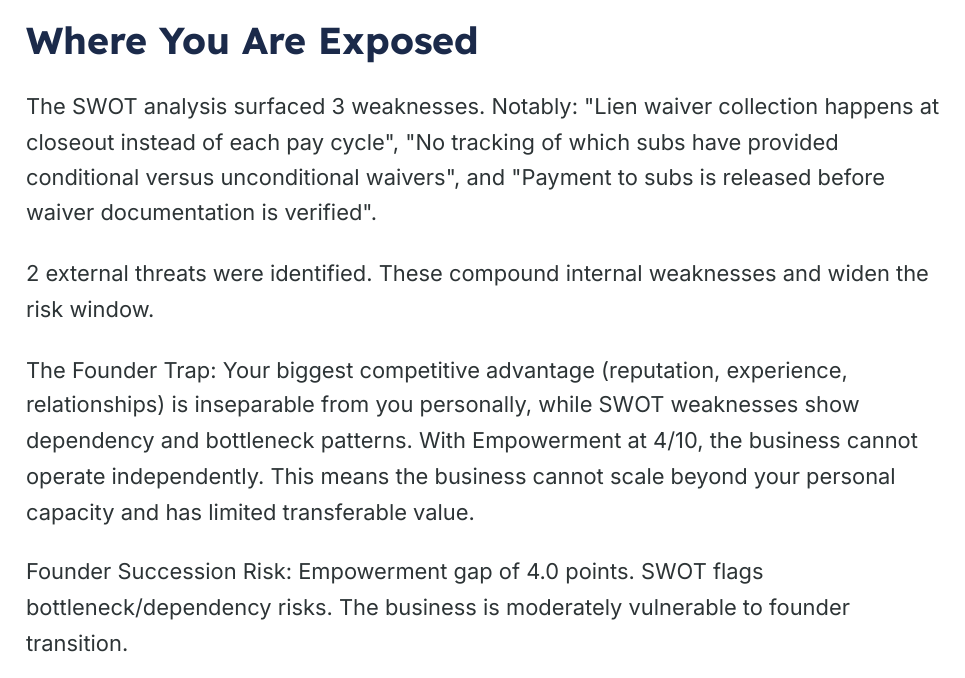
The exposure page reproduces the three weaknesses in the words they were entered in.
Moderate dependency with low readiness is the combination that predicts a stalled process change. The business does not need the owner daily, and it will resist a new documentation requirement unless the reason is made concrete.
Waivers belong to the pay cycle
Collecting waivers at closeout is the single decision that causes the rest.
At closeout, there is nothing left to withhold. Subcontractors have been paid, crews have moved on, and the person who can sign is working somewhere else. Chasing signatures at that point is an administrative task with no lever behind it and no deadline anyone else respects.
Collected with each pay application, the position reverses completely. The waiver for the previous period accompanies the request for the current one. No waiver, no inclusion in this cycle. Nobody has to be persuaded because the incentive is structural.
The change costs one line in the pay application checklist and one conversation at contract signing. It is the highest-return administrative change available in a construction business. Contractors resist it because it looks like extra paperwork rather than a payment control.
Contractors reviewing operational structure should read construction company management.
Chasing signatures after everyone has been paid? Sales Roadmaps moves waivers into the pay cycle. Start with the operations roadmap.
Verify before releasing, not after
Paying a subcontractor before confirming that its own suppliers have been paid transfers the risk to the wrong party.
The contractor has discharged its obligation, but still carries the exposure because the unpaid supplier below has a claim that survives payment. The money is gone, and the risk is not.
Verification is not onerous at the point of payment. The waiver package accompanying the request either contains the lower-tier releases, or it does not, and the answer determines whether the payment goes out. Once payment has cleared, the same question requires cooperation from someone who no longer needs anything.
Where a lower-tier party is already unpaid, a joint check addresses it directly. Issuing payment naming both the subcontractor and its supplier ensures the money reaches the party holding the lien right, which is the outcome the contractor actually needs.
Tracking is a matrix, not a folder
Waivers filed as documents cannot answer the only question that matters.
The question is whether every party on this project has released its rights through the current pay period. A folder of signed PDFs cannot answer it because the missing item is, by definition, not in there.
What answers it is a grid. Parties down one axis, pay periods across the other, and the type of waiver held in each cell. Gaps are then visible rather than discoverable, and the person preparing the pay application knows what to chase before the application goes out.
That grid can live in a spreadsheet. Software exists and helps at scale, but the discipline is the control, not the tool. A contractor who cannot maintain a sheet will not maintain a system either.
Deadlines run on their own clock
The remedies attached to lien rights are governed by notice and filing deadlines that do not wait for a dispute to develop.
Those periods vary and are typically counted from the last date of work or material supply rather than from the date a problem became apparent. A contractor discovering an issue at closeout has often done so after the useful window.
The operational consequence is that dates have to be recorded as work happens. Last date on site per party, per project, kept in the same place as the waivers live. That single column preserves options that are otherwise silently lost.
These periods and the specific waiver forms vary by jurisdiction. Confirm the applicable requirements with a construction attorney in each state where the contractor works. This article describes the operational discipline rather than the legal position.
Margin structure sits in construction company profit margins.
The sixty-second version
The same situation was typed, in plain language, into a second free tool that returns a written diagnosis rather than scores.
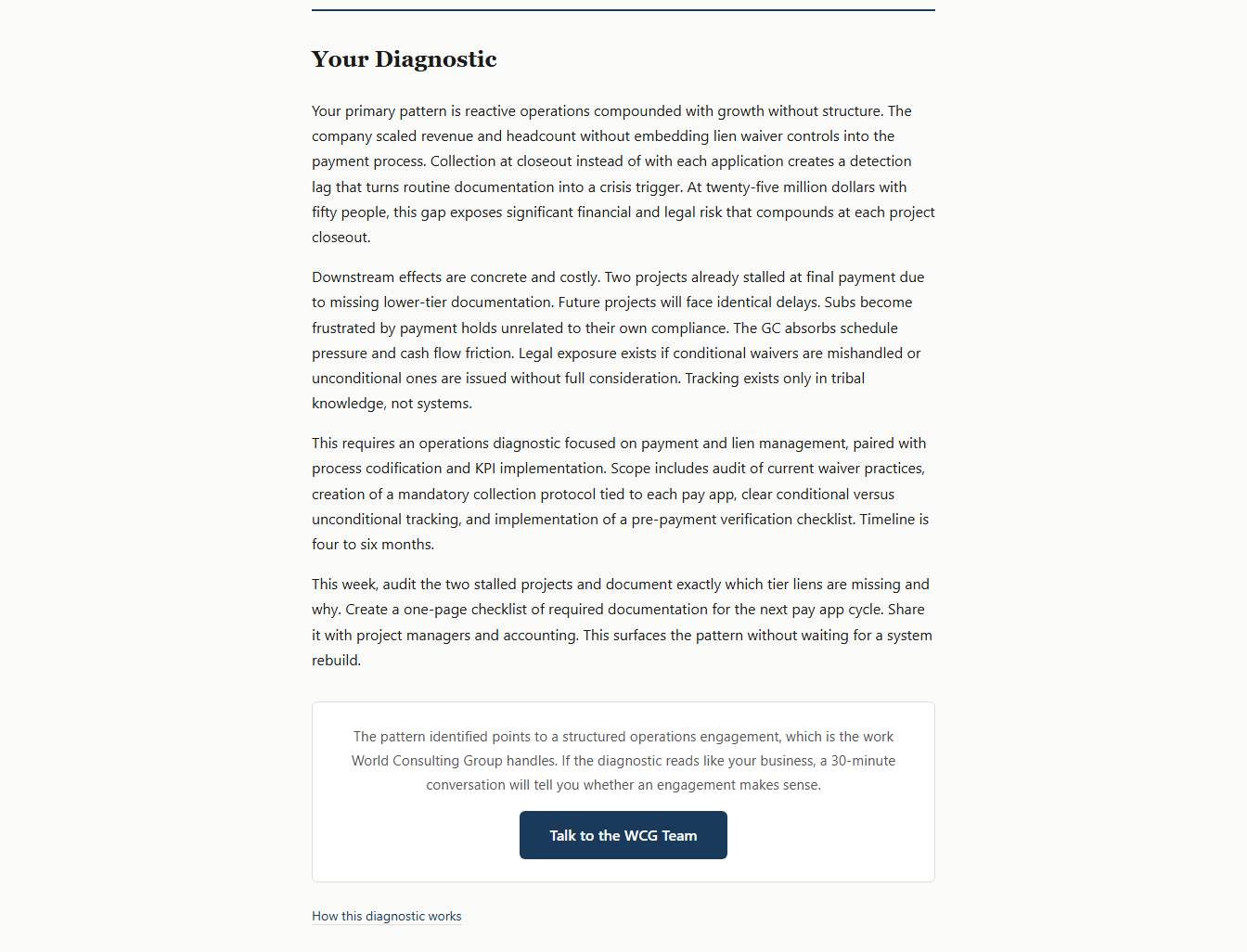
The diagnosis reads this as a documentation control failure with a direct cash consequence rather than as an administrative untidiness, which is the correct weighting.
Cash is the right frame. Waiver discipline is not filing. It is the mechanism that determines whether earned money arrives in 45 days or 6 months. That outcome is decided at the pay application rather than at the end.
Where this is not the constraint
If the contractor works directly for owners with no subcontractors, the lower-tier exposure largely disappears, and the discipline reduces to its own releases.
If projects are small and short, with no retainage, the financial consequences are modest, and the process costs may exceed the benefits.
Both tools used here are free. The written one is at businessconsultant.services, and the scored briefing is at vwcg.app.
The short version
Waivers are a payment control rather than closeout paperwork, and the exposure that holds final payment usually comes from a party the contractor never hired.
Exchange conditional waivers on issue and unconditional on clearance. Require each subcontractor to identify and furnish waivers for its lower-tier parties. Collect with every pay application rather than at closeout, verify before releasing payment, and record the last date on-site for each party.
One missing signature holding your final payment? Sales Roadmaps builds the waiver process. Book a working session.
Frequently Asked Questions
What is the difference between conditional and unconditional waivers?
A conditional waiver releases the lien right only once payment clears. An unconditional waiver releases it immediately, regardless of whether money arrives. The correct sequence is conditional on issue and unconditional on clearance.
Why does exposure come from lower-tier parties?
Lien rights typically extend to anyone who supplied labor or material to the project, regardless of who engaged them. A contractor can pay a first-tier subcontractor fully and still face a claim from a supplier it has never dealt with.
Why collect waivers with each pay application?
Because payment can still be withheld then, and cannot be at closeout. Requiring the previous period’s waiver before including the current period’s request makes compliance structural rather than something that has to be chased.
Should payment be released before waivers are verified?
No. Once payment clears, the contractor has discharged its obligation while retaining the exposure, because an unpaid lower-tier party still holds a claim. Verification belongs at the point of payment, not after it.
When is a joint check appropriate?
Where a lower-tier party is already unpaid. Naming both the subcontractor and its supplier on the payment ensures the money reaches the party actually holding the lien right rather than stopping one level short.
Why do the last dates on site need recording?
Because notice and filing deadlines typically run from the last date of work or material supply rather than from when a problem surfaced. A contractor learning of an issue at closeout has often already passed the useful window.