
Revenue cycle management is the process running from patient registration through final payment. Most practices treat it as billing, which places the work at the end. The errors that cause denials are made at the beginning, which is why working on denials harder produces effort rather than revenue.
The cycle starts at the front desk
By the time a claim is denied, the mistake is usually weeks old.
Eligibility not verified at scheduling. Demographics captured with a transposed digit. Authorization obtained for the wrong code or date range. Documentation that supports the visit but not the level billed. Every one of those is a front-end decision that surfaces as a back-end denial.
This is why practices that add billing staff often see no improvement. More capacity to rework claims does not reduce the number of claims requiring rework.
The administrative side of healthcare is growing quickly. The Bureau of Labor Statistics counted 616,200 medical and health services manager jobs in 2024, and projects 23 percent growth through 2034. That is one of the fastest rates in the economy. That growth reflects complexity, and complexity is what the revenue cycle absorbs.
First pass rate is the number to run on
The net collection rate indicates what was ultimately collected. The first pass rate indicates how much was collected without anyone touching it twice.
The second is the operational metric because it isolates process quality from persistence. A practice can reach an acceptable net collection rate through sheer rework, and that rework has a cost nobody books.
Every reworked claim consumes staff time, delays cash, and risks a timely filing deadline. A practice with a low first pass rate is not simply slower. It is running a permanent parallel workforce whose only job is to correct predictable errors.
A worked example, run through a real tool
The company described below is fictional. It was invented for this article and run through two free assessment tools to show what the output looks like. No real client, practice or person is described. The figures are tool output on invented inputs, not market data or benchmarks.
The simulated profile is a multi-specialty outpatient medical practice. Revenue between eight and fifteen million, thirty-one to sixty staff, ten to twenty years in operation, managing physician working fifty to sixty hours a week.
The three weaknesses entered at highest confidence describe a cycle managed reactively:
- Claim denials are worked reactively with no root cause analysis
- Days in accounts receivable have never been measured by the payer
- Prior authorization depends on one person and stalls when she is out
What the assessment returned
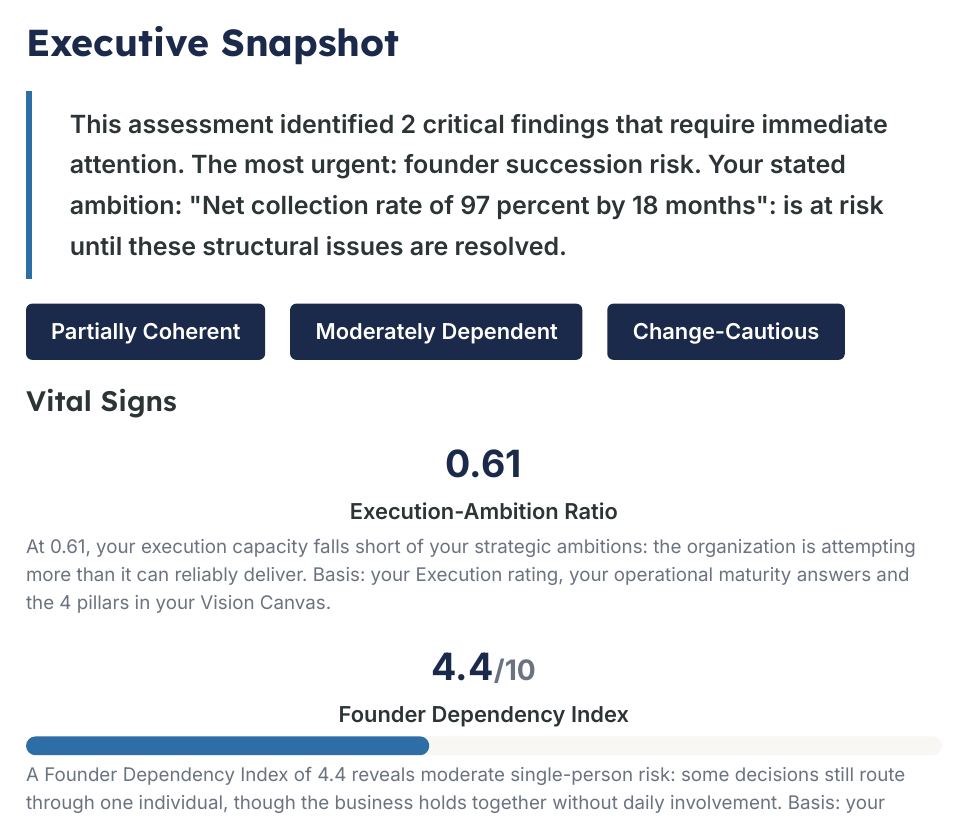
Execution to Ambition Ratio: 0.61. Execution capacity falls short of stated ambitions, and the organization is attempting more than it can reliably deliver.
Founder Dependency Index: 4.4 out of 10. Moderate, with decisions still routing through one individual.
Organizational Readiness: 43 out of 100.
The combination points at capacity rather than strategy. The practice knows what it wants to do. The people available to do it are already fully consumed by the rework the current process generates.

Root cause analysis on denials
Working a denial fixes one claim. Categorizing it prevents the next hundred.
The practice that improves does one additional thing: it records a reason code category on every denial and reviews the distribution monthly. Eligibility. Authorization. Coding. Documentation. Timely filing. Coordination of benefits.
The distribution is almost never even. One or two categories usually account for the majority. They trace back to a specific step, a specific payer, or a specific person who was never told.
That review takes an hour a month and is the difference between a billing department and a revenue cycle. Without it, every denial is a new event rather than an instance of a pattern.
Practices working through this in depth should read healthcare revenue cycle consulting.
Working denials without knowing why they happen? Sales Roadmaps builds the categorization and the monthly review. Start with the operations roadmap.
Days in AR have to be measured by the payer
An aggregate days-in-AR figure blends payers that behave completely differently and produces a number nobody can act on.
One commercial payer pays cleanly in three weeks. Another routinely requests records. Government payers follow their own cycle. Patient responsibility behaves differently again and has become a larger share of the total as plan designs shift.
Measured separately, each becomes a decision. A payer that consistently runs long is a contracting conversation. A payer that denies at a high rate on one code family is a documentation fix. A rising patient responsibility balance is a front-desk collection policy question.
Measured together, they average into a figure that moves slowly and explains nothing.
Prior authorization as a single point of failure
The weakness that reads as small is the one that stops revenue entirely.
When authorization is handled by a single individual, their absence does not slow the process. It halts it. Appointments proceed unauthorized or get rescheduled, and both outcomes cost money that never appears as a denial because the claim was never clean enough to submit.
The fix is unglamorous and effective. A written procedure per payer, a shared queue rather than a personal one, and a second trained person, even if they only cover absence. That is not redundancy for its own sake. It is the difference between a delay and a stop.
Eligibility verification is the cheapest control
The single highest-return step in the cycle costs almost nothing and is skipped more often than any other.
Verify eligibility at scheduling, and again at check-in for anything booked more than a few days out. That catches terminated coverage, changed plans, and deductible resets before the visit rather than after the claim. Coverage changes constantly, and a verification performed three weeks ago is not a verification.
The reason it gets skipped is that it feels administrative during a busy morning, and its benefit appears six weeks later in a denial that never happened. That delay is exactly why it needs to be a required field rather than a good habit.
Practices that make verification a hard stop in scheduling see the eligibility denial category collapse, which is usually one of the two largest categories to begin with.
Patient responsibility has become a collections function
Plan designs have shifted a growing share of the bill onto the patient. Most practices still run collection processes designed for an era when payers paid nearly all of it.
A practice can therefore hold excellent payer performance and still carry poor total AR. The patient portion behaves like consumer receivables rather than institutional ones. It ages faster, responds to different tactics, and is far harder to collect after the visit than during it.
The operational fix is point-of-service collection with an estimate that the front desk can produce and explain. That requires eligibility data, a fee schedule, and a script, and it converts a receivable into a payment while the patient is standing there.
Measured separately from payer AR, it becomes manageable. Blended in, it looks like a billing problem and gets sent to the billing team, who cannot fix it because the moment to collect has passed.
The sixty-second version
The same situation was typed, in plain language, into a second free tool that returns a written diagnosis rather than scores.
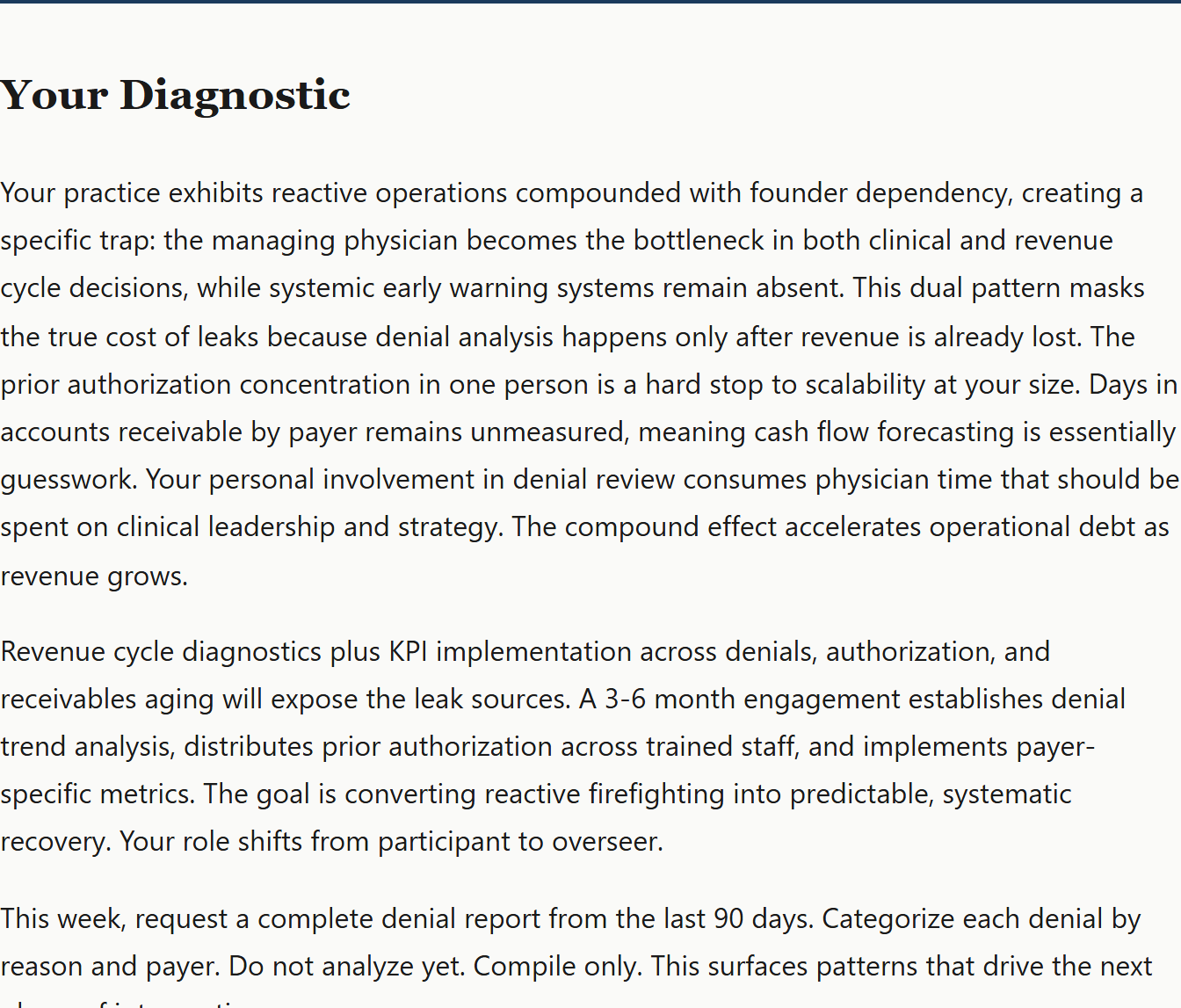
It is named reactive operations compounded with founder dependency, and identifies the specific trap: the managing physician becomes the bottleneck in both clinical and administrative decisions.
That double role is the compounding factor. A physician reviewing denials is not simply doing low-value work. They are the constraints on two systems simultaneously, and the clinical one has a higher opportunity cost.
Where this is not the priority
If the first pass rate is already high and days in AR sit within range by payer, the revenue cycle is functioning. Effort belongs in payer contracting or capacity.
If the practice is short on patient volume rather than on collections, revenue cycle work optimizes a smaller number, and growth is the higher priority.
Both tools used here are free. The written one is at businessconsultant.services, and the scored briefing is at vwcg.app. Growth framing is part of the medical practice growth strategy.
The short version
Denials are the visible end of a process that failed earlier. Adding staff to work them harder buys persistence rather than improvement.
Categorize every denial and review the distribution monthly. Measure days in AR by payer rather than in aggregate. Remove the single point of failure from authorization. Then, judge the revenue cycle by the first-pass rate, because that number reflects the process rather than the effort.
Not sure whether the problem is billing or the front desk? Sales Roadmaps traces it to the step that caused it. Book a working session.
Frequently Asked Questions
What is revenue cycle management?
Revenue cycle management is the full process from patient registration through final payment, including eligibility verification, authorization, coding, claim submission, denial management, and collection. Treating it as billing places the work at the end, after the causes of failure have occurred.
Why is first pass rate more useful than net collection rate?
Net collection rate reflects what was eventually collected, including through rework. First pass rate reflects what was collected without anyone touching the claim twice, thereby isolating process quality from persistence and exposing the hidden cost of correction.
How should denials be analyzed?
By recording a reason category on every denial and reviewing the distribution monthly. Categories such as eligibility, authorization, coding, documentation, and timely filing are rarely evenly distributed, and one or two usually account for the majority.
Why measure days in AR by payer?
Because payers behave very differently, and an aggregate blends them into a figure nobody can act on. Separated, a slow payer becomes a contracting conversation, and a high-denial payer becomes a documentation fix.
What makes prior authorization a single point of failure?
When one person holds the process, their absence halts it rather than slowing it. Appointments proceed unauthorized or get rescheduled, and both cost revenue that never appears as a denial because no clean claim was ever submitted.
Does adding billing staff improve collections?
Rarely on its own. More capacity to rework claims does not reduce the number of claims requiring rework. The errors causing denials usually occur during scheduling, registration, and authorization, where added capacity has the greatest effect.