Sales enablement is the work of making it possible for an ordinary salesperson to perform well. Firms usually interpret it as the purchase of content or software. The actual constraint is almost always that the knowledge which makes the best person effective has never been written down, so it leaves when they do.
Ramp time is a measurement of what was documented
The interval between hiring a salesperson and that person reaching productivity is a direct readout of how much the firm has captured.
Where a firm has written its qualification standard, discovery questions, common objections, and worked examples, a new person is useful in a couple of months. Where none of that exists, they are reconstructing years of accumulated patterns from scratch by listening to colleagues and losing deals.
A year to productivity is not a talent problem. It is the cost of an oral tradition, paid once per hire, forever.
The occupation is substantial. The Bureau of Labor Statistics counted about 1.6 million wholesale and manufacturing sales representative jobs in 2024, with 1 percent growth projected through 2034. Turnover in the function is high enough that ramp time compounds quickly.
The best performer usually cannot explain themselves
The instinctive fix is to have the strongest salesperson train the others, and it produces very little.
Expertise that has become automatic is difficult to articulate. Asked what they do differently, a strong performer offers a generic answer about listening or persistence. The actual difference sits in specific behavior they no longer notice. A question was asked early. A proposal is withheld until something is confirmed. A particular way of naming the cost of inaction.
Observation surfaces what interviewing does not. Sitting in on calls, reading the notes, and comparing them against a weaker performer on similar deals produces a list of concrete differences within a fortnight.
Those differences are the enablement material. They are specific, they came from the firm rather than from a book, and the team already believes they work because everyone can see who they came from.
A worked example, run through a real tool
The company described below is fictional. It was invented for this article and run through two free assessment tools to show what the output looks like. No real client, company, or person is described. The figures are tool output on invented inputs, not market data or benchmarks.
The simulated profile is a business-to-business commercial services firm. Revenue between eight and fifteen million, thirty-one to sixty staff, ten to twenty years in business.
The weaknesses entered describe an absent structure: no definition of a qualified opportunity, a forecast built on individual confidence, and results never measured by representative or by source.
What the assessment returned
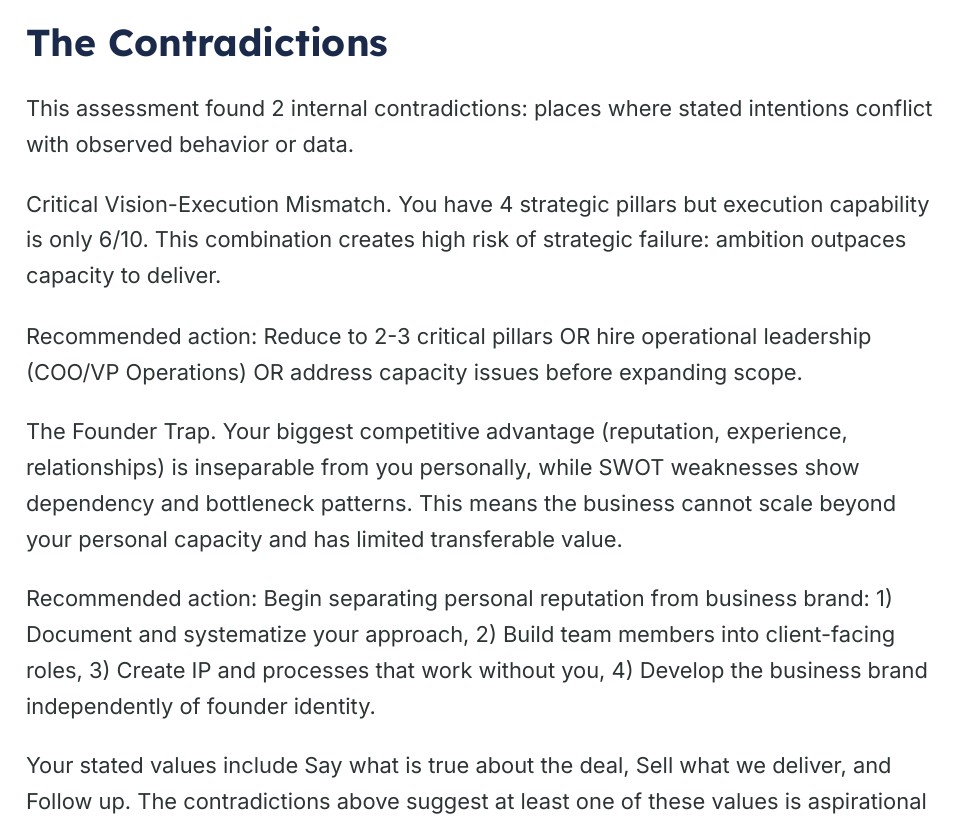
The contradictions page is the one worth reading closely. It sets what was claimed in one section against what was entered in another, naming the conflicts rather than smoothing them.
Execution to Ambition Ratio: 0.58. Founder Dependency Index: 4.0 out of 10. Organizational Readiness: 58 out of 100.
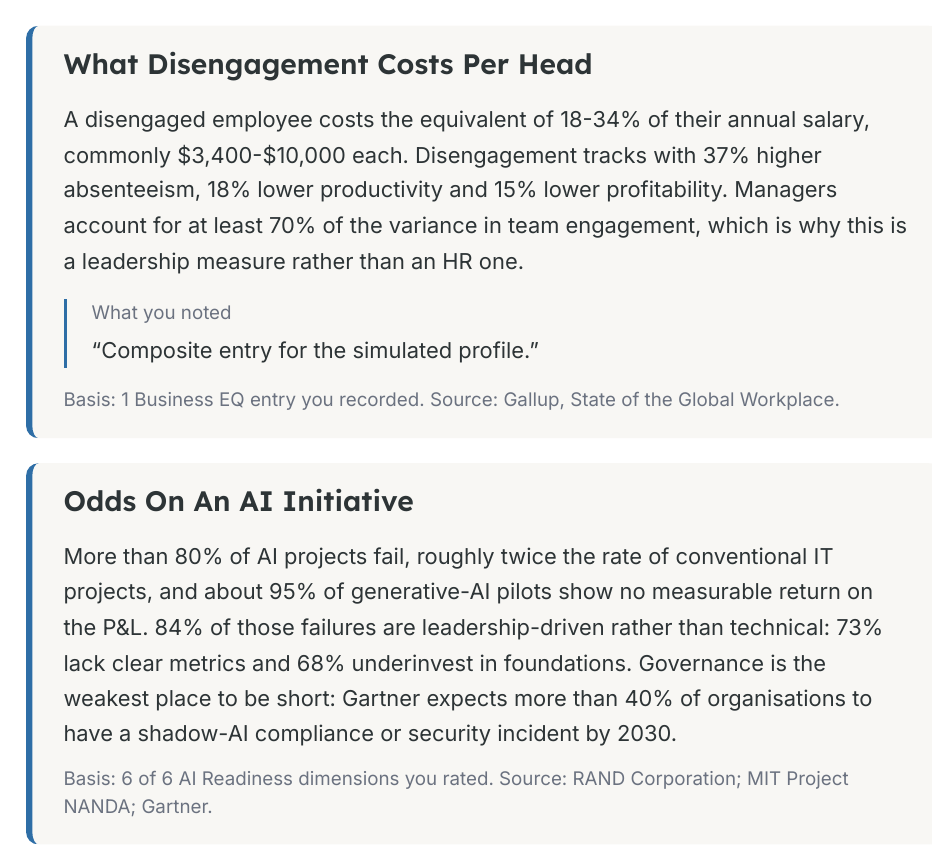
The briefing pairs published benchmark figures with what the owner actually typed, naming the source under each block rather than presenting the numbers as its own research.
A stated ambition of forecast accuracy sitting beside an admission that nothing is measured is exactly the conflict that enablement work has to resolve. No training holds until it does.
Structure the call before writing any content
Most enablement projects begin with material and should begin with a shape.
A defined call structure tells a salesperson what constitutes a good conversation: what must be established before discussing a solution, what must be confirmed before issuing a proposal, and what the next step should be at each stage.
Without it, content has nowhere to attach. A library of case studies and one-page summaries produces a team that sends more documents and holds identical conversations. That is why so many enablement investments produce no measurable change.
The structure should be short enough to hold in mind. Four or five things that must be true before a proposal goes out beat a twelve-step methodology nobody can recall under pressure.
Firms rebuilding the commercial function should read sales operations roadmap.
Does anything transfer from your best salesperson? Sales Roadmaps writes it down. Start with the operations roadmap.
Proposals are where enablement pays fastest
The document that closes or loses the deal is usually written from scratch by each person, every time.
That produces variation in quality, wasted hours, and a proposal that reflects how much effort the writer had available rather than how strong the case was. It also makes it impossible for the firm to be represented consistently, because every buyer sees a different company.
A structured template fixes most of it. Standard sections for the problem as the buyer described it, the approach, what is included, what is not, the commercial terms, and the next step. The variable content stays variable, and everything else stops being rewritten.
The section that matters most is the one restating the problem in the buyer’s own words. Buyers evaluate whether they were understood before they evaluate anything else, and a proposal that opens with the supplier describing itself has already lost that test.
Objections are finite and worth cataloging
Buyers raise the same few objections repeatedly, and most firms improvise a response every time.
Listed honestly, the set is usually shorter than a dozen. Price. Timing. An incumbent supplier. Internal capability. A previous bad experience with a similar firm. Uncertainty about whether the problem is worth solving.
Each deserves a considered response written once, tested, and refined. Not a script to recite, but a position the firm has actually thought through, so the salesperson is not inventing an argument while the buyer waits.
The catalog has a second, easy-to-miss use. Objections that recur constantly usually signal positioning or pricing rather than selling. They become visible as a pattern only when someone writes them down.
Coaching is what makes material stick
Documents change behavior far less than most firms expect because reading is not a practiced skill.
A salesperson who has read the call structure and never rehearsed it will revert under pressure to whatever they did before. The gap between knowing and doing closes through repetition with feedback, which means someone has to listen to calls and comment on specifics.
That is a manager’s task, and it is the one most often displaced by pipeline review. A sales meeting spent on deal status produces a forecast. A meeting spent on how a particular conversation was handled produces a better salesperson.
The lightest workable version is one call per person per fortnight, reviewed against the defined structure, with two observations. Not a score and not an appraisal. Two things were discussed during the call that are recent enough to remember.
Enablement decays without maintenance
The material is not the deliverable. The habit of updating it is.
Playbooks written in an intensive project and then left alone become inaccurate within a year. The market moves, the offering changes, and competitors shift. Material that no longer matches reality is worse than none, because it costs credibility with the team.
A light, standing rhythm keeps it alive. A short review after significant losses, a quarterly pass-over of the objection catalog, and a rule that anything a salesperson has to invent gets captured rather than forgotten.
That last rule is what makes the system compound. Every deal generates something worth keeping, and the firms that improve fastest are the ones where the person who worked it out is expected to write it down.
Process design sits in sales process consultant.
The sixty-second version
The same situation was typed, in plain language, into a second free tool that returns a written diagnosis rather than scores.

The diagnosis reads a long ramp as a knowledge-capture failure rather than a hiring-quality issue, which is the reading that leads to action.
Capture is the correct frame. A firm that hires better people into an undocumented process gets faster improvisation rather than a repeatable result. It then pays the same year as the ramp-on for the next hire.
Where this is not the constraint
If the team is one or two people who all sell well, the documentation cost is real, and the return is deferred until the next hire.
If the product or service is genuinely bespoke on every engagement, structure helps, and content libraries do not, because no two situations repeat closely enough.
Both tools used here are free. The written one is at businessconsultant.services, and the scored briefing is at vwcg.app.
The short version
Ramp time measures how much selling knowledge a firm has written down. A year to productivity means the answer is very little, and the cost repeats with every hire.
Observe the strongest performer rather than interviewing them. Define a short call structure before commissioning any content. Catalog the finite set of objections with considered responses, and maintain the material on a standing rhythm instead of in a single project.
A year to productivity on every hire? Sales Roadmaps captures what your best rep cannot explain. Book a working session.
Frequently Asked Questions
What does ramp time actually measure?
How much selling knowledge has the firm documented? When the qualification standard, discovery questions, objections, and worked examples are in place, new hires are productive within months rather than a year.
Why does having the top performer train others fail?
Because expertise that has become automatic is hard to articulate. Asked directly, strong performers describe generic qualities. The real differences are specific behaviors they no longer notice, which observation surfaces and interviewing do not.
Should content or structure come first?
Structure. A defined call shape tells a salesperson what must be established before discussing a solution and what must be confirmed before issuing a proposal. Content produced without it yields more documents and identical conversations.
How long should a call structure be?
Short enough to hold in mind under pressure. Four or five conditions that must be true before issuing a proposal outperform a twelve-step methodology nobody recalls in an actual conversation.
How many objections does a firm really face?
Usually fewer than a dozen: price, timing, an incumbent, internal capability, a prior bad experience, and doubt that the problem is worth solving. Each deserves a considered written response rather than repeated improvisation.
Why does enablement material decay?
Because markets, offerings, and competitors change while the document does not. Material that no longer matches reality costs credibility with the team. A quarterly pass and a rule that improvised answers get captured keep it current.