
Flat-rate pricing quotes a fixed price per task before work begins, rather than billing for hours and materials afterward. Almost every service company that wants to switch understands the concept immediately. Almost every one that fails at it fails on the price book, which is where the actual work sits.
Why time and materials produce arguments
Hourly billing puts the customer and the technician on opposite sides of the same clock.
A customer watching a technician work is watching a meter run. Every pause, every trip to the van, every conversation adds to a number nobody agreed to in advance. The technician knows this, which is why hourly work produces the odd behavior of skilled people visibly hurrying to appear efficient.
Flat rate removes the meter. The price is agreed upon before the wrench moves, and the risk that the job will take longer than expected transfers from the customer to the company. That transfer is the entire product, and it is worth paying for.
The trade is large and stable. The Bureau of Labor Statistics counted 504,500 plumber, pipefitter, and steamfitter jobs in 2024, with 4 percent growth projected through 2034. Pricing method is one of the few things a company in that market fully controls.
Two technicians, two prices, one problem
The strongest argument for a flat rate is rarely the one owners make first.
Under time-and-materials, two technicians on the same job produce two different invoices. The faster one charges less. The company, therefore, earns less on its best people, which is precisely backward, and the customer receives a price that depends on who was dispatched.
That variance is invisible until someone compares invoices for identical work. When someone measures it, the spread is usually wider than anyone expected. It explains margin swings previously blamed on materials or on a bad month.
A worked example, run through a real tool
The company described below is fictional. It was invented for this article and run through two free assessment tools to show what the output looks like. No real client, company, or person is described. The figures are tool output on invented inputs, not market data or benchmarks.
The simulated profile is a residential plumbing and drain service company. Revenue between one and three million, six to fifteen staff, five to ten years in business, owner working fifty to sixty hours a week.
The strengths entered describe a capable field operation: long technician tenure with customers requesting people by name, and emergency response faster than regional competitors.
What the assessment returned
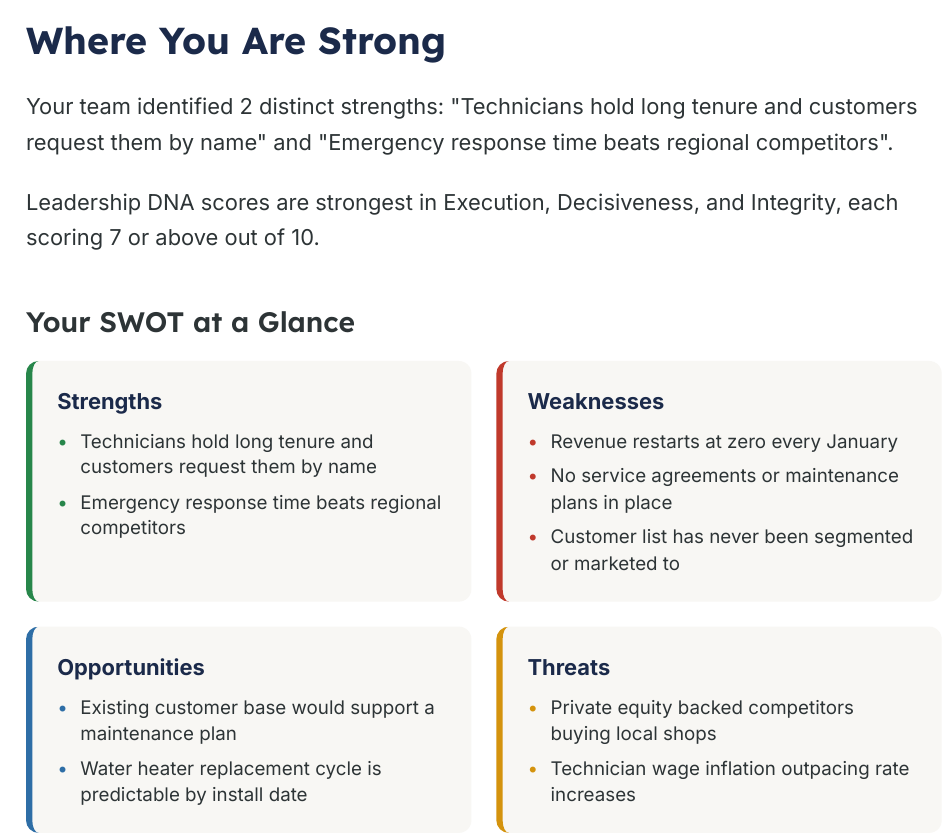
The briefing repeats the strengths back in the owner’s own words, then treats them as assets to protect rather than as evidence that nothing needs to change.
That framing matters for a pricing change. Technician tenure is the asset most at risk when the pricing method changes. The people who have quoted by feel for years are the people who have to stop.
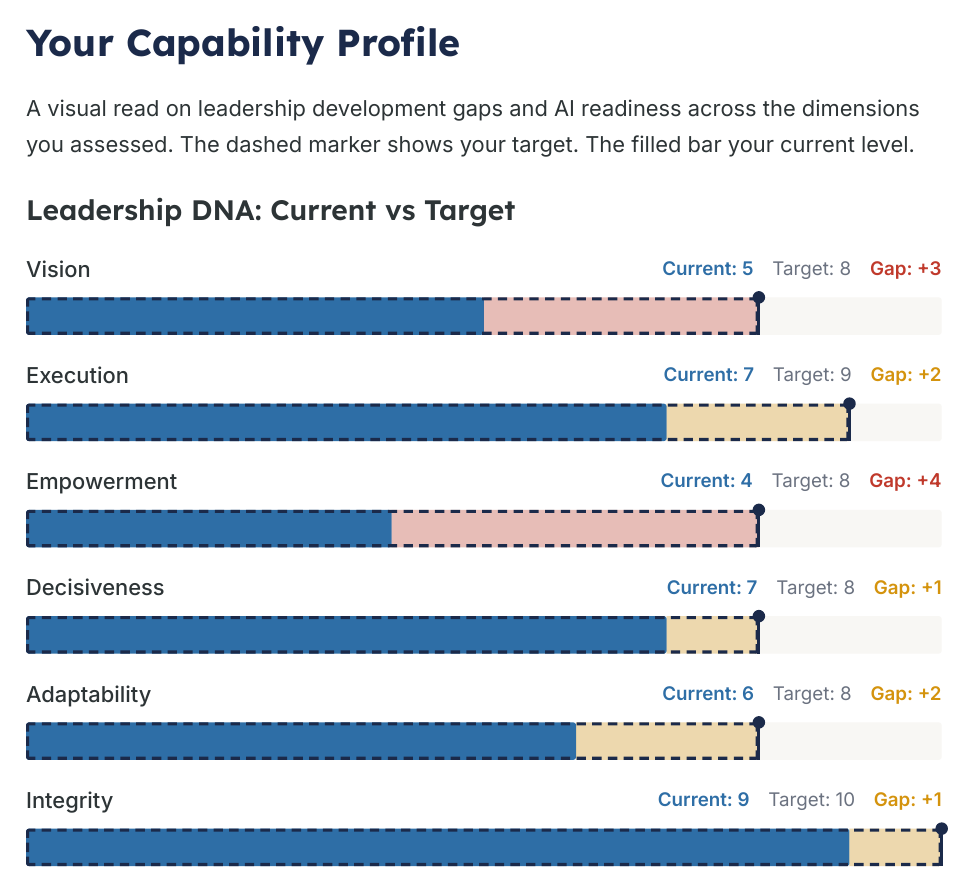
Founder Dependency Index: 3.2 out of 10. Execution to Ambition Ratio: 0.76. Organizational Readiness: 54 out of 100.
A readiness score in the middle band is the realistic case for most trade companies. The team accepts the change when someone explains the reason and paces the rollout. It resists when the price book arrives as an instruction.
Building the book from your own numbers
The failure mode is to buy a national price book and apply it unmodified.
A price book is labor time multiplied by a labor rate, plus materials at a defined markup, plus a share of overhead. Three of those four numbers are specific to one company. Borrowing them from a vendor produces prices that are wrong in both directions, and the errors do not cancel out.
The labor rate is the number most companies get wrong. It is not what technicians are paid. It is the fully loaded cost of putting a truck at a curb, including vehicle, insurance, billable time, training, dispatch, and office overhead. Companies that build a rate based solely on wages underprice everything and cannot work out why volume growth does not produce profit growth.
Task times should come from the history a company already holds rather than from a book. A year of invoices contains the real distribution of durations for every recurring task. The number to use from that distribution is not the average, for reasons the next section covers.
Owners reviewing the wider operational picture should read business efficiency consultant.
Still quoting by feel? Sales Roadmaps builds the price book from your own job history. Start with the operations roadmap.
Price the distribution, not the average
The single most common pricing error is setting the price at the average duration.
Job times are not symmetrical. Most jobs last a common duration, and a minority run long for reasons not visible at the door. Pricing at the average means the long jobs are unprofitable, and the company relies on volume to cover them, which works until the mix shifts.
Pricing closer to the upper end of the normal range accounts for the variance and yields a price that holds. That price will look high against a competitor quoting an hourly rate, and it will be honest in a way the hourly quote is not.
The exception has to be defined in advance. Some work falls genuinely outside the task definition. A wall that has to be opened, or a line that turns out to be collapsed, is a different task at a different price. That price is quoted before the additional work starts, not added afterward.
Presentation determines acceptance
Customers reject flat-rate pricing on the presentation far more often than on the number.
A price handed over without context invites comparison to an hourly rate the customer half-remembers. A price presented as a fixed outcome, with the scope stated and the guarantee attached, invites an entirely different comparison.
Options help. Presenting a repair, a replacement, and a longer-term fix at three prices moves the conversation from whether to buy toward what to buy. It also gives the customer a decision to make rather than an offer to accept, which is a materially easier position to occupy.
The technician needs a script and needs to have practiced it. Companies that hand out a price book without training the conversation get the worst of both approaches: rigid pricing and unconfident delivery.
The change management is the project
The technical work of building a price book takes weeks. The behavioral work takes longer and is where the effort should go.
Experienced technicians have been quoting from judgment for years, and a price book tells them their judgment is being replaced. Presented badly, that is an insult. Presented well, it removes an unpaid task from their day and stops them from absorbing the risk of a job running long.
Run both methods in parallel for a period, quoting a flat rate to the customer while recording actual hours internally. That produces the data to correct the book before it is fully live, and it lets technicians see the reasoning rather than being told it.
Companies with several trades should read how to grow an HVAC company.
The sixty-second version
The same situation was typed, in plain language, into a second free tool that returns a written diagnosis rather than scores.
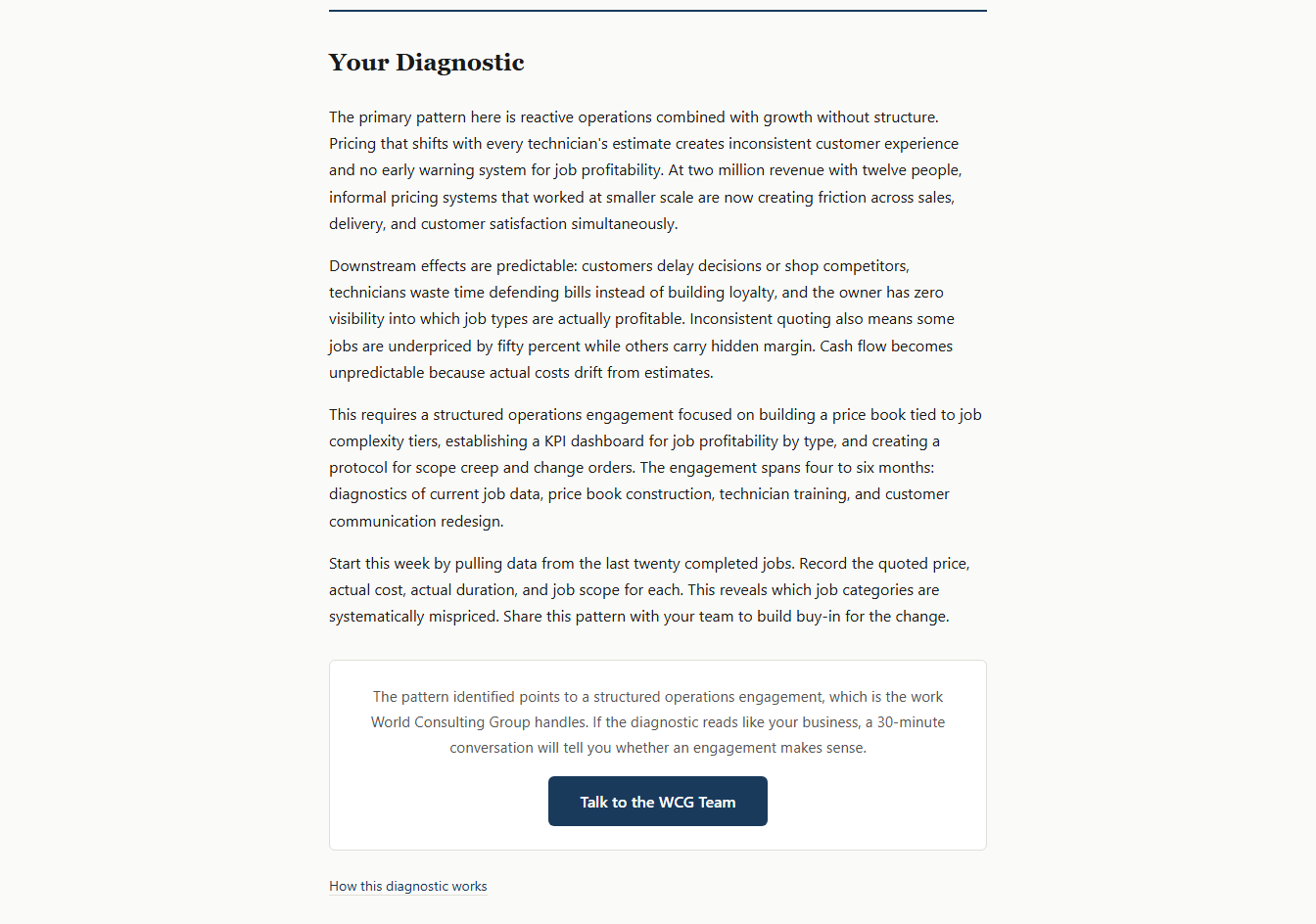
It is named reactive operations combined with unstructured growth, and it is observed that pricing shifts with every technician estimate, leaving no early warning system for job profitability.
The sharper line is the one about the spread. It suggested that some jobs are underpriced by half while others carry a hidden margin. That is exactly the pattern hourly billing produces, and exactly the pattern a price book removes.
Where this is not the constraint
If the work is genuinely bespoke, with no repeatable tasks, a price book cannot be built, and the answer is better to estimate rather than use a flat rate.
If job costing is unreliable, that comes first. A price book built on task times nobody trusts will be wrong in ways that are hard to detect until the margin falls.
Both tools used here are free. The written one is at businessconsultant.services, and the scored briefing is at vwcg.app.
The short version
Flat-rate pricing is easy to describe but hard to implement. The price book has to be built from a labor rate, a set of task times, and an overhead figure, all of which belong to the company applying it.
Build the rate from the fully loaded truck cost and take task times from a year of invoices. Price nearer the upper end of the normal range rather than the average. Then spend most of the remaining effort on the conversation with the technician, which is where these projects actually fail.
Want the price book built from your data rather than a vendor book? Sales Roadmaps does that work. Book a working session.
Frequently Asked Questions
What is flat rate pricing?
Quoting a fixed price for a defined task before work begins, rather than billing hours and materials afterward. The risk that a job will run longer than expected transfers from the customer to the company, which is what the customer is paying for.
Why does hourly billing cause margin variance?
Because two technicians on the same job produce two different invoices. The faster technician charges less, so the company earns less on its most capable people, and the customer receives a price that depends on who was dispatched.
Can a national price book be used directly?
No. A price is labor time multiplied by labor rate, plus materials markup, plus overhead recovery. Three of those inputs are specific to one company, so a borrowed book produces prices that are wrong in both directions.
What labor rate should be used?
The fully loaded cost of putting a truck at a customer’s curb, including vehicle, insurance, billable time, training, dispatch, and office overhead. Building the rate from technician wages alone underprices every task in the book.
Should tasks be priced at the average duration?
No. Job times are asymmetrical, so pricing at the average makes longer jobs unprofitable and forces the company to rely on volume. Pricing closer to the upper end of the normal range accounts for the variance.
Why do flat-rate rollouts fail?
Usually, on presentation and adoption rather than on the numbers. Experienced technicians hear a price book as a replacement for their judgment, and a price delivered without a practiced conversation invites comparison to a remembered hourly rate.