A membership program sells scheduled maintenance and preferential treatment for a recurring fee. It is the most reliable route out of a service business that restarts at zero every January. It is also routinely built backward, priced by guess, and handed to technicians with no reason to sell it.
What the customer is actually buying
Owners design memberships around visits. Customers rarely buy visits.
What a homeowner wants is the absence of problems and the certainty that, if one arises, it will be looked after. The maintenance visit is the mechanism. Priority scheduling, a known rate, and a familiar company are the product.
That distinction changes the design. A plan built with two inspections a year is a chore that the customer forgets they bought. A plan built to be at the front of the queue when something fails, with the inspections included, is insurance with a service attached.
The trade is large and stable. The Bureau of Labor Statistics counted 504,500 plumber, pipefitter, and steamfitter jobs in 2024, with 4 percent growth projected through 2034. Almost none of that market is sold on a recurring basis.
Price from the visit cost, then from the value
Two numbers bound the price, and most operators calculate neither.
The floor is what drives the plan costs: technician time for each included visit at the fully loaded rate, plus the discount applied to any work. If the fee does not cover that margin, the plan sells volume and loses money.
The ceiling is what the customer will pay for priority and predictability, which is usually higher than owners assume and lower than a full-service call. Between those two sits a workable price, and the mistake is picking a number that sounds palatable without checking it against either.
The second error is including too much. Every inclusion adds cost and dilutes the reason to buy. A short plan that delivers reliably beats a generous one that the schedule cannot absorb.
A worked example, run through a real tool
The company described below is fictional. It was invented for this article and run through two free assessment tools to show what the output looks like. No real client, company, or person is described. The figures are tool output on invented inputs, not market data or benchmarks.
The simulated profile is a residential plumbing and drain service company. Revenue between one and three million, six to fifteen staff, five to ten years in business, owner working fifty to sixty hours a week.
The weaknesses described in this article address the exact condition. Revenue restarts at zero each January. There are no service agreements or maintenance plans, and the customer list has never been segmented or marketed to.
What the assessment returned
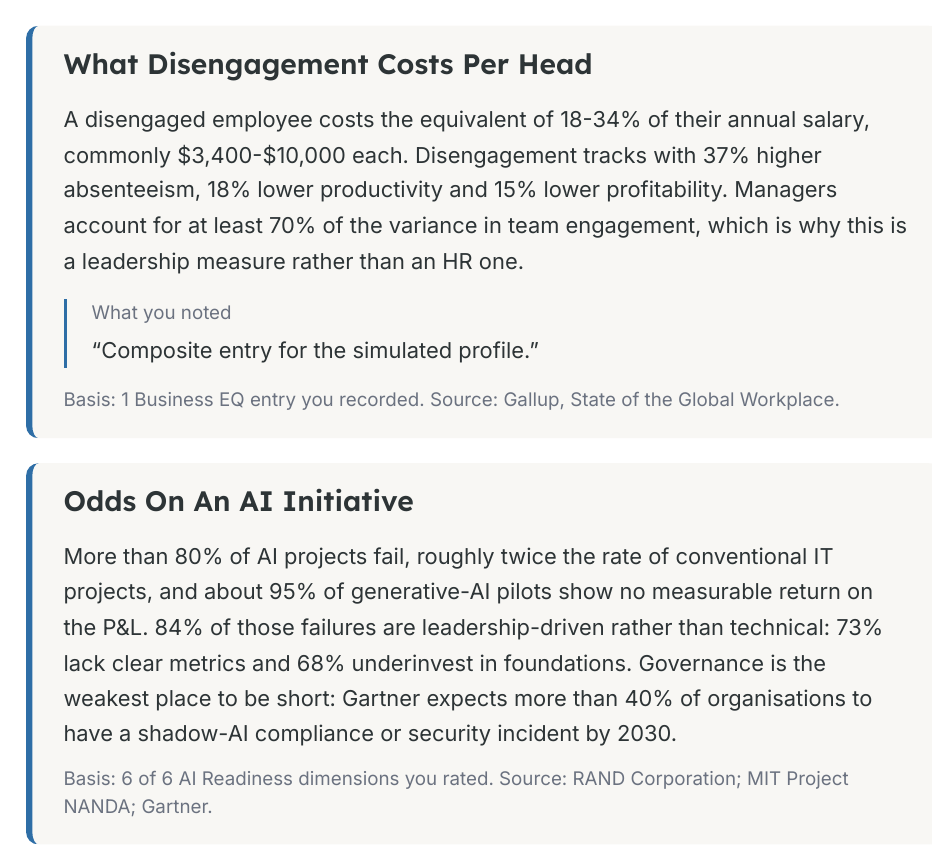
The briefing pairs published benchmark figures with what the owner actually typed. It names the source beneath each block rather than presenting the numbers as its own research.
Execution to Ambition Ratio: 0.76. Founder Dependency Index: 3.2 out of 10. Organizational Readiness: 54 out of 100.
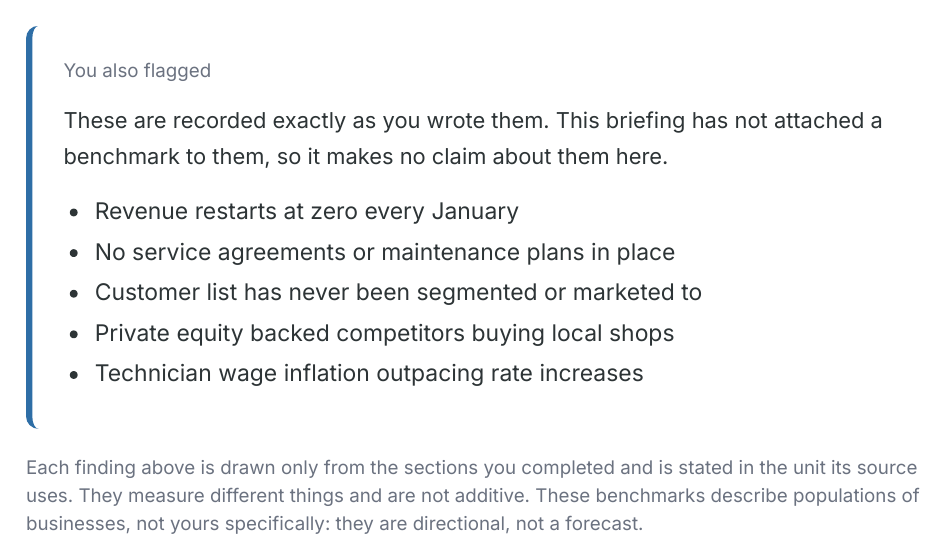
The flagged weaknesses are reproduced verbatim with no cost attached, which is correct. That recurring revenue sits near zero is a fact. The cost of the absence depends on the customer base and the local market.
Recurring revenue was the weakest financial indicator in this profile by a wide margin. That is what makes a plan the highest-return change available, rather than one option among several.
The list is the asset
Most service companies are sitting on the things they need and have never used them.
Years of past customers, with addresses, equipment installed, and dates of work performed, is a marketable database. It is also the single cheapest source of plan members available, because these people have already paid the company once and were satisfied enough not to complain.
Segmenting it takes an afternoon. Customers served in the last two years are the first to be approached. Those with equipment approaching the end of its typical life are the second. The third group is customers who had an expensive emergency, because they have direct experience of what the plan prevents.
The offer differs by segment. That is the whole reason to segment, and it is why an untargeted mailing to the entire list performs so poorly that owners conclude the plan does not work.
Owners reviewing the wider picture should read business efficiency consultant.
Thousands of past customers and no recurring revenue? Sales Roadmaps builds the plan and the offer. Start with the operations roadmap.
Technicians sell it, or nobody does
The plan is sold at the kitchen table by someone who did not take the job to sell anything.
That is the constraint on which every program lives or dies. A technician who has just fixed something is the most credible person in the transaction and the least prepared to make an offer. Handing them a brochure and a target produces neither sales nor goodwill.
Three things change it. A script short enough to remember, practiced until it is no longer embarrassing. An incentive is attached to the sale and, importantly, to the renewal, so nobody sells a plan to a customer who will not keep it. And an offer that a technician believes is genuinely good for the person in front of them.
The third one is the load-bearing element. Technicians decline to sell things they consider poor value. That is a feature rather than a problem, and it is the fastest available test of whether the plan is priced honestly.
Renewal is where the money actually is
The first year of a membership rarely justifies the effort. The fourth does.
A plan sold once and abandoned is a discount with extra steps. A plan renewed for several years produces predictable revenue, a customer who calls no one else, and visits that surface issues before they become emergencies.
That makes renewal rate the metric worth watching rather than members sold. A program growing its membership count while losing a third of it annually is running to stand still, and the count conceals it.
Renewals are won during the year rather than at the renewal date. Visits delivered when promised, priority honored when called upon, and a technician the customer recognizes are what make the decision automatic when the invoice arrives.
Delivery capacity has to exist first
A plan sold beyond what the schedule can absorb converts satisfied customers into disappointed ones.
Each membership creates an obligation: scheduled visits and a promise of priority. Both consume capacity. Sold aggressively in a business already running at the limit, the visits get deferred, the priority becomes fictional, and the renewal conversation is difficult.
The planning arithmetic is simple. Multiply expected members by included visits, add the expected priority calls, and check the result against available technician hours in the quieter months. If it does not fit, the plan needs fewer inclusions or a cap on members.
Scheduling the maintenance visits into slow periods is the design that makes the whole thing work. It fills the calendar precisely when the business would otherwise be idle, which is a large part of why recurring revenue smooths a service business at all.
Multi-trade operators should read how to grow an HVAC company.
The sixty-second version
The same situation was typed, in plain language, into a second free tool that returns a written diagnosis rather than scores.
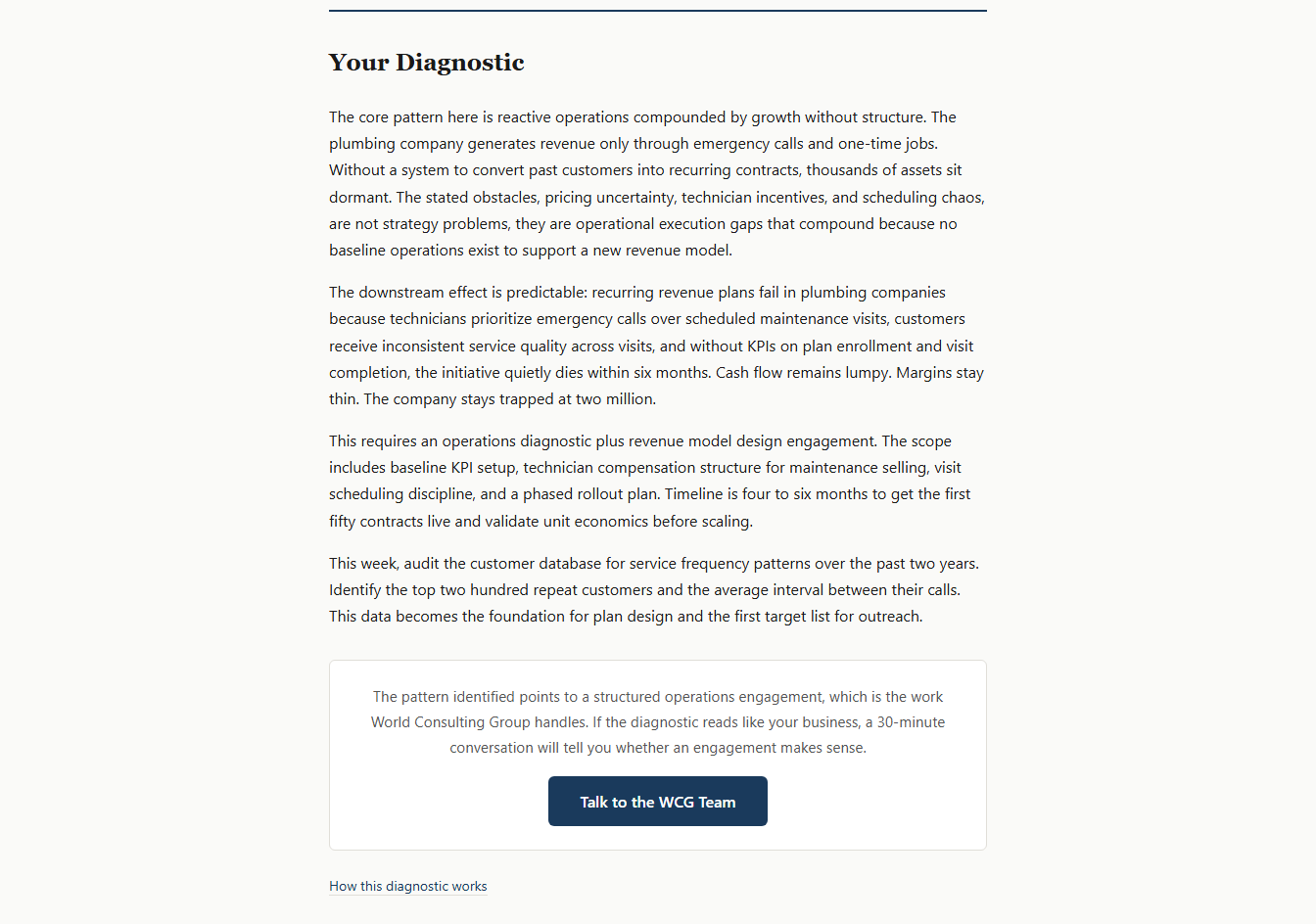
The diagnosis reads the absence of recurring revenue as a structural design gap rather than a marketing shortfall, which matches the assessment reading.
Structural is the right word. A company with no plan does not have a promotion problem. It has never built the product, and no amount of advertising can sell something that does not yet exist.
Where this is not the constraint
If the work is predominantly new construction or one-off installation, there is little to maintain, and the recurring model does not apply cleanly.
If technician capacity is already fully committed and hiring is not possible, building demand for scheduled visits will damage service before it helps revenue.
Both tools used here are free. The written one is at businessconsultant.services, and the scored briefing is at vwcg.app.
The short version
Customers buy priority and predictability rather than visits, so the plan should be designed around the promise and delivered through maintenance. Price it above the loaded delivery cost and below a full-service call.
Market it to the existing customer list by segment rather than in bulk. Give technicians a short, practiced script, with incentives tied to both renewal and the initial sale. Check the visit obligation against slow season capacity before selling a single membership.
Revenue restarting at zero every January? Sales Roadmaps builds the recurring base. Book a working session.
Frequently Asked Questions
What are customers actually buying in a membership?
Priority scheduling, a known rate, and a familiar company. The maintenance visit is the mechanism, not the product. A plan designed as two inspections a year becomes a chore that the customer forgets they purchased.
How should a membership be priced?
Above the fully loaded cost of the included visits, plus any discount extended on work, and below the price of a full service call. Picking a palatable number without checking either boundary is the common error.
Why does including more reduce performance?
Every inclusion adds delivery cost and dilutes the reason to buy. A short plan delivered reliably outperforms a generous one that the schedule cannot absorb, because failed delivery shows up at renewal.
Where do the first members come from?
The existing customer list is segmented. Customers served in the last two years, customers with equipment nearing the end of life, and customers who experienced an expensive emergency each warrant a different offer.
How do you get technicians to sell plans?
A short script practiced until it is comfortable, an incentive tied to both renewal and initial sale, and an offer the technician genuinely believes benefits the customer. Technicians decline to sell what they consider poor value.
What capacity check is needed before launching?
Expected members multiplied by included visits, plus expected priority calls, are compared with available technician hours during quieter months. Scheduling maintenance into slow periods is what makes the model smooth revenue.