
A punch list is the record of incomplete or defective work identified at substantial completion. Contractors treat it as the end of a job. It behaves like an unbudgeted second job, staffed with the least efficient crew configuration available, performed at the point in the schedule where the money has already been spent.
The cost is the return trip, not the repair
Punch items are individually small, which is why their cost is consistently underestimated.
Replacing a device takes minutes. Mobilizing a crew to a site to replace it is a different matter. Travel, parking, badging, and coordination with a general contractor consume most of a day, plus the productive time of people who were working elsewhere. The repair is the cheapest part of the transaction.
Three or four return trips per site are common, and each one carries that full overhead. A contractor who measures only labor hours for the repair itself will see a small number and conclude that closeout is not a problem.
The sector is large and durable. The Bureau of Labor Statistics counted 550,300 construction manager jobs in 2024, with 9 percent growth projected through 2034. Closeout discipline is one of the few margin levers that does not require winning better work.
Retainage is working capital held hostage by paperwork
The second cost is financial rather than operational, and it is usually larger.
Retainage is released against a completed closeout package that includes a signed punch list, as-built drawings, operation and maintenance manuals, warranties, lien releases, and final certified payroll, where applicable. Any missing element holds the whole release.
That means a contractor with excellent field work and disorganized documentation waits months longer for money it has already earned. The delay is not a dispute. It is an administrative gap that nobody owns, and it is invisible in every report except the cash position.
A worked example, run through a real tool
The company described below is fictional. It was invented for this article and run through two free assessment tools to show what the output looks like. No real client, company, or person is described. The figures are tool output on invented inputs, not market data or benchmarks.
The simulated profile is a commercial electrical and specialty trade contractor. Revenue between eight and fifteen million, thirty-one to sixty staff, ten to twenty years in business.
The strengths entered describe a capable field operation: prequalification with several general contractors, and a field crew that delivers work the firm is not embarrassed by.
What the assessment returned
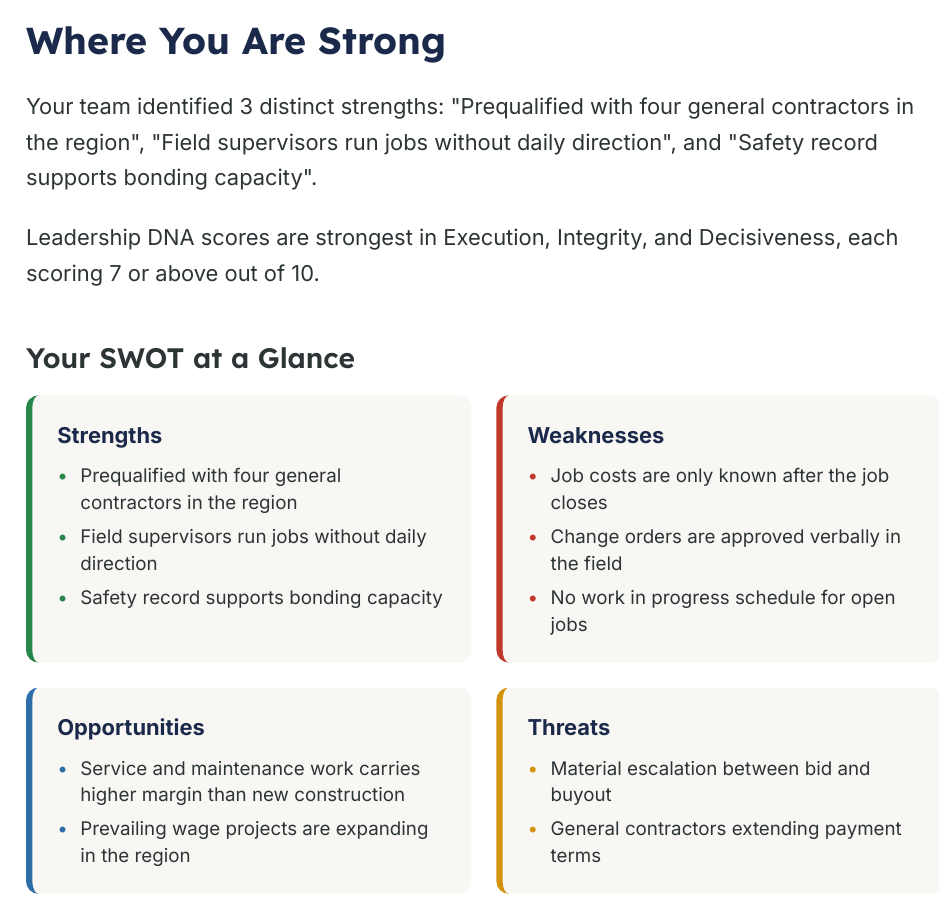
The briefing repeats the strengths as entered and treats them as assets rather than as evidence that the business needs no attention.
That is the relevant framing for closeout. Field quality and closeout performance are different capabilities, and a firm can be genuinely strong at one while losing money at the other.
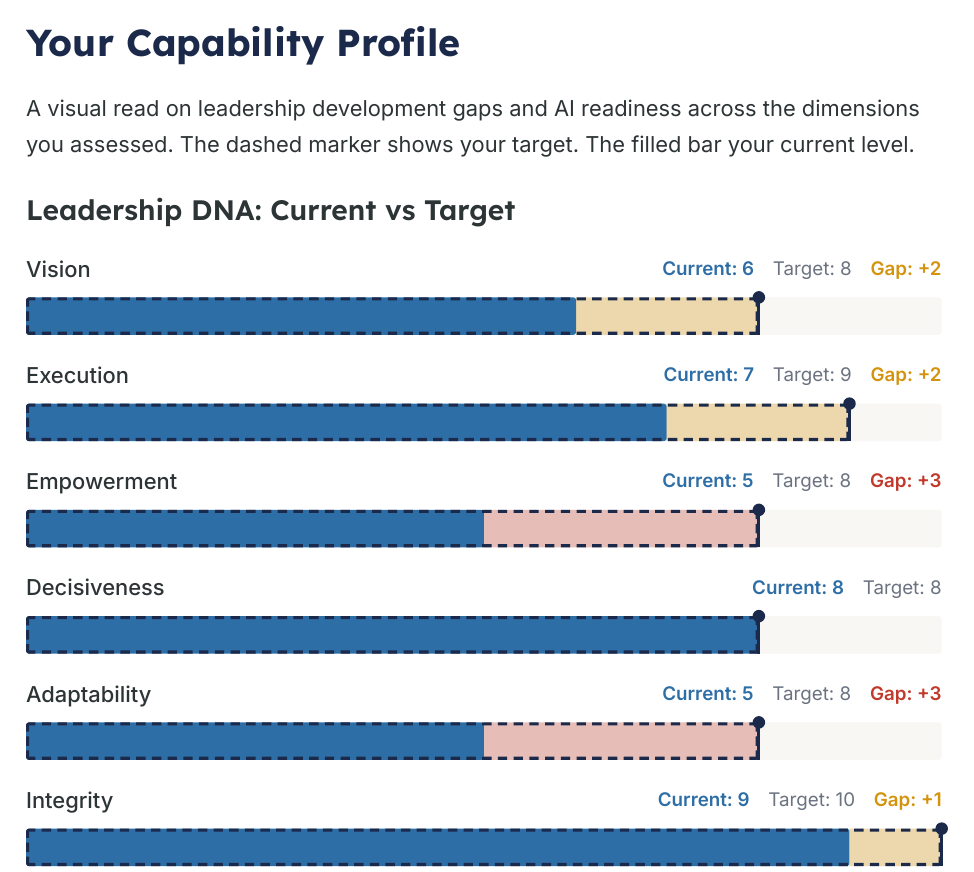
Execution to Ambition Ratio: 0.61. Founder Dependency Index: 2.6 out of 10, moderate, with the business holding together without daily owner involvement. Organizational Readiness: 51 out of 100.
Low dependency with low execution capacity describes a firm whose people are capable but whose processes are absent. Closeout is the function that most reliably exposes that combination, because it requires a defined sequence rather than competence.
Nobody owns the sequence
The structural failure is that the closeout has no single owner.
The project manager considers the job finished at substantial completion. The foreman has moved to the next site. Accounting waits for documents it has no authority to demand. The general contractor issues a punch list to whoever answers. Work happens, slowly, driven by whoever is most irritated that week.
Assigning one owner for the sequence from substantial completion to final payment is the entire fix, and it costs nothing. That person tracks the punch list, chases documents, schedules return trips efficiently, and escalates when retainage ages.
The following measurement is equally simple. Days from substantial completion to retainage release, tracked per project. A firm that starts recording it has a baseline within a quarter and an argument for change immediately.
Contractors reviewing operational structure should read construction company management.
Does anyone actually own closeout? Sales Roadmaps assigns the sequence and the metric. Start with the operations roadmap.
Self-punching moves the cost forward
The cheapest punch item is the one the contractor finds first.
Walking the work before the general contractor does converts an external defect into an internal correction. The crew is already mobilized, the material is already on site, and the item never appears on any list that serves as a record of performance.
That record matters more than the individual items. General contractors track which subcontractors generate long punch lists, and that history influences prequalification and invitation to bid. A short punch list is a business development asset rather than merely an operational one.
Self-punching requires a checklist for each work type rather than a general instruction to look around. Written from the last two years of actual punch items, that checklist is specific to the firm and finds the defects the firm actually produces.
The closeout package should be assembled during the job
Most closeout delays come from assembling documents at the end that could have been collected throughout the process.
As-built markups made weekly during installation are accurate and cost nothing. Reconstructed at closeout from memory and photographs, they take days and are wrong in places nobody can check. The same applies to submittal records, warranty documentation, and equipment data.
The practical version is a closeout folder opened at project start rather than at substantial completion. Each document goes in when it is created. At completion, the package is assembled rather than produced.
Firms that adopt this describe it as removing a fortnight from every project without adding an hour of work. That is roughly accurate because the documents were always going to be produced eventually.
Batching return trips is worth more than speed
The instinct upon receiving punch items is to respond immediately, which is usually the expensive choice.
Responding to items one at a time means one mobilization per item. Holding items until a defined batch exists, or until a scheduled return date, means one mobilization for several. The customer experience is comparable, provided the schedule is communicated.
The exception is anything that blocks occupancy or another trade. Those go immediately, because the cost of delay is borne by someone with the power to remember it.
Everything else can be scheduled. Scheduling it requires a single view of what is outstanding across all sites, rather than a set of separate message threads held by different individuals.
The pattern in the items is the training signal
Punch lists are treated as a nuisance to clear. Read in aggregate, they are the most specific quality data a contractor will ever receive.
Recorded by type over a quarter, items cluster. They focus on specific types of work, crews, or stages of installation. That is a training and sequencing signal, and it is currently discarded the moment each item is cleared.
A defect appearing repeatedly across crews is a process or specification problem. A defect concentrated in one crew is a supervision or instruction problem. The responses are different, and neither is available without the record.
Margin structure sits in construction company profit margins.
The sixty-second version
The same situation was typed, in plain language, into a second free tool that returns a written diagnosis rather than scores.
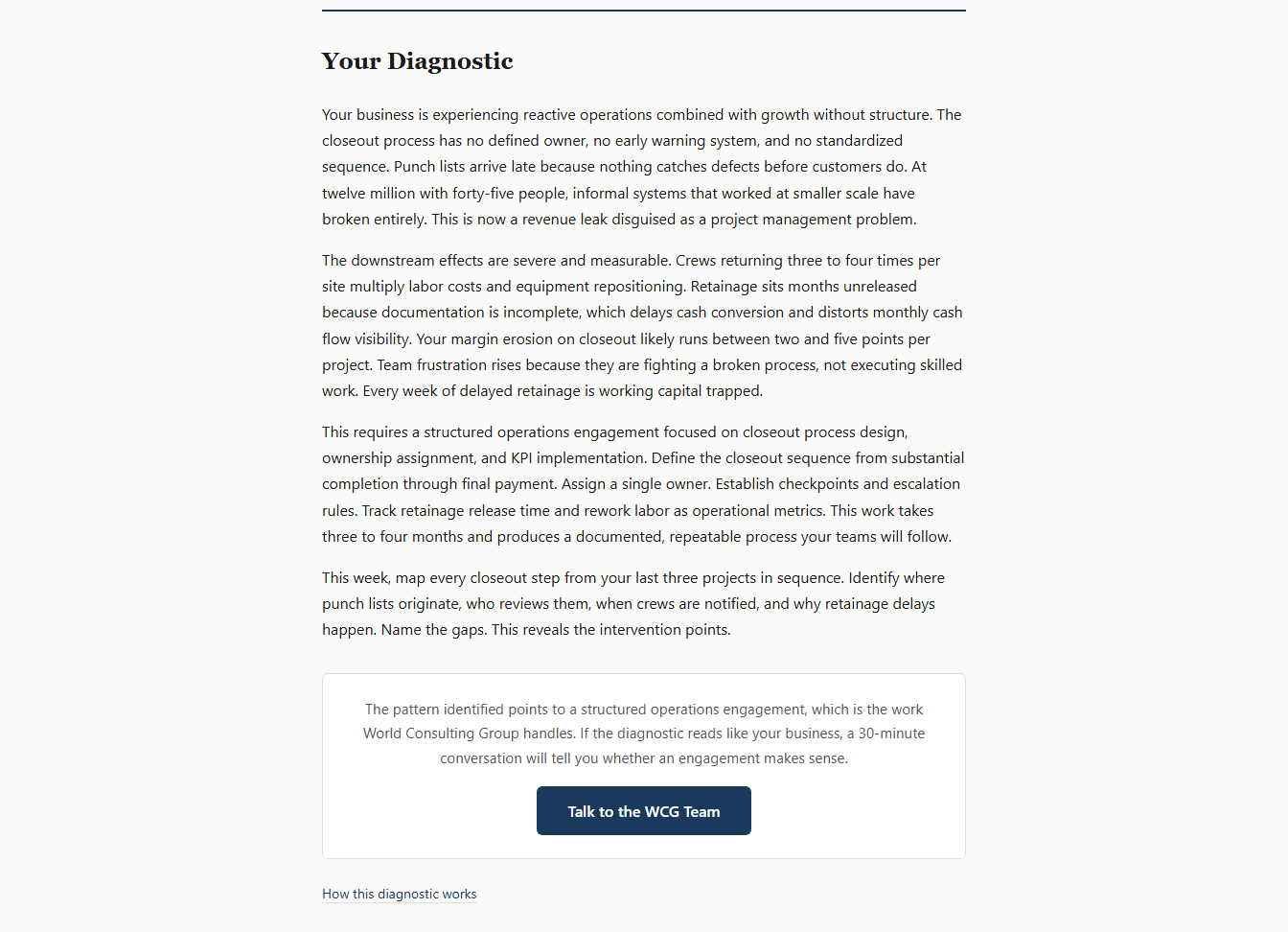
It is named reactive operations combined with growth without structure. It was observed that the closeout process has no defined owner and no standardized sequence. Then it described the situation as a revenue leak disguised as a project management problem.
That phrasing is worth keeping. Closeout failures present as scheduling irritation and are recorded as nothing, which is precisely why they persist for years in otherwise well-run companies.
Where this is not the constraint
If projects are short and retainage is minimal, the financial half of this matters less, and the argument reduces to rework cost alone.
If the firm cannot reliably estimate a job’s cost, general job costing precedes it. Closeout cost cannot be isolated inside a number nobody trusts.
Both tools used here are free. The written one is at businessconsultant.services, and the scored briefing is at vwcg.app.
The short version
Closeout is an unbudgeted second job that consumes margin after the money has been spent, and its cost is mobilization and delayed retainage rather than the repairs themselves.
Assign one owner for the stretch from substantial completion to final payment. Measure days to retainage release per project. Self-punch against a checklist built from historical items. Batch return trips except where occupancy is blocked, and read the item pattern quarterly.
Retainage aging and nobody chasing it? Sales Roadmaps builds the closeout process. Book a working session.
Frequently Asked Questions
What is a punch list?
The record of incomplete or defective work is identified at substantial completion. It functions as an unbudgeted second job performed after the project money has already been spent, which is why it consumes margin so reliably.
Why is the punch list cost underestimated?
Because the repair is the cheapest part. Mobilizing a crew to a site involves travel, parking, badging, coordination, and the loss of productive time for people who were working elsewhere. Measuring only repair hours makes the problem look small.
How does closeout affect retainage?
Retainage releases against a complete package, including signed punch list, as-builts, manuals, warranties, and lien releases. Any missing element holds up the entire release, so strong fieldwork with disorganized paperwork still waits months for earned money.
Who should own the closeout?
One named person is responsible for the sequence from substantial completion through final payment. That person tracks items, chases documents, schedules return trips efficiently, and escalates aging retainage. Assigning the role costs nothing.
What is self-punching?
Walking the work before the general contractor does, so a defect becomes an internal correction rather than a recorded item. It works best against a checklist written from historical punch items the contractor actually generated, rather than a general instruction to inspect.
Should punch items be addressed immediately?
Only where occupancy or another trade is blocked. Responding item by item means one mobilization per item. Batching to a scheduled return date gives a comparable customer experience at a fraction of the cost, provided the schedule is communicated.