
Trust accounting is the practice of holding and reconciling client funds separately from firm funds. It differs from every other back-office process in one respect: the consequence of failure is not financial, it is disciplinary. A firm can survive a bad quarter. It cannot survive a trust account, it cannot explain.
Why trust accounting is not ordinary bookkeeping
Ordinary bookkeeping errors are corrected. Trust errors are reported.
The obligation is absolute rather than proportionate. Commingling firm and client funds is a violation regardless of intent or amount. A negative client ledger balance is a violation, even if the account overall holds sufficient funds, because a client’s funds cannot cover a disbursement to another client.
That asymmetry is why trust accounting deserves controls disproportionate to the transaction volume. A firm processing forty settlements a year still needs the discipline of one processing four hundred.
The profession is large and the rules vary. The Bureau of Labor Statistics counted 864,800 lawyer jobs in 2024, with 4 percent growth projected through 2034. Each state bar sets its own requirements, and the specifics of reconciliation frequency and record retention differ.
The three-way reconciliation
The control that actually catches errors compares three figures that must agree exactly.
The bank statement balance. The trust account check register balance. And the total of all individual client ledger balances.
Two of three agreeing proves very little. A register that matches the bank while client ledgers total differently means funds have been moved between clients. That is the failure that the whole system exists to prevent.
Monthly is the common minimum. The firms that never have a crisis reconcile more often than the rule requires. The cost of finding a discrepancy grows with every transaction layered on top of it.
A worked example, run through a real tool
The company described below is fictional. It was invented for this article and run through two free assessment tools to show what the output looks like. No real client, firm, or person is described. The figures are tool output on invented inputs, not market data or benchmarks.
The simulated profile is a personal injury and civil litigation practice. Revenue between three and eight million, sixteen to thirty staff, managing partner working sixty to seventy hours a week.
The weaknesses entered describe authority concentrated in one person: every fee agreement is routed to the managing partner, intake is handled by a single individual, and there is no documented follow-up process.
What the assessment returned
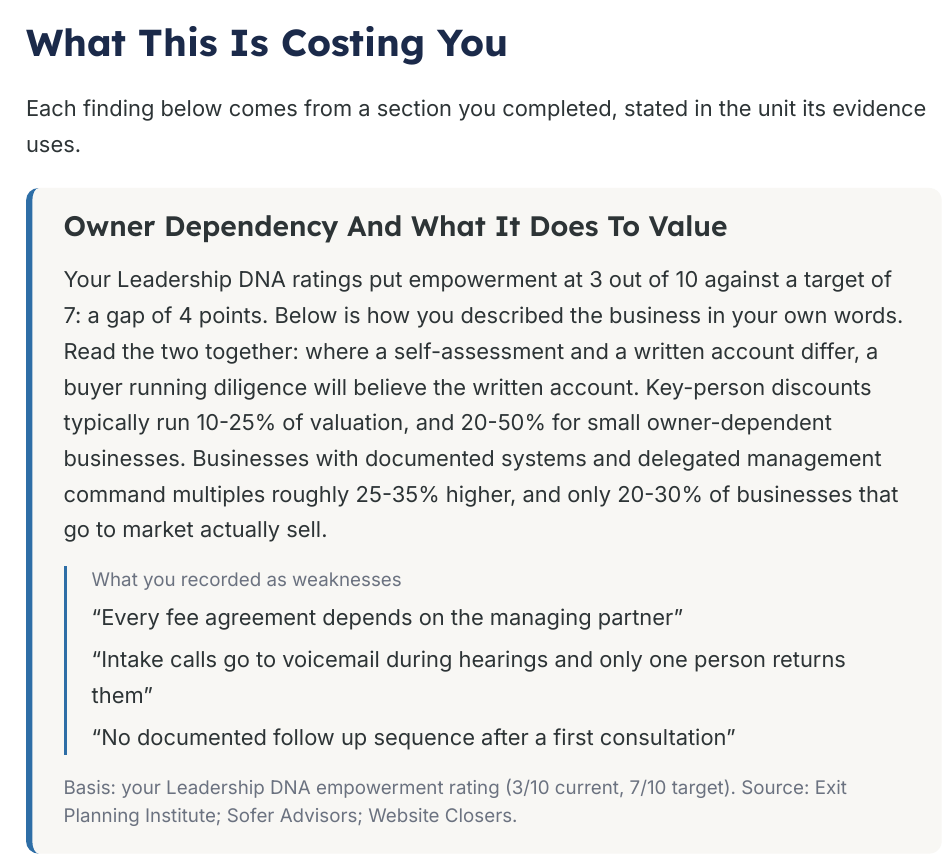
The briefing states its basis beside each finding and reads the self-rating against what the owner wrote in their own words. The line worth noting is that when a self-assessment and a written account differ, a buyer conducting due diligence will believe the written account.
That principle applies directly to trust accounting. A firm can rate its controls highly and still describe a process in which one person reconciles, reviews, and approves. The description is what an auditor will act on.
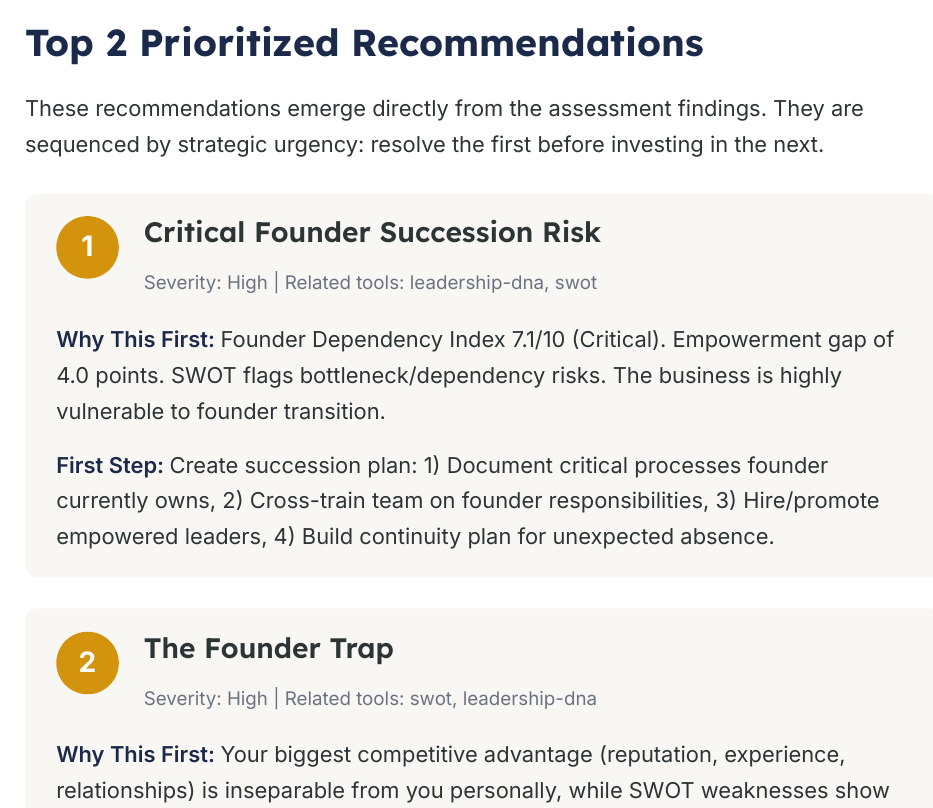
The briefing returns three figures for this profile. Founder Dependency Index 7.1 out of 10, which it describes as a critical vulnerability, noting that if the founder stepped away for thirty days, multiple operations would stall. Execution to Ambition Ratio 0.68. Organizational Readiness 44 out of 100.
A critical dependency reading is exactly what a trust function should never sit inside. The score does not measure the trust account. It measures the condition that makes a trust failure likely: decisions and knowledge concentrated in one unavailable person.
Retention and the records nobody keeps
Record retention is the quiet half of the obligation and the one firms discover late.
Requirements typically cover reconciliations, client ledgers, bank statements, canceled items, and supporting documentation, for a period set by each state bar. Firms that migrate accounting software mid-period often lose older records without realizing it because the new system retains only what was imported.
The practical control is an annual export of the full trust record set to a location independent of the accounting platform. It takes an afternoon once a year, and it is the difference between a tedious audit and one that cannot be answered.
Segregation of duties in a firm too small for it
The textbook control separates the person who records transactions from the person who reconciles and from the person who authorizes disbursement. Most firms with 20 people cannot staff 3 roles.
The workable substitute is to separate the two most dangerous adjacencies rather than all three. Whoever prepares the reconciliation should not also authorize disbursements. The person who authorizes should review the completed reconciliation and sign it.
That is achievable with two people. It is not achievable with one, and most firms have only one.
The signature matters more than it looks. A reconciliation nobody reviews is a document rather than a control, and the difference only becomes visible during an audit.
Firms working on the broader operational picture should read law firm operations consultant.
Is your trust reconciliation reviewed by anyone? Sales Roadmaps builds the separation a small firm can actually staff. Start with the operations roadmap.
Settlement disbursement as a bottleneck
Disbursement delay is the operational symptom that firms notice before they notice the control weakness.
When every disbursement waits on one partner who is frequently in court, funds sit in trust longer than necessary. Clients call to ask why, and staff work around the queue rather than through it. Workarounds are where trust errors originate.
A threshold policy resolves most of it. Disbursements below an agreed amount, for matters with a completed and reviewed ledger, proceed according to a defined checklist. Anything above, or anything with an anomaly, still routes to the partner.
That converts a universal bottleneck into an exception path. The same structural fix applies to fee agreements, pricing authority, and every other decision concentrated in one person.
What a bar audit actually examines
Audits are more predictable than firms expect, which makes preparation tractable.
They look for the three-way reconciliation, performed at the required frequency, with evidence that it was reviewed. They look for individual client ledgers with no negative balances at any point. They look for records retained for the required period. And they look at whether disbursements were made only against collected funds.
None of that requires software. It requires that the reconciliation have happened on schedule, with a second signature. Firms fail audits on the process rather than on the arithmetic.
The earned fee transfer
The routine transaction most likely to create a violation is moving earned fees out of trust.
Three conditions must hold. The fee must actually be earned under the engagement terms. The client must have been billed or notified as required. And the individual client ledger must carry sufficient funds at that moment. Missing any one converts an ordinary transfer into a commingling or shortfall issue.
Firms get into difficulty by sweeping earned fees on a schedule rather than per matter. A monthly sweep calculated from the account total, rather than on a matter-by-matter basis, is precisely how one client ends up funding another without anyone intending it.
The safeguard is transferring per matter, against the individual ledger, with the calculation retained. Slower, and it is the difference between a defensible record and an unexplainable one.
The sixty-second version
The same situation was typed, in plain language, into a second free tool that returns a written diagnosis rather than scores.
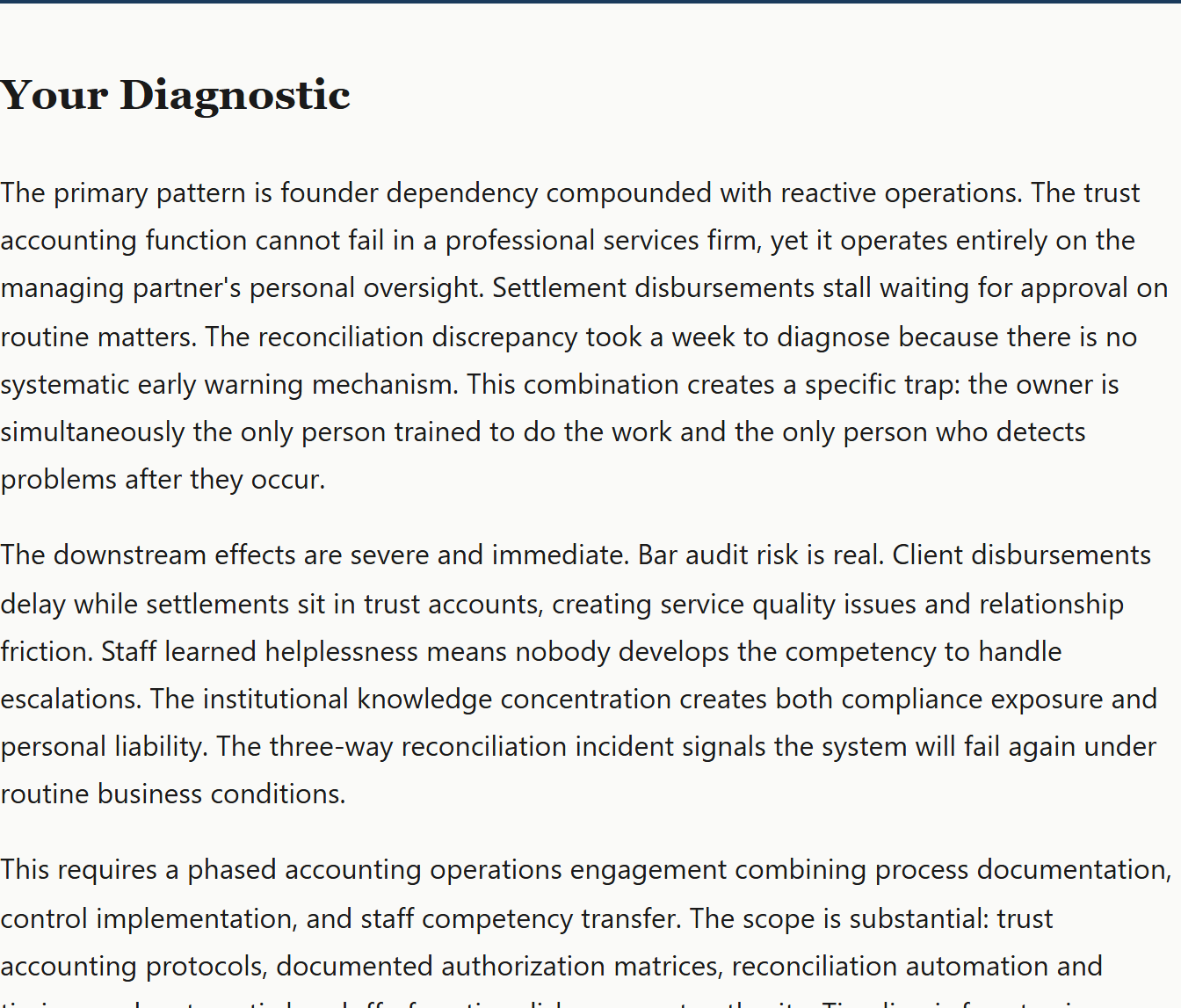
It is named founder dependency compounded with reactive operations. The point is made: a trust accounting function cannot be permitted to fail in a professional services firm, yet this one operated entirely on the managing partner.
That is the sentence that reframes the problem. The issue is not that reconciliation is difficult. It is a control that cannot fail that has exactly one point of failure.
Where this is not the priority
If the firm already reconciles three ways monthly with a documented second review, the control is sound, and the effort belongs elsewhere.
If the firm holds minimal client funds because of its practice area, the exposure is genuinely lower, though the obligation does not disappear with volume.
Both tools used here are free. The written one is at businessconsultant.services, and the scored briefing is at vwcg.app. Financial framing sits in law firm profitability.
The short version
Trust accounting is the one back-office process where the downside is disciplinary rather than financial, which means it warrants controls out of proportion to its transaction volume.
Reconcile three ways on schedule. Have someone other than the preparer review and sign it. Set a disbursement threshold, so the partner is an exception path rather than a queue.
Want the trust process reviewed before the bar does? Sales Roadmaps maps the control and the gap. Book a working session.
Frequently Asked Questions
What is trust accounting?
Trust accounting is the practice of holding client funds separately from firm funds and reconciling them on a defined schedule. Unlike ordinary bookkeeping, failures carry disciplinary rather than purely financial consequences, and the obligation is absolute regardless of amount.
What is a three-way reconciliation?
A three-way reconciliation compares the bank statement balance, the trust check register balance, and the sum of all individual client ledger balances. All three must agree exactly. Two matching, with the third differing, indicates funds moved between clients.
How often should a trust account be reconciled?
Monthly is the common regulatory minimum, though requirements vary by state bar. Firms that avoid crises reconcile more frequently because the cost of locating a discrepancy grows with every transaction layered on top of it.
How do small firms achieve segregation of duties?
By separating the two most dangerous adjacencies rather than all three. Whoever prepares the reconciliation should not authorize disbursements, and whoever authorizes should review and sign the completed reconciliation. That works with two people.
What does a bar audit examine?
Whether three-way reconciliations were performed at the required frequency, with evidence of review. Whether any individual client ledger went negative. Whether records were retained for the required period, and whether disbursements were made only against collected funds.
Why do settlement disbursements get delayed?
Usually, because approval concentrates on one partner who is frequently unavailable. Funds sit longer than necessary, and staff build workarounds, which is where trust errors originate. A value threshold with a defined checklist resolves most of the queue.