Preventive maintenance is scheduled work performed before failure rather than after it. For a service contractor, its real value is not equipment longevity. Maintenance is the only work whose timing the company chooses. That makes it the only tool available for filling weeks that would otherwise be empty.
Reactive work cannot be scheduled
A purely reactive service business has its calendar written by weather and by failure.
The consequence is not average utilization. It is variance. A freeze produces more work than the company can staff, and a mild fortnight produces less than it can pay for. Both are expensive, and the second is the one nobody counts.
Payroll does not fluctuate with demand. A technician idle on a Tuesday in April costs exactly as much as a technician on a call. That gap is the structural problem that preventive maintenance exists to close.
The trade itself is stable. The Bureau of Labor Statistics counted 504,500 plumber, pipefitter, and steamfitter jobs in 2024 and projects 4 percent growth through 2034. Demand for the work is steady. Demand for a given company in a given week is not.
What a maintenance visit should actually do
Three purposes, in order of financial importance, and most contractors rank them backward.
It occupies a slot the company chose. That is the scheduling value, and it is the largest.
It surfaces deferred work. An inspection finds a water heater at eleven years, a seeping shutoff, and a pressure regulator out of range. None of it is an emergency and all of it is revenue, discovered in a week that had none.
It extends equipment life. That is the customer-facing rationale, it is true, and it is the smallest of the three in revenue terms.
Pricing the visit against its labor cost prices it against the least valuable of the three purposes.
A worked example, run through a real tool
The company described below is fictional. It was invented for this article and run through two free assessment tools to show what the output looks like. No real client, company, or person is described. The figures are tool output on invented inputs, not market data or benchmarks.
The simulated profile is a residential plumbing and drain service company. Revenue between one and three million, six to fifteen staff, five to ten years in business, owner working fifty to sixty hours a week, stated goal of predictable revenue.
The weaknesses entered describe a business that earns customers and then discards them. Revenue restarts at zero each January, there are no maintenance plans, and the customer list has never been segmented or marketed to.
What the assessment returned
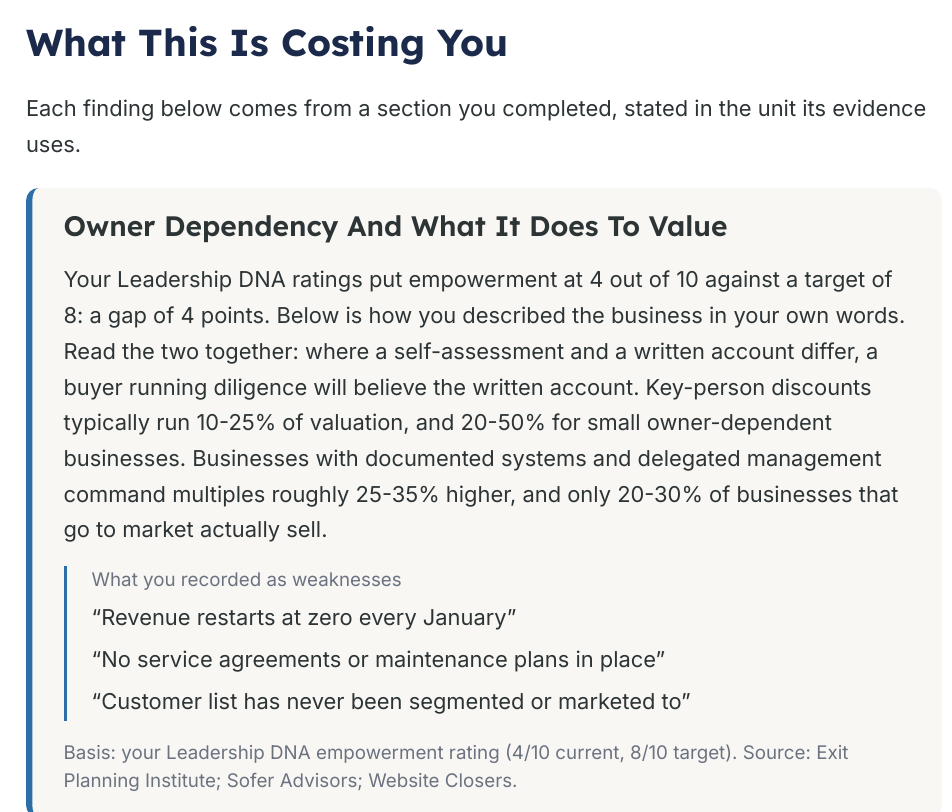
The briefing states each finding in the unit, its evidence, and names the basis alongside it, rather than converting everything to a single score.
For a reactive contractor, the relevant reading is that the constraint is not capability. The crews are competent, and the work is good. What is missing is any mechanism that converts completed work into future scheduled work.
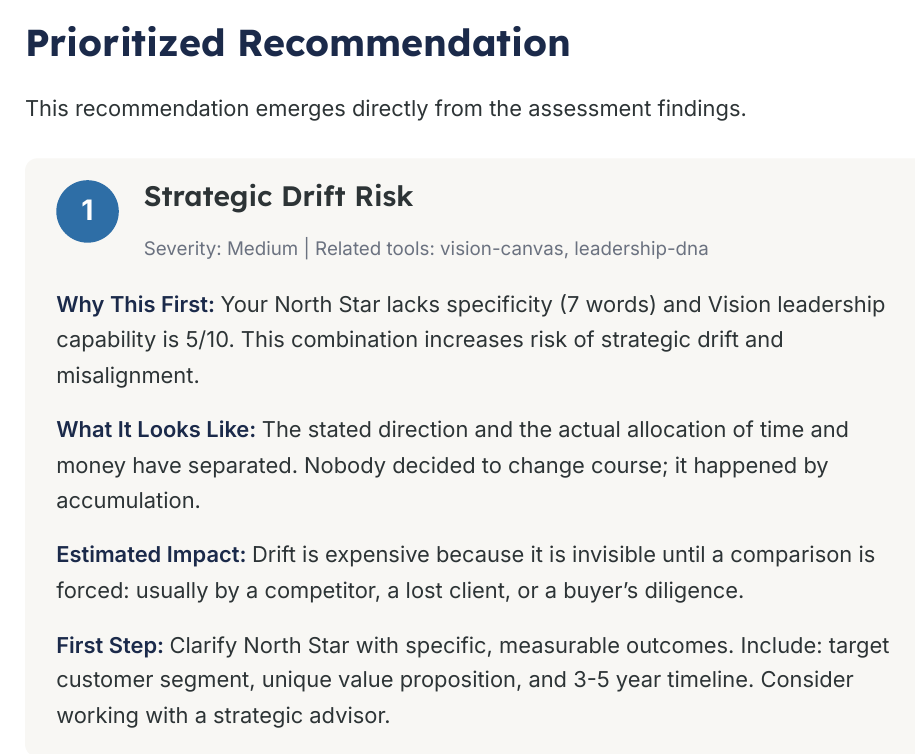
The briefing returns three figures for this profile. Execution to Ambition Ratio 0.76, capacity roughly matching ambition with a thin margin. Founder Dependency Index 3.2 out of 10, moderate. Organizational Readiness 54 out of 100.
None of those describes an owner bottleneck, which is the point. This is not a business held back by its founder. It is a business with no mechanism to retain what it has already earned, and the scores confirm that it has the capability to run a program.
What to build before selling on the first visit
Three things must exist before enrollment starts, and skipping any of them results in cancellation within a year.
A written scope, plain enough that a customer knows what a visit includes, and a technician knows when it is finished. A vague scope produces disputes at the second visit rather than the first.
A renewal mechanism, ideally card on file with automatic renewal and clear cancellation terms. Programs requiring an annual re-sell decay quickly and consume office time doing it.
A tracking method that shows who is enrolled, when they are due, and whether the visit occurred. A spreadsheet is adequate at the start. Nothing is, and forgotten visits are the fastest route to cancellation.
Scheduling maintenance into the gaps, not the peaks
The mistake that kills maintenance programs is booking visits when the customer asks rather than when the company needs the work.
A program sold with open scheduling fills the same weeks that were already full, because customers ask in the seasons they are thinking about their systems. That produces obligations during the busiest period and does nothing for the empty ones.
The fix is to sell the visit as company-scheduled within a window. Twice yearly, at a time the dispatcher selects, with reasonable notice. Customers accept this readily when the tradeoff is priority response during a failure.
That single design decision is the difference between a program that smooths demand and one that amplifies it.
Contractors working through the wider growth sequence can start with how to grow an HVAC company, which applies to plumbing with the trade names changed.
Want maintenance that fills your slow weeks rather than your busy ones? Sales Roadmaps designs the program and the scheduling rules. Start with the operations roadmap.
The capacity objection, answered
The common objection is that a truck cannot be spared for low value inspections during a freeze.
That objection is correct and also an argument for the program rather than against it. Maintenance visits are the one category of work that can be moved. During a freeze, the dispatcher defers them. During a mild fortnight, the dispatcher pulls them forward.
A maintenance obligation is a schedulable buffer. Emergency work is not. A business with only emergency work has no buffer at all, which is precisely why its slow weeks are empty and its busy weeks turn work away.
The scheduling window is what makes this possible, and it must be written into the agreement rather than assumed.
Measuring whether the program works
Two numbers, and neither is revenue.
Attachment rate, meaning the share of completed jobs that end in an enrollment. It measures whether the offer and the technician conversation function. A rate near zero is an offer problem rather than a customer problem.
Completion rate, meaning the share of due visits actually performed on schedule. This is where neglected programs fail, usually about a year in, when obligations accumulate faster than the dispatcher can schedule them. A missed maintenance visit is a delayed cancellation.
Track attachment weekly by the technician and completion monthly. Both are leading indicators of a revenue number that will not move for two quarters.
Pricing against the slow week, not the visit
The pricing error that follows from misreading the purpose is charging roughly the labor in the visit plus a margin.
That produces a break-even product sold with effort, which technicians can sense and therefore sell badly. It also anchors the customer on the inspection as the thing being bought, which makes the price feel high for what it appears to deliver.
Price it instead against what it secures. The customer is buying priority when something fails, and the reassurance of a system that has been looked at. The company is buying a filled slot in a dead week and first access to the deferred work on the inspection surfaces.
Those are worth substantially more than two hours of labor, on both sides, and pricing that reflects it is easier to sell rather than harder.
The sixty-second version
The same situation was typed, in plain language, into a second free tool that returns a written diagnosis rather than scores.
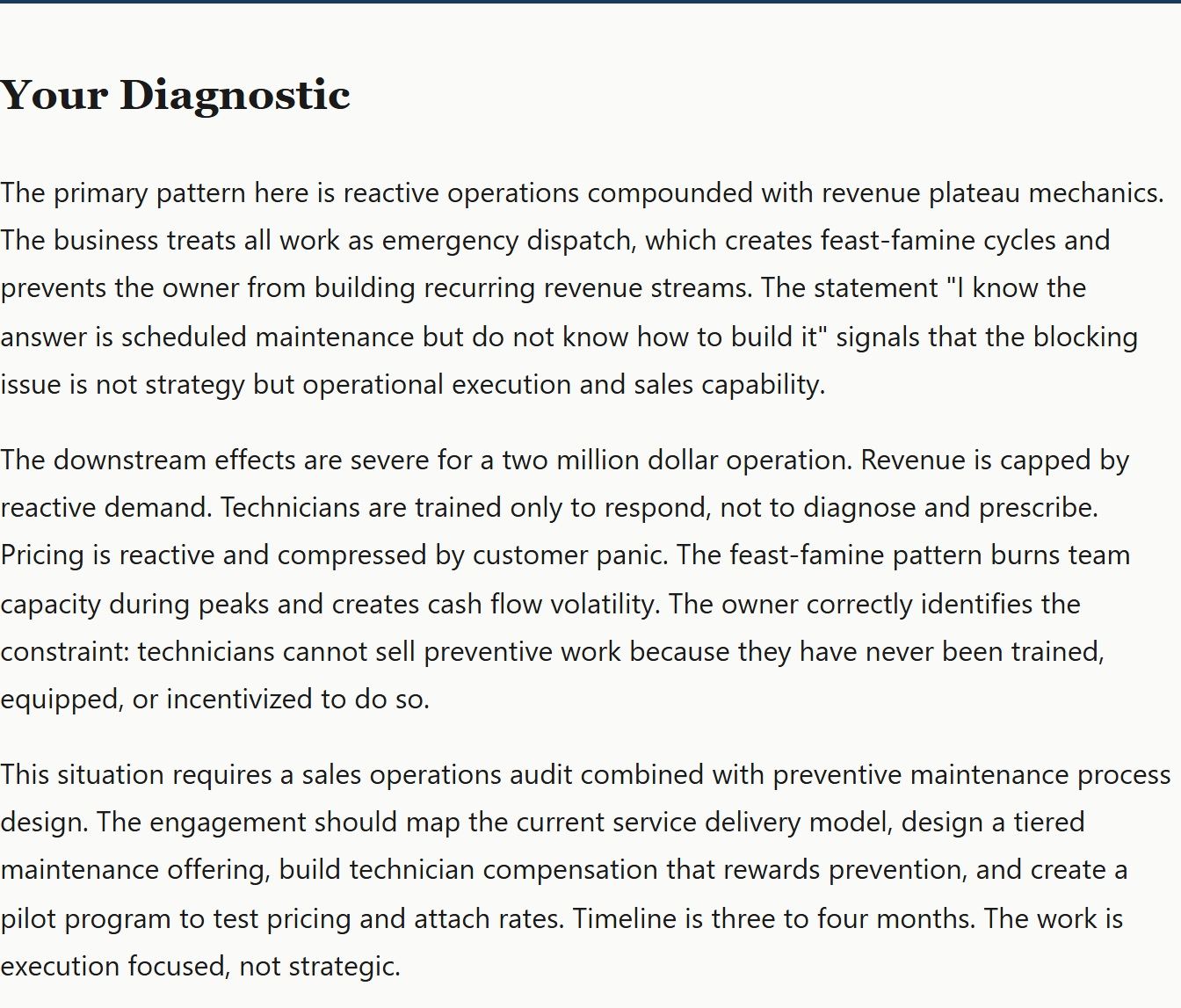
It is named reactive operations compounded with revenue plateau mechanics. It identified the mechanism as a business treating all work as an emergency dispatch, which creates feast and famine cycles.
The phrase feast and famine is the one to keep. The problem is not the average. It is the variance, and variance is what scheduled work reduces.
Where preventive maintenance is not the answer
If service quality is inconsistent, a recurring relationship amplifies whatever the experience already is, and the program will generate cancellations rather than revenue.
If the company cannot reliably schedule the visits it has already sold, the obligation becomes a complaint queue. Dispatch capacity has to exist before the commitment does.
Both tools used here are free. The written one is at businessconsultant.services, and the scored briefing is at vwcg.app. Operational groundwork sits in ten strategies to streamline operations.
The short version
Preventive maintenance is a scheduling instrument that also serves equipment. Its value is that it is the only work a service contractor can move, which makes it the only defense against a calendar written by weather.
Sell it company-scheduled, price it against what it protects rather than the labor in the visit, and measure attachment and completion before looking at revenue.
Not sure whether the constraint is demand or scheduling? Sales Roadmaps identifies which before recommending a fix. Book a working session.
Frequently Asked Questions
What is preventive maintenance in a service business?
Preventive maintenance is scheduled work performed before failure rather than after it. For a service contractor, its principal value is scheduling control. It is the only category of work whose timing the company chooses rather than the customer or the weather.
Why does reactive work create idle weeks?
Because demand is written by failure and weather rather than by the company. Payroll does not fluctuate with that demand, so a mild fortnight costs the same in wages as a busy one while producing far less revenue. The problem is variance, not average volume.
When should maintenance visits be scheduled?
In a window the company selects, not on customer request. Open scheduling fills weeks that are already busy, because customers ask during the seasons when they are thinking about their systems. Company-scheduled visits smooth demand rather than amplify it.
How should a maintenance visit be priced?
Against what it protects rather than the labor it consumes. The visit occupies a chosen slot, surfaces deferred repair work, and extends equipment life. Pricing against labor prices only the least valuable of those three purposes.
How do you measure a maintenance program?
Attachment rate, the share of completed jobs ending in enrollment, is tracked weekly by the technician. And completion rate, the share of due visits performed on schedule, is tracked monthly. Both lead revenue by roughly two quarters.
Can a busy contractor spare trucks for maintenance?
Yes, because maintenance is deferred and emergency work is not. During peak demand, the dispatcher postpones visits within the agreed window. During slow periods, the dispatcher pulls them forward. That flexibility is the entire point.