
Billable hours are time recorded against client matters and are eligible for invoicing. The revenue a firm loses is rarely lost at collection. It is lost at capture, in the gap between doing the work and writing it down. By the time anyone reviews a bill, the time to argue about it no longer exists.
Reconstructed time is understated time
Time entered days later is not a record. It is a recollection, and recollections are systematically conservative.
An attorney reconstructing Tuesday on Friday remembers the two-hour drafting block. They forget the eleven-minute call. They forget the email exchange that required reading a contract, and the corridor conversation that resolved a question. Each is trivial individually and substantial collectively.
The bias runs one way. Nobody over-reconstructs. That is why firms that move to contemporaneous capture see recorded hours rise without anyone working longer, and why the increase is not padding but recovery.
The profession is large, and the economics are tight. The Bureau of Labor Statistics counted 864,800 lawyer jobs in 2024, with 4 percent growth projected through 2034. In a market that size, a firm losing a fraction of its capture is competing with firms that are not.
Realization is three separate leaks
Firms quote one realization number and lose the ability to act on it.
Time recorded against time worked is captured. Time billed against time recorded is the billing decision, where a partner writes down before the invoice goes out. Cash collected against cash billed is a collection.
Those are three different problems with three different owners. A firm with a capture problem needs a change in habits at the desk. A firm with a billing-decision problem needs a conversation about scope and expectations. A firm with a collection problem needs credit control.
Reported as a single blended percentage, they average to a number that identifies nothing and therefore changes nothing.
A worked example, run through a real tool
The company described below is fictional. It was invented for this article and run through two free assessment tools to show what the output looks like. No real client, firm, or person is described. The figures are tool output on invented inputs, not market data or benchmarks.
The simulated profile is a personal injury and civil litigation practice. Revenue between three and eight million, sixteen to thirty staff, managing partner working sixty to seventy hours a week.
The weaknesses identified describe the concentration of authority: every fee agreement is routed to the managing partner, intake is handled by a single individual, and there is no documented follow-up process.
What the assessment returned
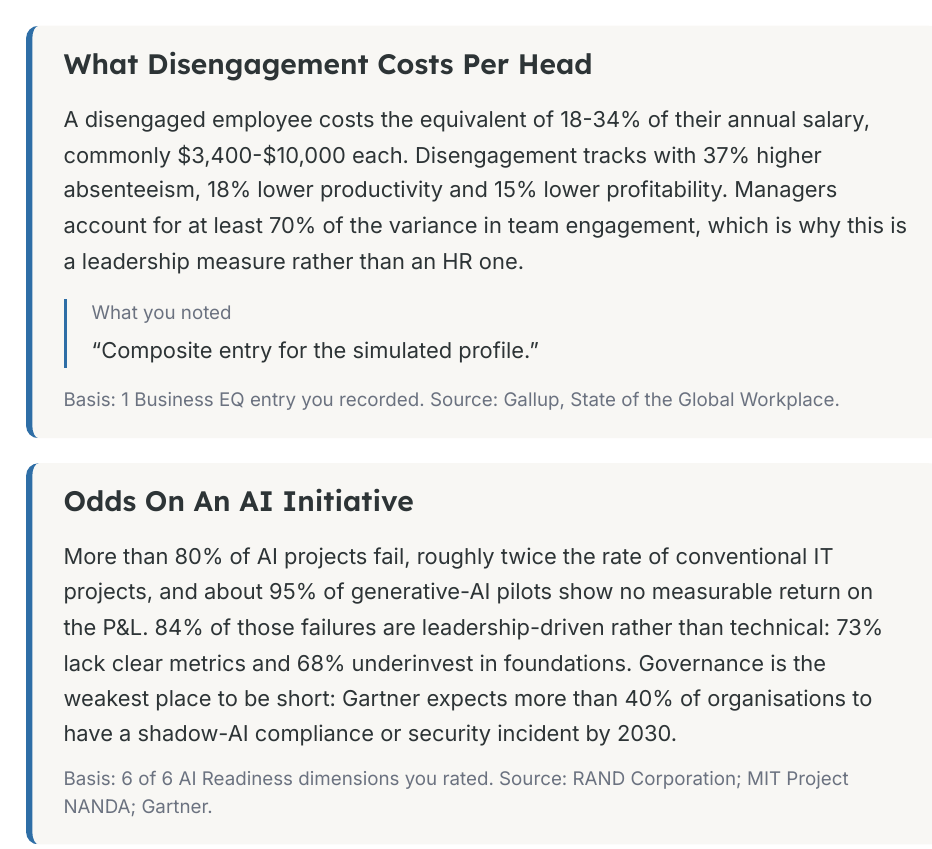
The briefing compares the profile against general SMB averages and top-quartile performers, noting on the page that the comparison is directional rather than absolute.
Founder Dependency Index: 7.1 out of 10, which the briefing describes as a critical vulnerability. Execution to Ambition Ratio: 0.68. Organizational Readiness: 44 out of 100.
A critical dependency reading matters here for a specific reason. Where one person reviews every bill before it goes out, write-downs become a private judgment rather than a recorded decision. The firm loses the ability to see the pattern.
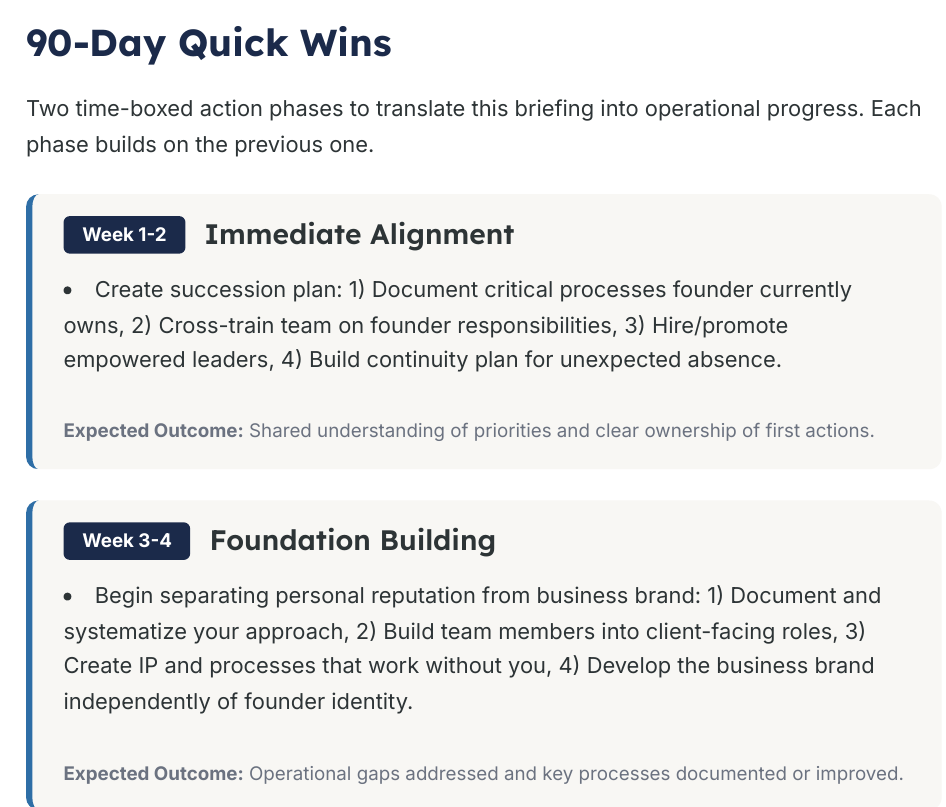
The write-down nobody records
The most expensive habit in professional services is silently reducing a bill.
A partner reviewing an invoice removes an entry that looks excessive, trims a block that would be hard to explain, or discounts to protect a relationship. Each decision is defensible. None is recorded as a decision, so the firm cannot tell whether it wrote down a hundred thousand dollars last year or four hundred thousand.
The fix costs nothing. Record the reduction with a one-word reason: scope, efficiency, relationship, or error. Four categories, entered at the moment of the write-down.
Within a quarter, the distribution tells the firm something it did not know. Efficiency write-downs point to training. Scope write-downs point to engagement letters. Relationship write-downs point at pricing. Error write-downs point at supervision.
Firms working through the financial picture should read law firm profitability.
Do you know what you wrote off last year? Sales Roadmaps builds the capture discipline and the write-down record. Start with the operations roadmap.
Contemporaneous capture is a habit problem
Every firm knows time should be entered as work happens. Very few achieve it, and the reason is not discipline.
Entry friction is the actual barrier. If recording six minutes requires opening a system, finding the matter, selecting a code, and typing a narrative, the attorney defers it. Deferred often enough, it becomes reconstruction.
The firms that succeed reduce the friction rather than increase the exhortation. Entry from the device already in hand, matter selection that remembers recent work, narratives that can be refined later rather than composed perfectly at the point of capture.
The measurement that reveals the problem is simple. Compare the timestamp of the entry against the date of the work. A firm with a median gap of 3 days has a capture problem regardless of its realization percentage.
Matter budgets change the conversation
Write-downs frequently trace back to a conversation that never happened at the start.
A matter with no budget produces a bill the client did not anticipate, followed by a discussion in which the firm reduces the bill to preserve the relationship. The reduction is recorded as a discount when its actual cause was an absent expectation.
A budget at engagement, with a defined checkpoint when work approaches it, converts that into a conversation before the cost is incurred. The client can authorize, narrow the scope, or accept. All three outcomes are better than a surprise invoice.
That is not a billing control. It is a scoping control that removes a write-down category at the source rather than managing it at the end.
Utilization and realization move independently
Two firms with identical revenue can have opposite problems, and one number cannot tell them apart.
Utilization is the percentage of available time spent on client work. Realization is how much of that work converts to cash. A firm with high utilization and low realization is busy and undercompensated. A firm with low utilization and high realization is well run and underused.
The responses are opposite. The first needs discipline in pricing and scope. The second needs business development. Treating either with the other approach makes it worse.
Reported together as a single profitability figure, both firms look mediocre, and neither learns anything. Reported separately, each has a clear next action.
Supervision shows up in the write-down data
The write-down category most firms find uncomfortable is efficiency, because it is a judgment about the person who did the work.
Recorded honestly over a quarter, efficiency write-downs cluster. They concentrate on particular people, particular types of matter, or particular stages of work. That is not an indictment. It is the most direct training signal a firm will ever get, and it is currently being discarded at every invoice review.
A junior consistently written down on document review needs a different instruction rather than a different job. A matter type consistently written down across everyone requires a different pricing model or process.
Both conclusions are available only if someone records the reason at the time the reduction is made.
Time entry is a management signal, not just a billing input
The firms that treat timekeeping purely as a billing input miss what it tells them about the work.
Recorded properly, time shows which matter types consume more than expected, which stages overrun, and which clients generate disproportionate unbilled effort. All three are pricing and staffing questions, and none of them are visible from revenue.
A partner who knows that a particular matter type routinely takes forty percent longer than quoted can either price it differently or resource it differently. Without capture, the same partner knows only that the year felt busy, and the margin felt thin.
That is the argument to make internally when capture discipline is resisted. It is not about billing more aggressively. It is about knowing what the work costs.
The sixty-second version
The same situation was typed, in plain language, into a second free tool that returns a written diagnosis rather than scores.
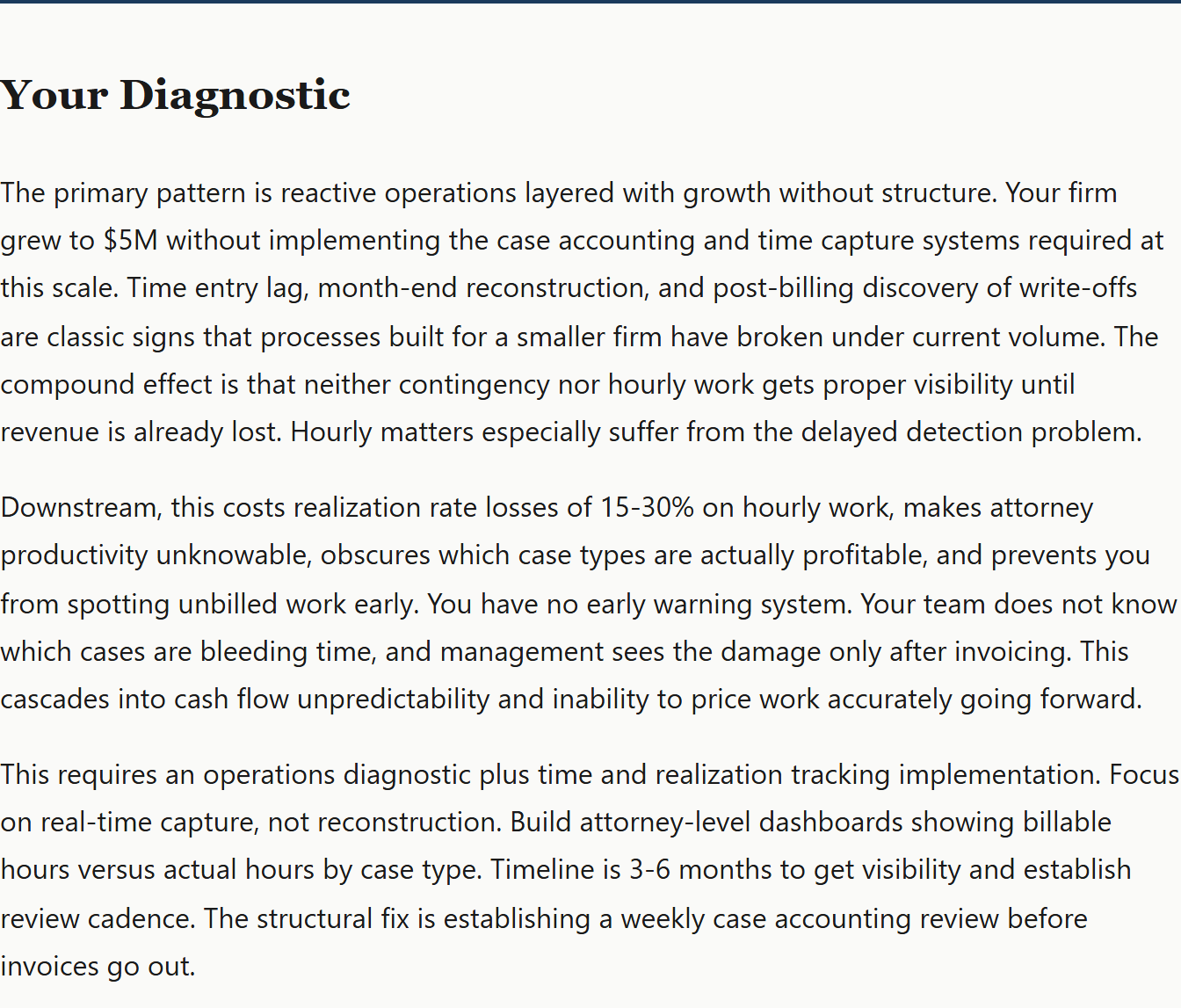
It is named reactive operations compounded by growth without structure, and it is observed that the firm had reached its current size without the systems that size requires.
That framing applies precisely to timekeeping. A practice of five people can run on memory and goodwill. At twenty-two, the informal version silently loses a share of everything it produces, and nobody can say how much.
Where this is not the constraint
If the firm is predominantly contingency-based, hourly capture matters less for revenue, though it still matters for understanding matter cost and staffing decisions.
If capture is already contemporaneous and write-downs are recorded with reasons, the leak is elsewhere, and collection or pricing is the higher priority.
Both tools used here are free. The written one is at businessconsultant.services, and the scored briefing is at vwcg.app. Operational framing sits in law firm operations consultant.
The short version
Billable revenue leaks first at capture, then at the silent write-down, then at collection. Firms measure the third, argue about the first, and never record the second.
Reduce entry friction, so time is captured as it happens. Record every write-down with a one-word reason. Set budgets at engagement, so the scope conversation precedes the invoice rather than following it.
Not sure whether you have a capture, billing or collection problem? Sales Roadmaps separates the three. Book a working session.
Frequently Asked Questions
Why is reconstructed time understated?
Because recollection is systematically conservative. An attorney rebuilding a day from memory recalls long blocks of work but not brief calls, email exchanges requiring review, or corridor conversations. The bias runs one way, so recorded hours rise when capture becomes contemporaneous.
What is the realization rate?
Realization is usually quoted as one figure. It contains three separate leaks: time recorded against time worked, time billed against time recorded, and cash collected against cash billed. Each has a different cause and a different owner.
Why record reasons for write-downs?
Because a silent reduction is a private judgment rather than a recorded decision. Categorizing each write-down as scope, efficiency, relationship, or error reveals a distribution that points to training, engagement letters, pricing, or supervision, respectively.
How do you improve contemporaneous time entry?
By reducing entry friction rather than increasing exhortation. Capture from the device already in hand, matter selection that remembers recent work, and narratives that can be refined later instead of being composed perfectly at the moment of entry.
How can a firm tell it has a capture problem?
Compare the timestamp of each time entry with the date the work was performed. A median gap of several days indicates reconstruction rather than recording, regardless of what the reported realization percentage suggests.
How do matter budgets reduce write-downs?
They move the scope conversation before costs are incurred. Without a budget, an unanticipated invoice leads to a relationship-preserving reduction. That gets recorded as a discount when its real cause was an absent expectation at the outset.