Account management is the deliberate effort to retain and grow existing clients after the sale. Most firms treat it as something that happens naturally because someone is always in contact. That assumption is why the cheapest revenue available to a business is also the revenue least likely to be pursued.
Contact is not coverage
Every firm believes its clients are looked after, and the belief rests on activity rather than evidence.
Somebody speaks to the client. Work gets delivered. Problems get solved. None of that is account management, because none of it involves a plan for what the relationship should become or a person accountable for getting it there.
The distinction shows up at renewal. A firm with contact discovers what the client thinks when the contract is already in question. A firm with coverage knew six months earlier, because someone was asking questions that nobody had to be prompted to ask.
The occupation is substantial. The Bureau of Labor Statistics counted about 1.6 million wholesale and manufacturing sales representative jobs in 2024, with 1 percent growth projected through 2034. Very few of those roles are defined around retention rather than acquisition.
The economics are not close
Expansion revenue is cheaper than new revenue by a margin large enough to warrant a strategy change.
A new client requires marketing spend, a sales cycle, an evaluation, a procurement process, and a period of onboarding before any margin appears. An existing client requires a conversation with someone who already trusts the firm and already knows what the work looks like.
Firms nonetheless staff the expensive path and leave the cheap one unowned. The reason is structural rather than stupid. Acquisition has a role attached to it, a target, and a commission. Retention usually has none of those, so it belongs to nobody in the specific sense that no one is measured against it.
A worked example, run through a real tool
The company described below is fictional. It was invented for this article and run through two free assessment tools to show what the output looks like. No real client, company, or person is described. The figures are tool output on invented inputs, not market data or benchmarks.
The simulated profile is a business-to-business commercial services firm. Revenue between eight and fifteen million, thirty-one to sixty staff, ten to twenty years in business, owner working fifty to sixty hours a week.
The weaknesses described are a lack of structure rather than a lack of care. There is no definition of a qualified opportunity. The forecast is built on how each representative feels, and results are never measured by representative or by source.
What the assessment returned
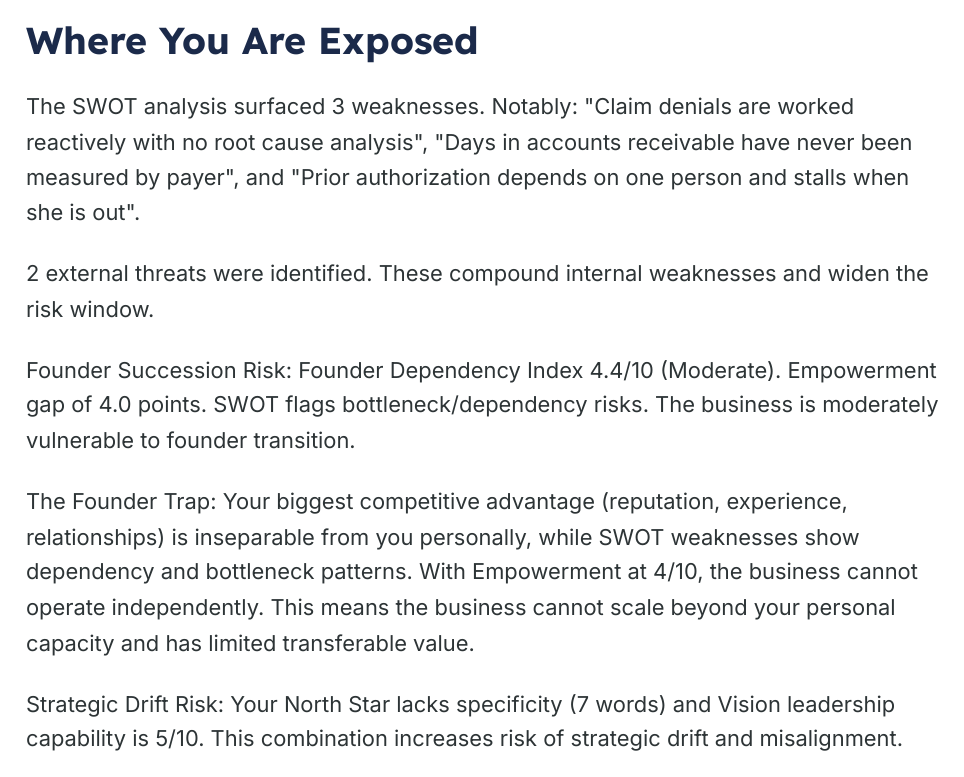
The cost section states each finding in the unit, and its own evidence uses. It names which part of the assessment produced the finding rather than presenting a single blended figure.
Execution to Ambition Ratio: 0.58. Founder Dependency Index: 4.0 out of 10. Organizational Readiness: 58 out of 100.
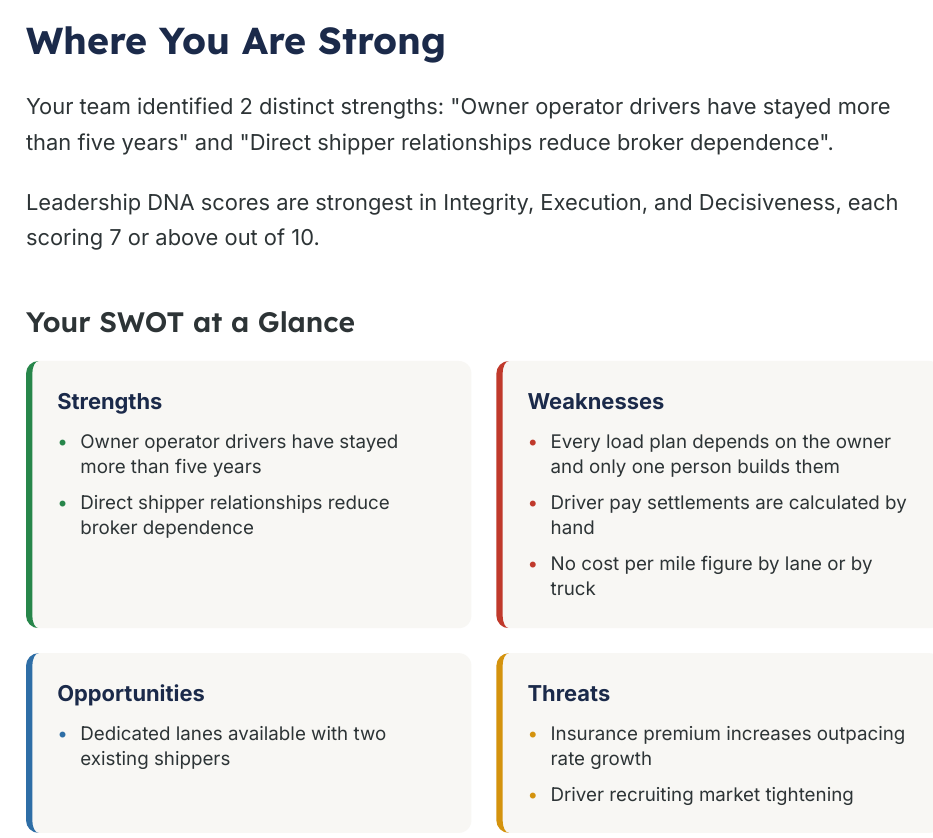
The recommendations are sequenced by urgency rather than by ease, which is the opposite of how most internal improvement lists get ordered.
That ordering matters here. Account structure is the kind of work that is never urgent on any given Tuesday and is extremely expensive in aggregate.
Segment before assigning
Treating every client identically guarantees the wrong allocation of attention.
A few clients usually represent a large share of revenue and a larger share of growth potential. Others are profitable and stable and need reliability rather than attention. A third group consumes disproportionate effort for modest return.
Those three groups need different coverage models. The first justifies a named owner and a written plan. The second justifies a scheduled review and a responsive service. The third justifies a decision about whether the relationship should continue in its current shape.
Segmenting takes an afternoon with a revenue report and produces a staffing answer that no amount of general effort will reach.
Firms restructuring the commercial function should read sales operations roadmap.
Who owns your largest client this quarter? Sales Roadmaps builds the coverage model. Start with the operations roadmap.
Single-threaded accounts are fragile
The most common structural risk in a client base is invisible until it fires.
An account held together by one relationship on each side is one resignation away from a competitive review. The person who championed the firm leaves, and the replacement has no history with anyone. A relationship built over years restarts from zero with a procurement process attached.
Mapping is the defense. For each significant account, who are the people involved, what does each of them care about, and who inside the firm knows them? Where the map shows a single line, that is a risk to close deliberately rather than a fact to accept.
Multithreading is unglamorous work. It means introducing colleagues, arranging conversations that have no immediate commercial purpose, and accepting that some of them will produce nothing. It is also the difference between a client base and a set of personal relationships that happen to be billed by the same company.
The review nobody schedules
The highest-return activity in account management is a meeting most firms never hold.
A structured review is held quarterly or half-yearly. It covers what was delivered, what the client is trying to achieve next, what is not working, and what else the firm could help with. It is neither a social lunch nor a renewal negotiation.
The reason it works is that it surfaces problems while they are still cheap and opportunities while they are still open. Clients rarely volunteer either. They raise problems when they have become intolerable, and they buy elsewhere when nobody asked.
Scheduling it in advance for the year removes the recurring decision about whether now is a good time. It never is.
Onboarding decides the next three years
The period that most determines whether a client stays is the one immediately after they sign.
A client whose first ninety days are smooth forms a view of the firm that survives later problems. A client whose start is disorganized spends the rest of the relationship interpreting every issue as confirmation. That view is set early and is expensive to revise.
Firms nonetheless staff onboarding lightly, because the sale is complete, and the delivery team is busy. A short written handover costs an hour. It covers what was promised, what matters to this client, and who is responsible. It prevents the most common early failure: a client repeating themselves to an unfamiliar audience.
Health signals beat renewal dates
Waiting for a renewal to discover a client is unhappy is waiting far too long.
Usable signals already exist in most firms and go unread. Volume trend against the previous period. Response latency on communication. Number of contacts engaged this quarter versus last. Whether the client has raised the same issue more than once. Whether the original sponsor is still in the role.
None of those requires a system. A simple sheet per significant account, updated monthly, produces a view that identifies which relationships are drifting long before the drift becomes a decision.
Firms that do this describe the change as removing surprises rather than increasing revenue. The revenue follows, but the first benefit is the absence of the phone call that arrives too late.
Process design sits in sales process consultant.
The sixty-second version
The same situation was typed, in plain language, into a second free tool that returns a written diagnosis rather than scores.
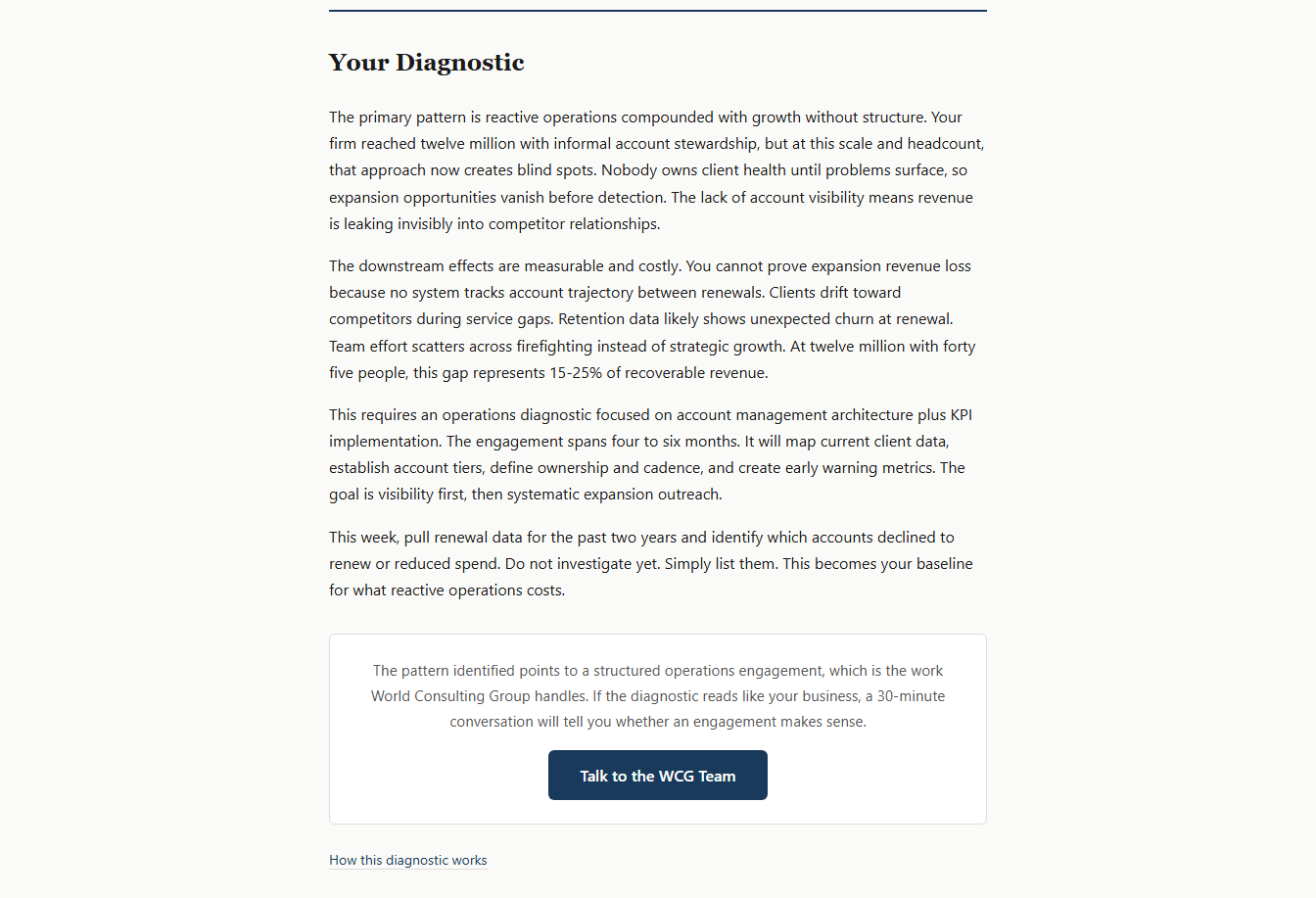
The diagnosis frames this as a structural gap rather than an effort gap. That is the correct reading of a firm where clients are well served, and no individual is accountable for what the relationship becomes.
Structure is the operative word. Adding effort to an unowned function produces busier people and the same result, because the missing element is assignment, not energy.
Where this is not the constraint
If the client base is very small, formal account management is overhead, and the owner already holds the relationships in a way that no process can improve.
If delivery quality is unreliable, that comes first. No amount of relationship work can retain a client whose work is being done poorly.
Both tools used here are free. The written one is at businessconsultant.services, and the scored briefing is at vwcg.app.
The short version
Existing clients are the cheapest source of revenue and the least likely to be pursued, because acquisition has a role attached, whereas retention usually does not.
Segment the client base into three coverage tiers and name an owner for the top one. Map the relationships and close the single-threaded ones. Schedule structured reviews a year in advance and track a handful of health signals monthly, rather than waiting until renewal.
Expansion revenue sitting unclaimed? Sales Roadmaps assigns it. Book a working session.
Frequently Asked Questions
What is account management?
The deliberate work of keeping and growing existing clients after the sale, with a named owner and a written plan. Regular contact during delivery is not account management because it involves no one accountable for what the relationship becomes.
Why is expansion revenue cheaper than new revenue?
A new client requires marketing spend, a sales cycle, an evaluation, procurement, and onboarding before margin appears. An existing client requires a conversation with someone who already trusts the firm and understands the work.
How should a client base be segmented?
Into three coverage tiers. A small group representing most revenue and growth potential justifies a named owner and a plan. A stable, profitable group needs scheduled reviews. A third group consuming disproportionate effort needs a decision about its shape.
What is a single-threaded account?
An account held together by one relationship on each side. When that person leaves, years of history restart from zero with a procurement process attached. Mapping contacts per account exposes these before they fire.
What belongs in an account review?
What was delivered, what the client is trying to achieve next, what is not working, and what else the firm could help with. It is neither a social meeting nor a renewal negotiation, and it should be scheduled a year in advance.
What health signals predict client loss?
Volume trend against the prior period, response latency, number of contacts engaged this quarter versus last quarter, repeated unresolved issues, and whether the original sponsor is still in the role. None requires a system to track.