DOT compliance is the set of records and practices a motor carrier must maintain to operate legally. Most small carriers run it through a single individual who also holds another full-time role. That arrangement works until it does not, and its failure mode is a compliance review rather than a gradual decline.
Compliance is a records obligation before it is a safety one
Carriers tend to think of compliance as driving behavior. Auditors think of it as documentation.
A driver qualification file must contain specific items for every driver. Application, motor vehicle record checks at defined intervals, road test or equivalent, medical certification, and annual review of driving record. Missing any one is a finding, regardless of how safely that driver operates.
Vehicle maintenance files require documented periodic inspections and repair records retained for a defined period. Hours-of-service records require retention and supporting documents to corroborate them.
None of this is difficult. All of it is cumulative, and gaps do not announce themselves.
The population is enormous. The Bureau of Labor Statistics counted about 2.2 million heavy and tractor-trailer driver jobs in 2024, with 4 percent growth projected through 2034. Every one of those drivers carries a file that has to be right.
CSA scores are a leading indicator
Scores creep before they jump, which makes them the most useful early warning a carrier has.
The categories that move first in a small fleet are usually hours-of-service compliance and vehicle maintenance. Both reflect process rather than intent. A driver logging a violation once is a behavior. A pattern across drivers is that the system is not catching anything.
Rising scores also raise insurance costs and can affect which shippers contract, so the financial consequences arrive well before any regulatory ones. That makes the score a business metric rather than a safety-department metric.
Checking monthly costs nothing and gives months of warning. Most small carriers check after they receive a letter.
A worked example, run through a real tool
The company described below is fictional. It was invented for this article and run through two free assessment tools to show what the output looks like. No real client, company, or person is described. The figures are tool output on invented inputs, not market data or benchmarks.
The simulated profile is a regional trucking and freight company. Revenue between three and eight million, sixteen to thirty staff, ten to twenty years in business, owner working sixty to seventy hours a week.
The weaknesses described concern concentration rather than incompetence: every load plan depends on the owner, settlements are calculated by hand, and there is no cost-per-mile figure by lane or truck.
What the assessment returned
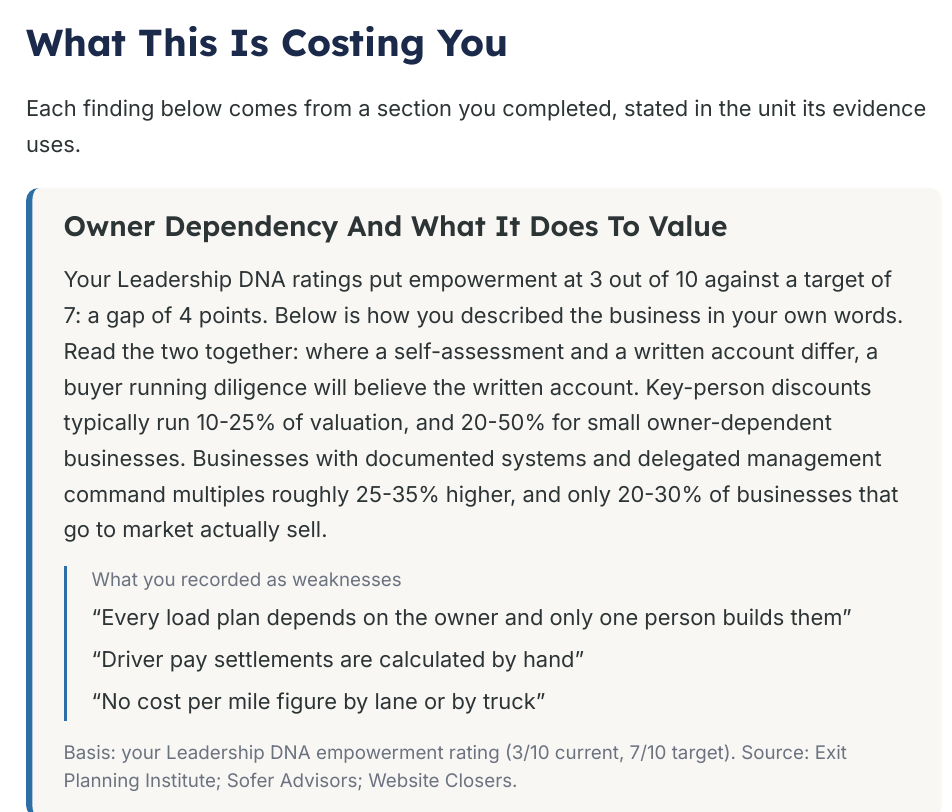
The briefing converts the inputs into a cost narrative and names its basis beside each finding rather than reducing everything to a single number.
The relevant pattern for compliance is the same one that produces the margin problem. Work that depends on one person has no second path. A compliance function with no second path fails silently because whoever holds it is also the one who would notice.
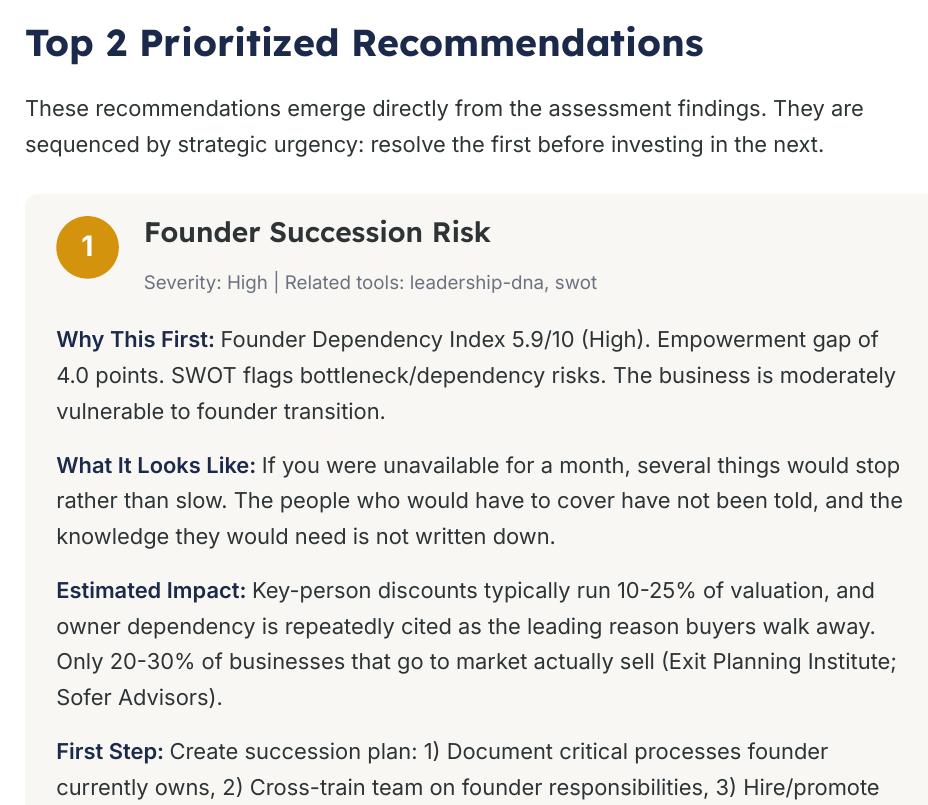
The briefing returns three figures for this profile. Founder Dependency Index: 5.9 out of 10, described as a substantial single-person risk, with the owner remaining the decision-making point for work that the business cannot reroute. Execution to Ambition Ratio 0.65, capacity falling short of ambition. Organizational Readiness 42 out of 100.
Both readings move together, which is the signature of a capacity problem rather than a strategy problem. The plan is not wrong. There are not enough people to execute it, and compliance is the function where that shortage stays invisible the longest.
Supporting documents are where hours of service fail
Electronic logging captures driving time. It does not, by itself, prove the log is accurate.
Reviews compare logs against supporting documents: bills of lading, fuel receipts, toll records, dispatch records, anything showing the vehicle in a place at a time. A log that contradicts a fuel receipt is a falsification finding rather than a paperwork one, and it is treated far more seriously.
The control is retention and matching rather than more logging. Keep the supporting documents for the required period, filed, so they can be located by driver and date, and spot-check a handful against logs each month.
The person doing compliance cannot audit compliance
This is the structural issue, and it is not solved by hiring more carefully.
When one individual maintains driver files, tracks maintenance intervals, monitors hours of service, and is also the one who catches omissions, there is no control. There is a diligent employee who is a different thing and fails differently.
The minimum viable separation in a small carrier is a quarterly file review performed by someone else against a written checklist. Not an audit, not a consultant. A second set of eyes with a list, four times a year.
That single practice converts personal diligence into a process, and it is affordable at twenty-five trucks.
Carriers reviewing their broader risk posture should start with cargo insurance requirements.
Is anyone checking the person who checks compliance? Sales Roadmaps builds the review cadence a small carrier can actually staff. Start with the operations roadmap.
What a compliance review examines
Reviews are more predictable than carriers expect, which makes preparation tractable.
Driver qualification files for completeness and currency. Hours-of-service records with supporting documents. Vehicle maintenance and inspection records for the retention period. Drug and alcohol testing program records, including the random selection process. And whether the carrier can produce all of it on request within the time allowed.
The last item defeats carriers that are otherwise compliant. Records that exist but cannot be located quickly are treated much like records that do not exist.
Knowing the list turns preparation into a checklist exercise rather than an open-ended worry.
Succession risk in the compliance function
The scenario worth planning for is not an audit. It is the compliance person leaving.
If one individual holds the files, the intervals, the vendor relationships, and the knowledge of where everything sits, their departure creates immediate exposure. No replacement resolves that quickly. The new person inherits an undocumented system and a clock.
The mitigation is ordinary and unglamorous. A written procedure for each recurring obligation, a shared location for records rather than a personal one, and a calendar of intervals held outside any individual memory.
That work also happens to be exactly what makes a review survivable, which is why it repays doing before either event forces it.
The drug and alcohol program is usually the weakest file
Testing programs fail review more often than driving records do, and almost always on process rather than on results.
The random selection must be genuinely random, drawn from the correct pool, at the required rate, and spread throughout the year. Carriers that batch selections into one or two rounds fail the spread requirement even when the annual percentage is right.
Records must show the selection method, the pool for each draw, the timing of notifications, and the outcome, including any refusals. Refusals are treated as positives, and a poorly documented refusal is worse than a documented positive.
Most small carriers use a consortium, which handles the mechanics but does not transfer the obligation. The carrier remains responsible for producing the records, so the file must exist on the carrier’s side rather than only at the vendor’s.
The sixty-second version
The same situation was typed, in plain language, into a second free tool that returns a written diagnosis rather than scores.
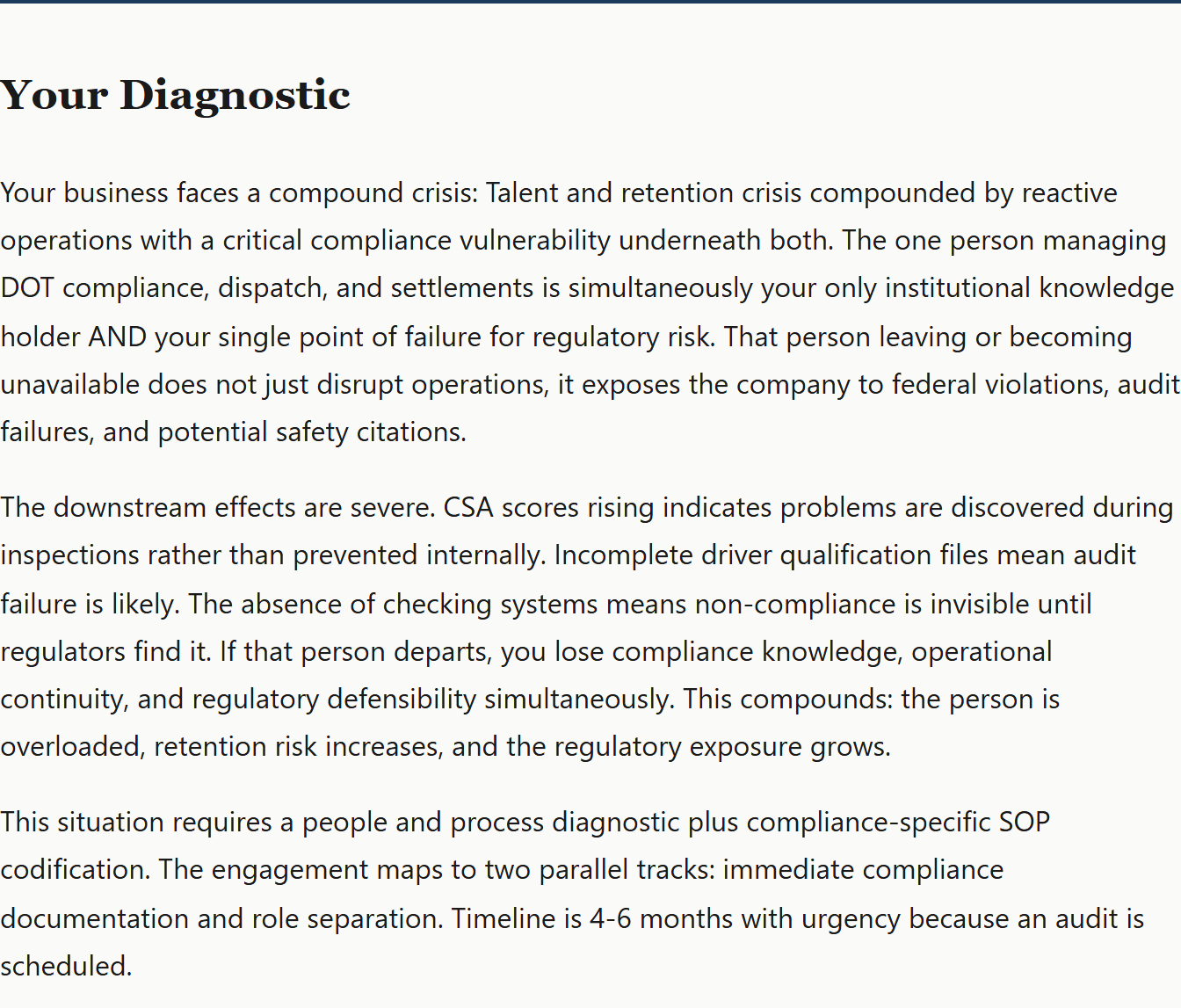
It described a compound condition rather than a single problem: a talent and retention issue compounded by reactive operations, with a compliance vulnerability underneath both.
Underneath is the accurate word. Compliance exposure does not present as a compliance problem. It presents as one overloaded person, and it is discovered when that person is unavailable.
Where this is not the priority
If the carrier already has a written procedure per obligation, records in a shared location, and a quarterly second review, the control is sound, and the effort belongs elsewhere.
If the fleet is small enough that the owner personally knows every file, the exposure is lower, though the succession risk is higher.
Both tools used here are free. The written one is at businessconsultant.services, and the scored briefing is at vwcg.app. New carriers should also review motor carrier insurance requirements.
The short version
DOT compliance is a records discipline that most small carriers run as the diligence of one person. Diligence is not a control, because the person who would catch the omission is the person who made it.
Write the procedures, put the records somewhere shared, calendar the intervals, and have someone else review against a checklist quarterly.
Want the compliance function to survive one person leaving? Sales Roadmaps documents it before that happens. Book a working session.
Frequently Asked Questions
What does DOT compliance require?
Complete driver qualification files, hours of service records with supporting documents, vehicle maintenance and inspection records retained for the required period, and a compliant drug and alcohol testing program. All of it must be producible on request within the time allowed.
What is in a driver qualification file?
The application requires motor vehicle record checks at defined intervals, a road test or accepted equivalent, current medical certification, and an annual review of driving record. A missing item is a finding regardless of how safely the driver operates.
How often should CSA scores be checked?
Monthly. Scores creep before they jump, and the categories that move first in small fleets are usually hours of service and vehicle maintenance. Checking monthly provides months of warning at no cost. Most carriers check only after receiving a letter.
Why is one compliance person a risk?
Because the individual maintaining the records is also the only person in a position to notice an omission. That is diligence rather than control. Having someone else conduct a quarterly review against a written checklist turns it into a process.
What does a compliance review examine?
Driver qualification files, hours of service records, supporting documents, vehicle maintenance and inspection records, and drug and alcohol program records, including random selection. Reviewers also assess whether records can be produced promptly.
What happens if the compliance person leaves?
The replacement inherits an undocumented system and an active clock. Mitigation is written procedures per obligation, records in a shared rather than personal location, and interval calendars that exist outside the memory of any individual.