
Law firm marketing is the system a practice uses to attract potential clients and convert them into signed cases while staying within the advertising rules enforced by its bar association. The marketing that fills the top of the funnel matters far less than the intake and follow-up that turn an inquiry into a client.
A study of 5,071 negative law firm reviews found that 89.1 percent describe a business-process failure, with responsiveness the largest single mode at 50.6 percent.
Where most law firm marketing goes wrong
The typical firm treats marketing as an advertising problem. It buys more ads, ranks for more keywords, runs more campaigns, and then judges the result by how many calls and form submissions arrive.
That is the wrong scoreboard. A lead is not revenue. A signed case is revenue, and the distance between the two is where most firms quietly lose money.
The failure is rarely a shortage of leads. It is a leaky intake process. A potential client calls during a hearing and reaches voicemail. A web form sits unanswered for two days while the prospect hires the firm that called back in ten minutes. A promising inquiry never gets a second follow-up.
The profession is not short of competitors. The Bureau of Labor Statistics counted 864,800 lawyer jobs in 2024 and projects 4 percent growth through 2034. In a market that size, the firm that answers first usually signs the case.
Client intake response time is the whole game
Intake is an operations function that most firms staff as an afterthought.
The person answering the phone is often the least trained and most interrupted individual in the office. They take a message. The message goes to an attorney who is in court. The attorney returns the call that evening, by which point the prospect has already spoken to two other firms.
Response time is the single most controllable variable in legal marketing, and it costs nothing to change. It requires only that someone owns it, that inquiries route to a person rather than a voicemail box, and that the standard states minutes rather than intent.
A worked example, run through a real tool
The company described below is fictional. It was invented for this article and run through two free assessment tools to show what the output looks like. No real client, firm or person is described. The figures are tool output on invented inputs, not market data or benchmarks.
The simulated profile is a personal injury and civil litigation practice. Revenue between three and eight million, sixteen to thirty staff, ten to twenty years in operation, managing partner working sixty to seventy hours a week. The stated goal was to convert more inquiries.
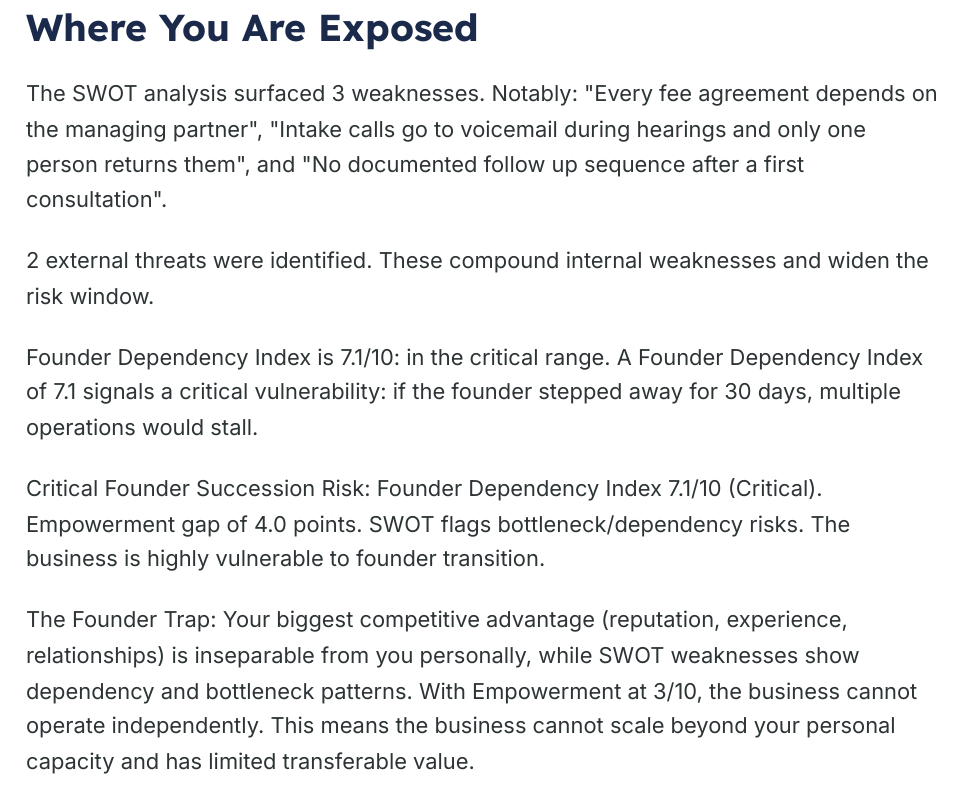
Advertising was not the weakness. The three items entered at the highest confidence were all downstream of the phone ringing:
- Every fee agreement depends on the managing partner
- Intake calls go to voicemail during hearings, and only one person returns them
- No documented follow-up sequence after a first consultation
What the assessment returned
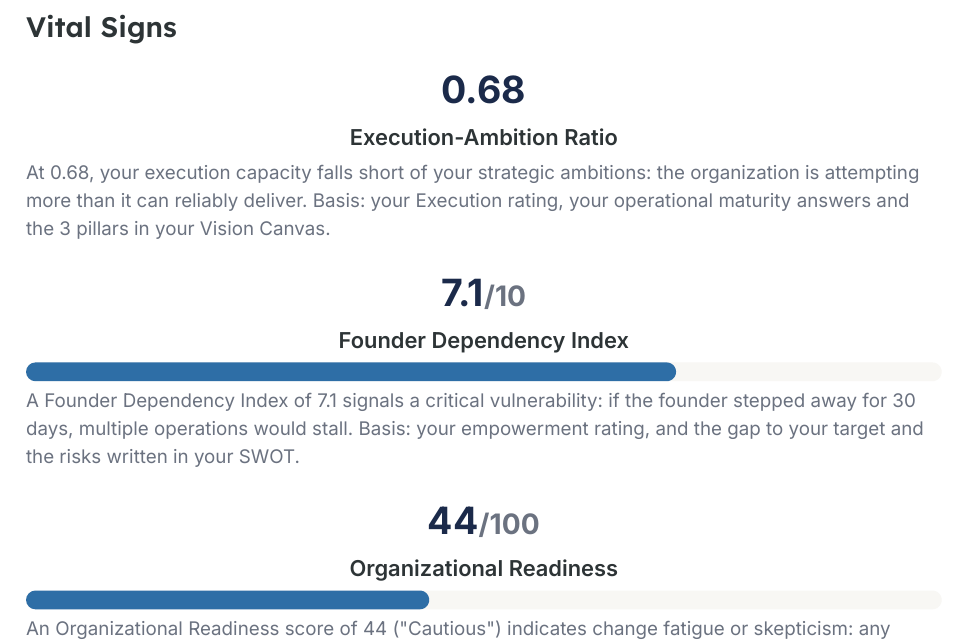
Founder Dependency Index: 7.1 out of 10. The briefing states that this signals a critical vulnerability and that if the founder stepped away for 30 days, multiple operations would stall.
Execution to Ambition Ratio: 0.68. Execution capacity falls short of stated ambitions, and the organization is attempting more than it can reliably deliver.
Organizational Readiness: 44 out of 100.
Both readings point in the same direction. The firm has a demand it cannot process, and the bottleneck is a person rather than a system.
Marketing inside the bar rules
Every state bar restricts attorney advertising, and the specifics vary. The common threads are consistent enough to plan around.
No guarantees of outcome. No claims that cannot be substantiated. No comparative superiority implies a result. Testimonials and case results are frequently permitted with a disclaimer, sometimes restricted, and occasionally prohibited outright.
The practical consequence is that firms cannot differentiate on promises. What remains is responsiveness, clarity, and process, which are the things prospects experience directly and which no rule prevents a firm from being better at.
Firms working on the wider picture should read law firm growth strategy.
Losing cases between the call and the retainer? Sales Roadmaps builds the intake and follow-up system that converts the demand you already pay for. Start with the operations roadmap.
The follow-up sequence after a first consultation
Most firms treat the consultation as the decision point. The prospect decides afterward, usually over several days, often after speaking with family.
A documented sequence covers that gap. A same-day summary of what was discussed and what happens next. A check-in two days later. A final contact at one week before the file is closed. Four contacts before giving up is a reasonable standard, and most firms stop after one.
None of that requires new software or additional spend. It requires that the sequence be in writing and that someone other than the attorney own its execution.
Fee agreement authority as a bottleneck
The item that drives the dependency score is the one that firms defend most readily. The managing partner reviews every fee agreement because the stakes are real, and the judgment is genuine.
The cost is a queue. Every agreement waits for one person who is frequently in court, and every day of delay is a day the prospect can hire someone else.
The workable middle is a threshold. Standard matters below an agreed value proceed on a template with associate sign-off, and anything unusual still routes to the partner. That converts a universal bottleneck into an exception path.
Measuring law firm marketing properly
Cost per lead is the metric most firms track and the least useful one they could choose.
The number that matters is cost per signed case, and it can only be calculated if inquiries are tracked through to retainer. Firms that measure only the top of the funnel optimize for volume and are surprised when more leads produce the same revenue.
Two supporting measures make it actionable. Response time to first contact, measured in minutes. And contacts per inquiry before closure, measured as a count. Both are operational, both are cheap, and both move signed cases more than any change in ad spend. Deeper financial framing sits in law firm profitability.
The channels that work, and the order to fix them
Channel choice matters less than most firms assume, and it matters last.
Referral relationships with other attorneys produce the highest conversion because the prospect arrives pre-qualified and pre-trusted. They are also the slowest to build and the least scalable, which is why firms under revenue pressure neglect them.
Paid search captures active intent, converts well, and is expensive precisely because everyone knows that. It punishes slow intake harder than any other channel, since the searcher is contacting several firms in the same sitting.
Content and organic search compound slowly and cost little per inquiry once established. They suit practice areas where the client researches before calling, which describes most civil matters and almost no emergency ones.
The order is the point. A firm with a leaking intake process should fix the intake first. Every channel feeds the same broken step, and each one makes the leak more expensive.
Why this is an operations problem, not a marketing one
The vocabulary causes the mistake. Everything from the ad to the retainer gets filed under marketing, so it lands with whoever handles marketing. That person has no authority over intake staffing, attorney availability, or fee agreement approval.
Every fix named above is an operations decision. Who answers the phone, and what happens when they cannot reach an attorney? What the follow-up sequence is and who executes it. What value threshold lets an agreement proceed without partner review?
None of those sit with a marketing agency, which is why firms cycle through agencies while the signed case rate stays flat.
The sixty-second version
The same situation was typed, in plain language, into a second free tool that returns a written diagnosis rather than scores.
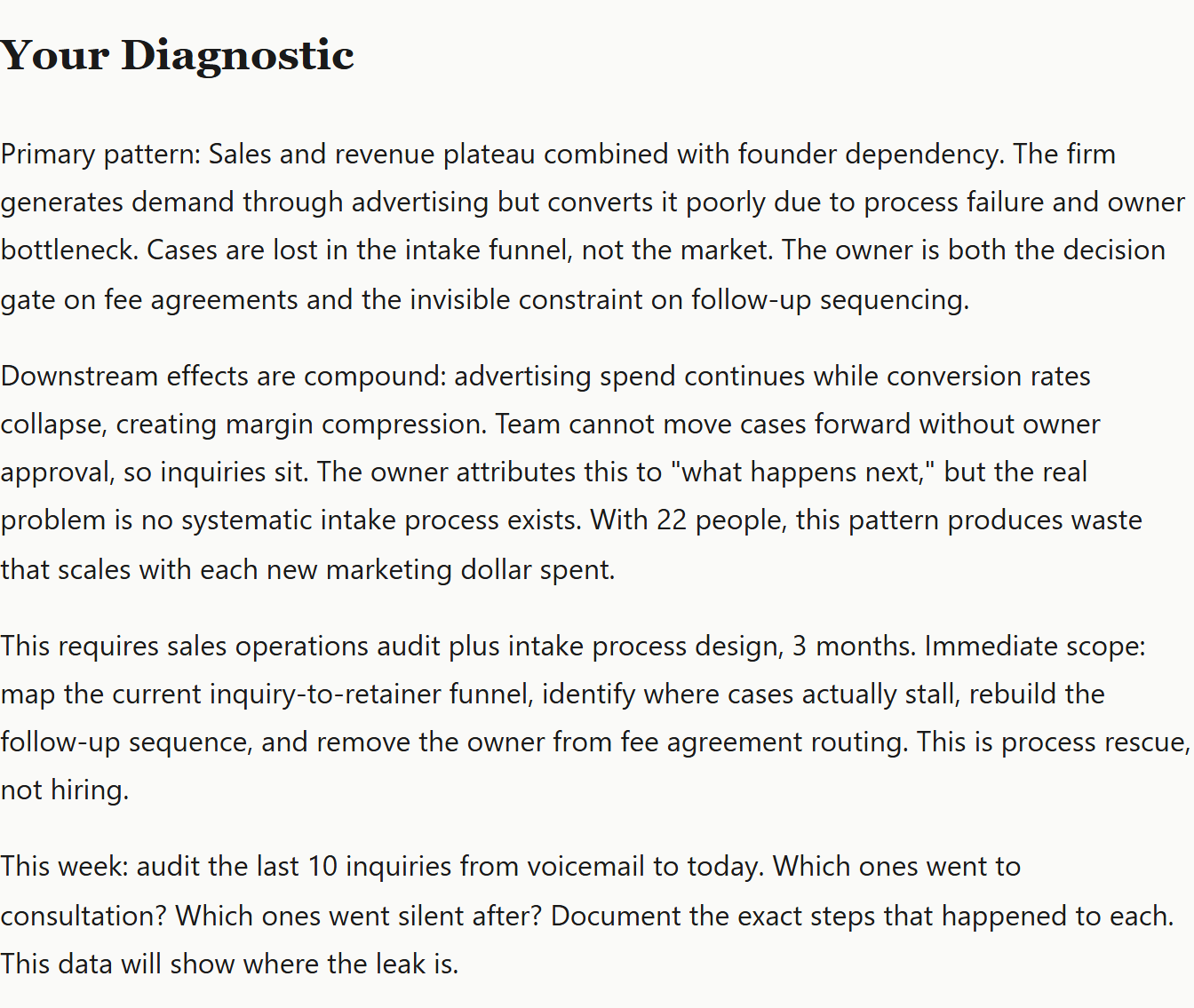
It is named a sales and revenue plateau combined with founder dependency, and states the mechanism plainly. The firm generates demand through advertising but converts it poorly due to process failures and an owner bottleneck. Cases are lost in the intake funnel, not the market.
The closing observation is the one worth quoting to a partner who wants a bigger ad budget. With twenty-two people, this pattern produces waste that scales with every new marketing dollar spent.
Where more marketing is the right answer
If intake is already fast, documented, and measured, and the signed case rate is healthy, then volume genuinely is the constraint, and advertising is the correct investment.
The test is simple. If the firm cannot state its response time in minutes and its contacts per inquiry as a number, the constraint is not demand. Both tools used here are free. The written one is at businessconsultant.services, and the scored briefing is at vwcg.app. Operational context sits in law firm operations consultant.
The short version
Law firm marketing is judged at the retainer, not at the click. Most firms pay more attention while losing the attention they already paid to, somewhere between the phone ringing and the agreement being signed.
Fix the response time, write the follow-up sequence, set a fee-agreement threshold, and measure cost per signed case. Then buy more ads.
Want to know where the cases are leaking? Sales Roadmaps maps the intake path before recommending spend. Book a working session.
Frequently Asked Questions
What is law firm marketing?
Law firm marketing is the system a practice uses to attract potential clients and convert them into signed cases while staying within bar advertising rules. It covers demand generation, intake, and the follow-up that turns an inquiry into a represented client.
Why do law firms waste money on marketing?
Because they measure leads rather than signed cases. Additional advertising in a leaky intake process produces more inquiries at the same conversion rate, thereby raising costs without increasing revenue. The waste scales with every additional marketing dollar.
What are the bar rules for attorney advertising?
Rules vary by state, but common restrictions prohibit guaranteeing outcomes, making unsubstantiated claims, and implying comparative superiority. Testimonials and case results are often permitted with disclaimers. Firms should verify the specific rules their bar association enforces.
What is the highest return investment in law firm marketing?
Intake response time. It costs nothing to change, requires no additional spend, and determines whether inquiries that have already been paid for become clients. A firm that responds within minutes converts at a multiple of one that responds the next day.
How many times should a firm follow up after a consultation?
Four contacts before closing the file is a reasonable standard. A same-day summary, a check-in two days later, and a final contact at one week. Most firms stop after a single attempt, thereby forfeiting prospects who are still making up their minds.
How should a law firm measure marketing results?
By cost per signed case, not cost per lead. Two supporting measures make it actionable: response time to first contact (in minutes) and contacts per inquiry (as a count). Both are operational, and both move signed cases.