Customer pay covers service and parts work; customer funds are used directly, distinct from warranty work funded by the manufacturer and internal work funded by the store. It is the highest-margin revenue in a dealership and the least measured. Warranty and internal get reported for other reasons, while customer pay is simply assumed.
Three pay types, three different businesses
A service department running one report across all three is measuring an average that describes none of them.
Warranty work is reimbursed at a rate set by the manufacturer, with defined timelines and administrative requirements. The margin is largely outside the store’s control.
Internal work is the store billing itself for reconditioning and delivery preparation. It moves money between departments and creates the appearance of service volume without creating profit.
Customer pay is the only one where the store sets the price, controls the conversation, and keeps the margin. It is also the only one facing outside competition, because no independent shop competes for warranty work.
Technicians are not scarce in aggregate. The Bureau of Labor Statistics counted 805,600 automotive service technician and mechanic jobs in 2024, with about 70,000 openings projected annually through 2034. The capacity to do the work exists. The capacity to measure it usually does not.
Service absorption is the number that matters
Service absorption is the share of total fixed expense at the store covered by gross profit from fixed operations.
A store with high absorption survives a bad month in vehicle sales because the service department pays the rent. A store with low absorption depends on unit volume, which depends on the manufacturer, the market, and interest rates, none of which the dealer controls.
That is why absorption is the single most useful number in a dealership. A store that has never calculated is flying without the one instrument that matters. It is not difficult to produce. It is simply not assigned to anyone.
A worked example, run through a real tool
The company described below is fictional. It was invented for this article and run through two free assessment tools to show what the output looks like. No real client, company, or person is described. The figures are tool output on invented inputs, not market data or benchmarks.
The simulated profile is a franchise automotive retailer with a service department. Revenue between thirty and fifty million, sixty-one to one hundred fifty staff, more than twenty years in business, dealer principal working fifty to sixty hours a week.
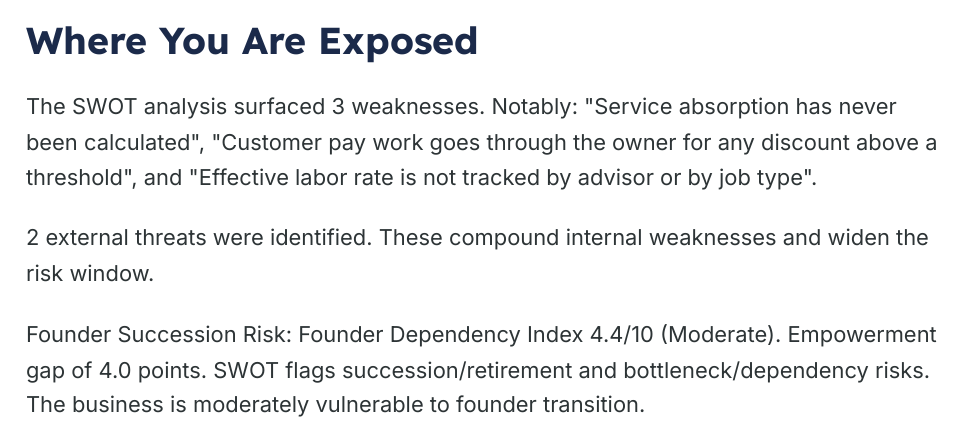
The three weaknesses entered at the highest confidence are all measurement or authority problems rather than capability problems:
- Service absorption has never been calculated
- Customer pay work goes through the owner for any discount above a threshold
- The effective labor rate is not tracked by the advisor or by job type
What the assessment returned
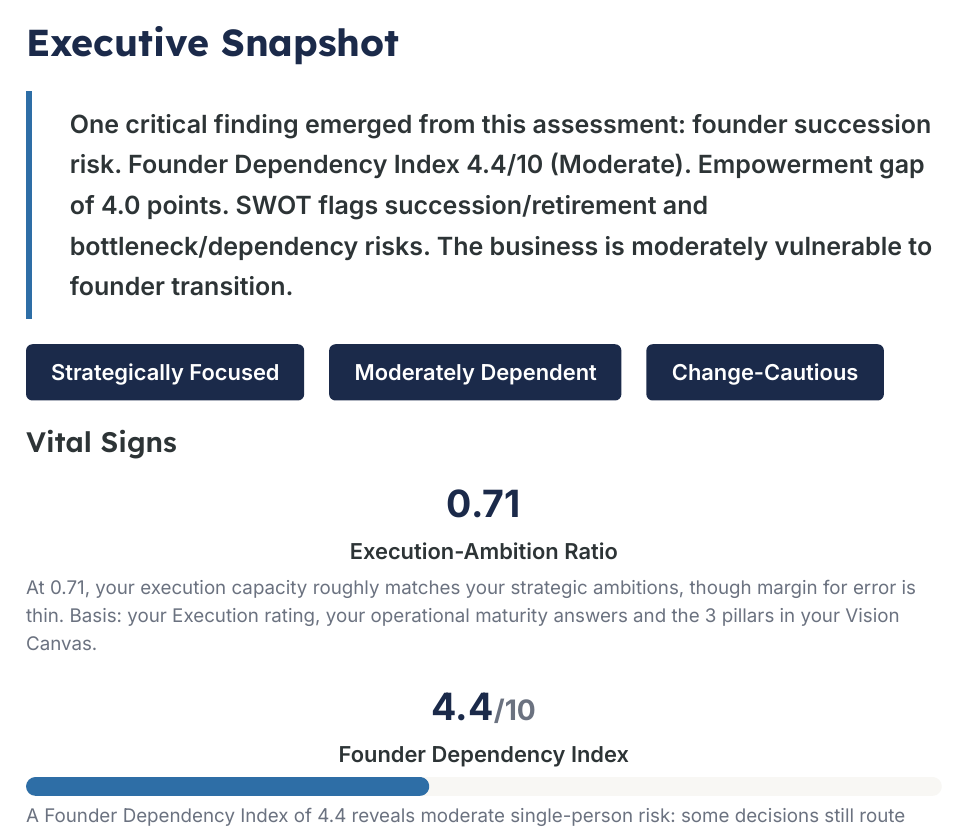
Execution to Ambition Ratio: 0.71. Capacity roughly matches stated ambition, with a thin margin for error.
Founder Dependency Index: 4.4 out of 10. Moderate, with some decisions still routing through one individual.
Organizational Readiness: 46 out of 100.
The reading is a store with capable people and no instrumentation. Nothing here says the technicians are weak or the advisors are lazy. It says the numbers that would show which of them is profitable do not exist.
Effective labor rate by advisor
The posted labor rate is the number on the wall. The effective labor rate is what the store actually realizes after discounts, menu pricing, competitive matching, and goodwill.
The gap between them is entirely made of decisions individual advisors made in the drive lane, and in most stores, nobody measures it at that level.
Tracked by an advisor, the distribution is usually wide. One advisor holds the rate and explains the value. Another discounts reflexively to avoid a difficult conversation. Both appear identical on a departmental report, and the second is expensive in a way that compounds every day.
Tracked by job type, it is equally revealing. Diagnostic work, maintenance, and repair carry different realizations, and a store that discounts uniformly across them is subsidizing the wrong category.
Stores working through operational measurement should generally read “operations consultant”.
Can you name your most profitable advisor? Sales Roadmaps builds the fixed operations reporting that answers it. Start with the operations roadmap.
Discount authority as a drive lane bottleneck
The weakness that drives the dependency reading is the one who feels most responsible.
When every discount above a small threshold routes to the dealer principal, three things happen. The customer waits in the lane. The advisor learns to avoid the conversation entirely rather than seek approval. And the principal spends time on decisions that a policy could make.
The middle path is a written discount matrix. Defined authority by advisor level, by dollar amount, by circumstance. Anything outside the matrix escalates, and the matrix is reviewed quarterly against the realized rate.
That converts a queue into an exception path. It also produces a byproduct worth more than the time saved. Every discount becomes a recorded decision rather than an untracked one.
Independent competition only exists on a customer-pay basis
The competitive pressure a dealership feels is entirely concentrated in one of its three pay types.
Independents cannot perform warranty work and have no interest in internal. They compete for maintenance and common repairs, which are exactly the customer-pay category, and they compete on convenience and price rather than on capability.
That has a strategic consequence for most underused stores. The defensible ground is not price. It is the work an independent cannot easily do, the record of the specific vehicle, and the scheduling experience. Competing on price in the one category where the store has the highest cost base is the losing version of the fight.
Internal work hides the real picture
The pay type that distorts reporting most is the one the store creates for itself.
Reconditioning and delivery preparation are billed internally, which produces service hours, technician productivity, and departmental revenue without producing external cash. A department with high internal volume appears busy and profitable in a summary report, while the customer pay side quietly shrinks.
The distortion runs both ways. The store sets internal rates, so a dealer who raises them makes fixed operations look stronger and vehicle gross look weaker. Nothing in the business has changed.
The discipline is to report all three pay types separately, always. The judge fixed operations health on customer pay hours per repair order rather than on total hours. Total hours can be manufactured. Customer pay hours cannot.
Advisor development is the actual lever
Once the effective labor rate is visible to the advisor, the improvement path stops being a pricing exercise and becomes a coaching one.
Advisors who hold a rate are usually doing something specific and teachable. They present findings rather than prices. They sequence recommendations by safety, then by cost, and give the customer a reason to decline rather than forcing a yes-or-no.
The advisors discounting reflexively are usually avoiding a conversation they have never been trained to have. That is a fixable condition, and it is cheaper to fix than to replace.
Ride along with each advisor for a morning, compare against the rate data, and the coaching agenda writes itself. Most stores never do this because nobody has the data that makes it worth doing.
The sixty-second version
The same situation was typed, in plain language, into a second free tool that returns a written diagnosis rather than scores.
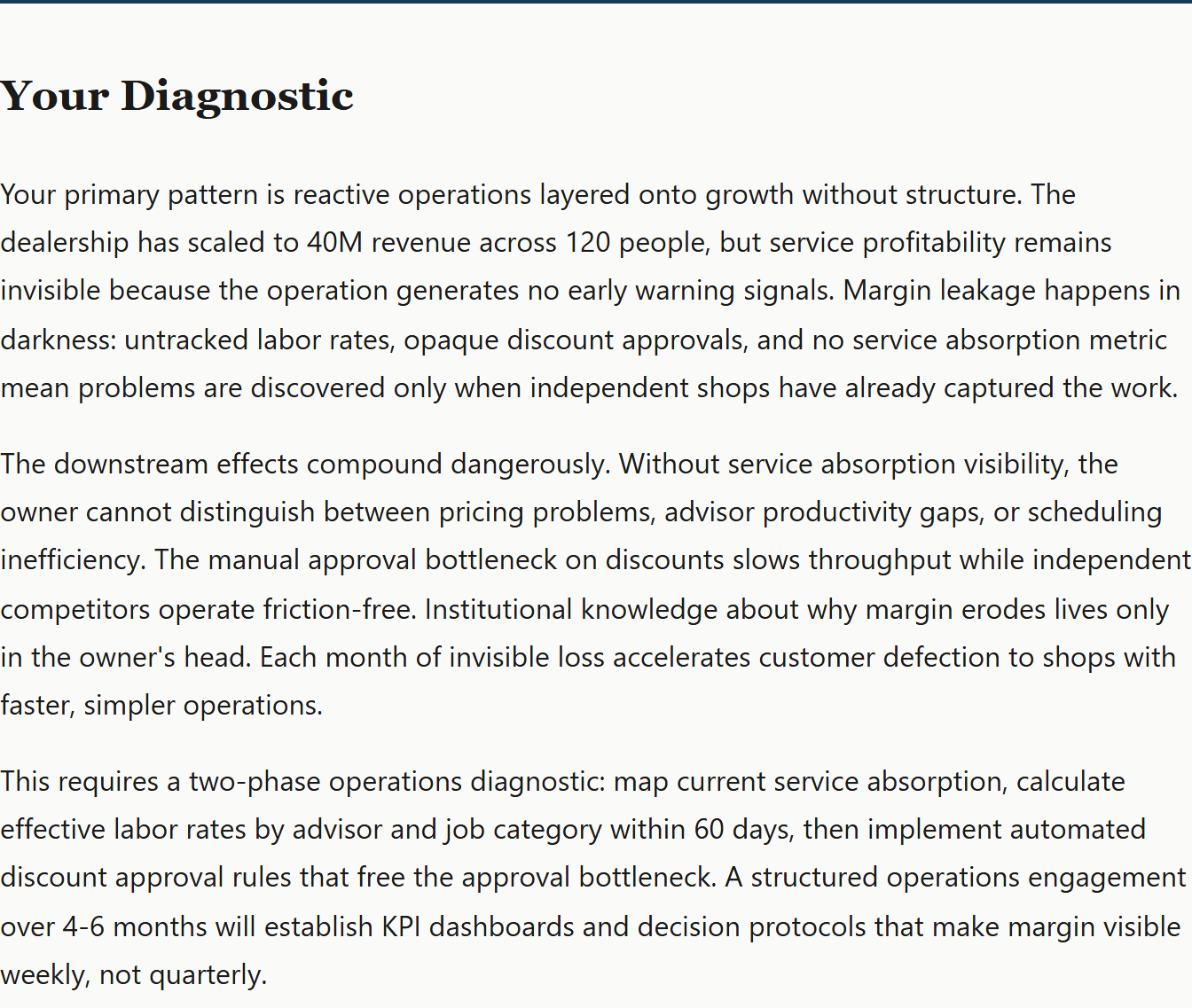
It is named reactive operations layered onto growth without structure. The store had scaled to substantial revenue and headcount while service profitability remained unmeasured.
Growth without structure is the accurate phrase. The store did not fail to build reporting out of carelessness. It grew past the point where informal knowledge worked, and nobody noticed the threshold being crossed.
Where this is not the constraint
If the service department is capacity-constrained rather than margin-constrained, measurement will confirm the obvious without changing it. The tell is a booked-solid drive lane with technicians working overtime.
If technician recruitment is the limit, absorption cannot rise regardless of rate discipline, and hiring is the higher priority.
Both tools used here are free. The written one is at businessconsultant.services, and the scored briefing is at vwcg.app. Broader process framing is found in construction company management and applies to any multi-department operation.
The short version
Customer pay is the only dealership revenue stream in which the store controls the price, keeps the margin, and faces real competition. It is usually the least measured of the three pay types.
Calculate absorption. Track the effective labor rate by advisor and by job type. Replace discount approval with a written matrix. None of that requires new systems, and all of it is invisible until someone builds the report.
Want fixed operations measured properly? Sales Roadmaps builds the reporting and the discount policy. Book a working session.
Frequently Asked Questions
What is customer pay in a dealership?
Customer pay is service and parts work funded directly by the customer, as distinct from warranty work funded by the manufacturer and internal work funded by the store. It carries the highest margin and is the only pay type facing outside competition.
What is service absorption?
Service absorption is the share of a dealership’s total fixed expense covered by gross profit from fixed operations. High absorption means the service department pays the overhead, which insulates the store from fluctuations in vehicle sales volume.
What is the effective labor rate?
The effective labor rate is what a store actually realizes per hour after discounts, menu pricing, competitive matching, and goodwill, rather than the posted rate. The gap between posted and effective consists entirely of decisions made in the drive lane.
Why track labor rate by advisor?
Because the distribution is usually wide. One advisor holds the rate and explains the value while another discounts reflexively, and both look identical on a departmental report. Advisor-level tracking is what makes the difference visible and coachable.
How should discount authority be handled?
With a written matrix defining authority by advisor level, dollar amount, and circumstance, reviewed quarterly against realized rate. Routing every discount to the dealer principal creates a drive lane queue and teaches advisors to avoid the conversation.
Why do independents only compete on customer pay?
Because they cannot perform warranty work and have no interest in internal work. Competition concentrates entirely on maintenance and common repairs, on convenience and price, which is the category in which a dealership carries the highest cost base.