An HVAC business coach usually starts with owner dependency rather than marketing. Most three- and four-crew contractors are limited by decisions routed through one person, not by lead volume. A structured diagnostic turns that bottleneck into a score, making the constraint measurable rather than anecdotal.
The question behind the search
Owners who look for an HVAC business coach rarely describe a marketing problem. They describe a time problem. The phone works, the crews are booked, and the owner still prices every large job at nine at night.
Coaching gets sold as growth. What most contractors buy is the removal of a bottleneck.
The trade itself is not short of demand. The U.S. Bureau of Labor Statistics counted 425,200 heating, air conditioning, and refrigeration mechanic and installer jobs in 2024. The same source projects 8 percent employment growth through 2034, with about 40,100 openings each year. A contractor operating in that market and still feeling stuck is usually not constrained by the market.
The constraint sits inside the business. Identifying which part is the work a coach is paid for.
Delegation, not lead generation, is the first move
A coach who opens with lead generation is treating a symptom. Adding volume to a business where every quote above a threshold depends on one person results in longer quote times, not more revenue.
The sequence that works runs the other way. Find the decisions that only one person can make. Count them. Then move them, one at a time, to a person or a documented procedure.
That is difficult in practice because the owner is usually the best technician, the best estimator, and the best closer in the company. Competence created the bottleneck.
A worked example, run through a real tool
The company described below is fictional. It was invented for this article and run through a free assessment tool to show what the output looks like. No real client, company, or person is described here. The figures below are tool outputs on invented inputs. They are not market data and should not be read as benchmarks.
The simulated profile is for a residential and light-commercial HVAC contractor. Revenue between three and five million dollars, sixteen to thirty staff, ten to twenty years in business. The owner works sixty to seventy hours a week and named margin improvement as the goal.
The self-ratings were deliberately uneven, which is what a really strong operator tends to produce. Execution rated eight out of ten. Integrity rated nine. Vision rated seven. Empowerment, meaning the degree to which the team can act without the owner, was rated three against a target of seven.
Three weaknesses were entered at the highest confidence level:
- Every quote above eight thousand dollars needs the owner
- No documented dispatch or callback procedure
- Job costing is reconciled monthly in arrears
Those are ordinary sentences. What follows is what a structured assessment does with them.
What the assessment returned
The full briefing runs fifteen pages. The relevant page is the second, which carries the vital signs.
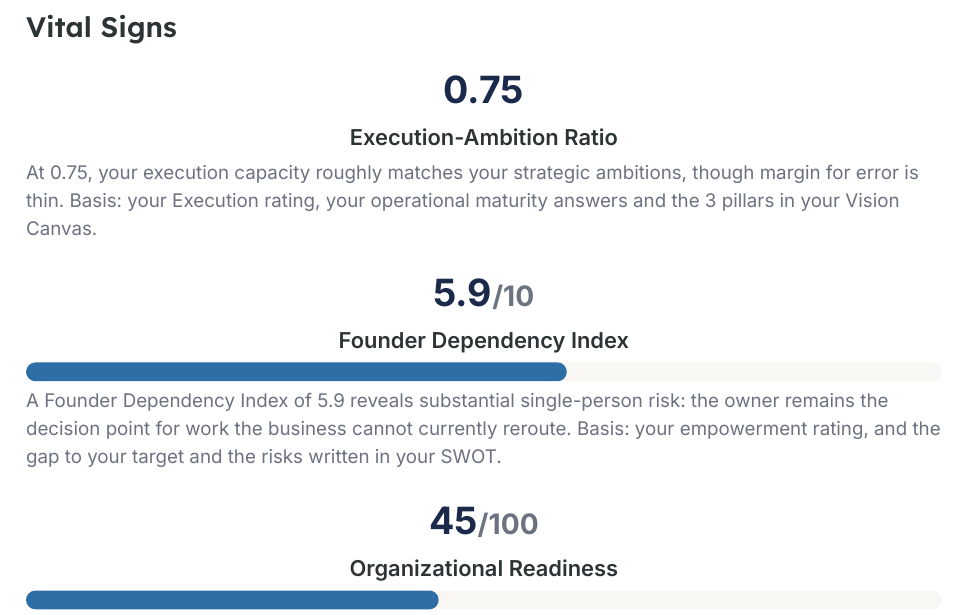
Three numbers came back.
Founder Dependency Index: 5.9 out of 10. The accompanying line reads that the score reveals substantial single-person risk. It adds that the owner remains the decision point for work that the business cannot currently reroute.
Execution to Ambition Ratio: 0.75. The briefing reads that execution capacity roughly matches strategic ambition, though the margin for error is thin.
Organizational Readiness: 45 out of 100, labeled Cautious.
The headline finding the tool generated on its own was founder succession risk. The exposure page states the problem more bluntly than most owners would say it out loud.
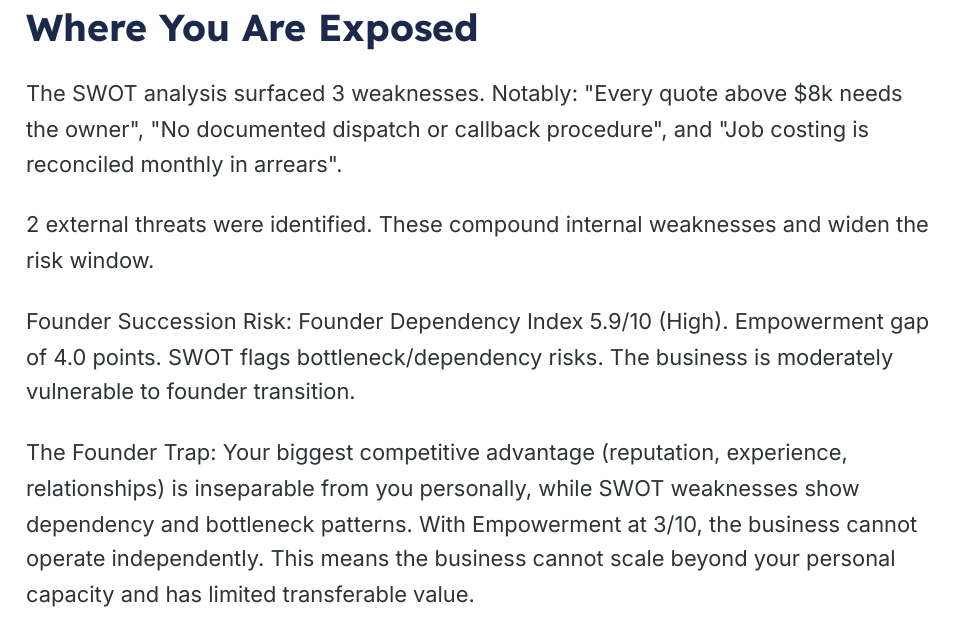
The wording there is worth quoting, because it names the pattern a coach is hired to break. The biggest competitive advantage, meaning reputation, experience, and relationships, is inseparable from the owner personally. The weaknesses, meanwhile, show patterns of dependency and bottlenecks. The consequence stated is that the business cannot scale beyond personal capacity and has limited transferable value.
Owner dependency and succession risk, measured
A score of 5.9 falls within the substantial band rather than the critical band. That distinction is useful.
Critical would mean multiple operations stall within thirty days of the owner stepping away. Substantial means something narrower and more common. The business survives a two-week absence. It does not grow during one.
The score is built from three inputs. The first is the empowerment rating and the distance to its target. The second is the set of risks written into the weaknesses and threats. The third is the vision rating, which only contributes when it falls below a threshold. The empowerment rating of three carried most of the weight here. The written weaknesses added to it, because a sentence like “every quote above eight thousand dollars needs the owner” describes a routine decision rather than a missing skill.
That is the practical takeaway for any contractor reading this. Dependency is not measured by how busy the owner feels. It is measured by how many decisions have no second path.
Capacity planning against stated ambition
The 0.75 figure compares delivery capacity against the breadth of stated ambition. Capacity draws on the execution self-rating and on operational maturity answers. Ambition draws on the pillars of the vision.
The simulated contractor rated execution at eight, which is high, but the operational maturity answers were near the floor. Undocumented dispatch and monthly retrospective job costing are operational maturity problems, not effort problems. The ratio landed below one because the capability and process disagreed.
A ratio under one on three pillars is a narrowing signal. Three strategic priorities are not many. A capacity that cannot comfortably cover three suggests sequencing rather than expansion.
Job costing, dispatch, and delegation: what to fix first
The value of a diagnostic is that it translates a vague feeling into a set of steps. For this profile, the sequence writes itself.
Documented dispatch comes first, because it is the cheapest decision to move off the owner, and it touches every job. Quote authority comes second, with a threshold and a review sample rather than a blanket handover. Job costing is moving from monthly arrears to weekly because margin improvement was the stated goal, and monthly reconciliation cannot support it.
None of those three items is a marketing initiative. All three raise the empowerment rating, which is the input that most strongly influences the dependency score.
An HVAC business coach earns the fee by holding the sequence when the owner wants to skip to growth. Contractors who want a longer-term operational view can read the HVAC business consultant breakdown or the sequenced version on how to grow an HVAC company.
Why documenting dispatch beats delegating quote authority
Most contractors already know the three items above. The list is not the insight. The order is.
Moving the quote authority first is a common mistake. It feels like the biggest win because it consumes the most of the owner’s hours. It also fails most often because a threshold handed to an estimator with no job-costing feedback results in mispriced work within a month. The owner then takes the authority back, and the team learns that delegation is temporary.
Dispatch documentation may look slower at first, but it is not. It creates the routine that later decisions attach to. Job costing cadence sits between the two because weekly costing provides the estimator with a feedback loop.
The sixty-second version
The same situation was typed, in plain language, into a second free tool. That one takes a paragraph and returns a written diagnosis in under a minute. No scores, no briefing.
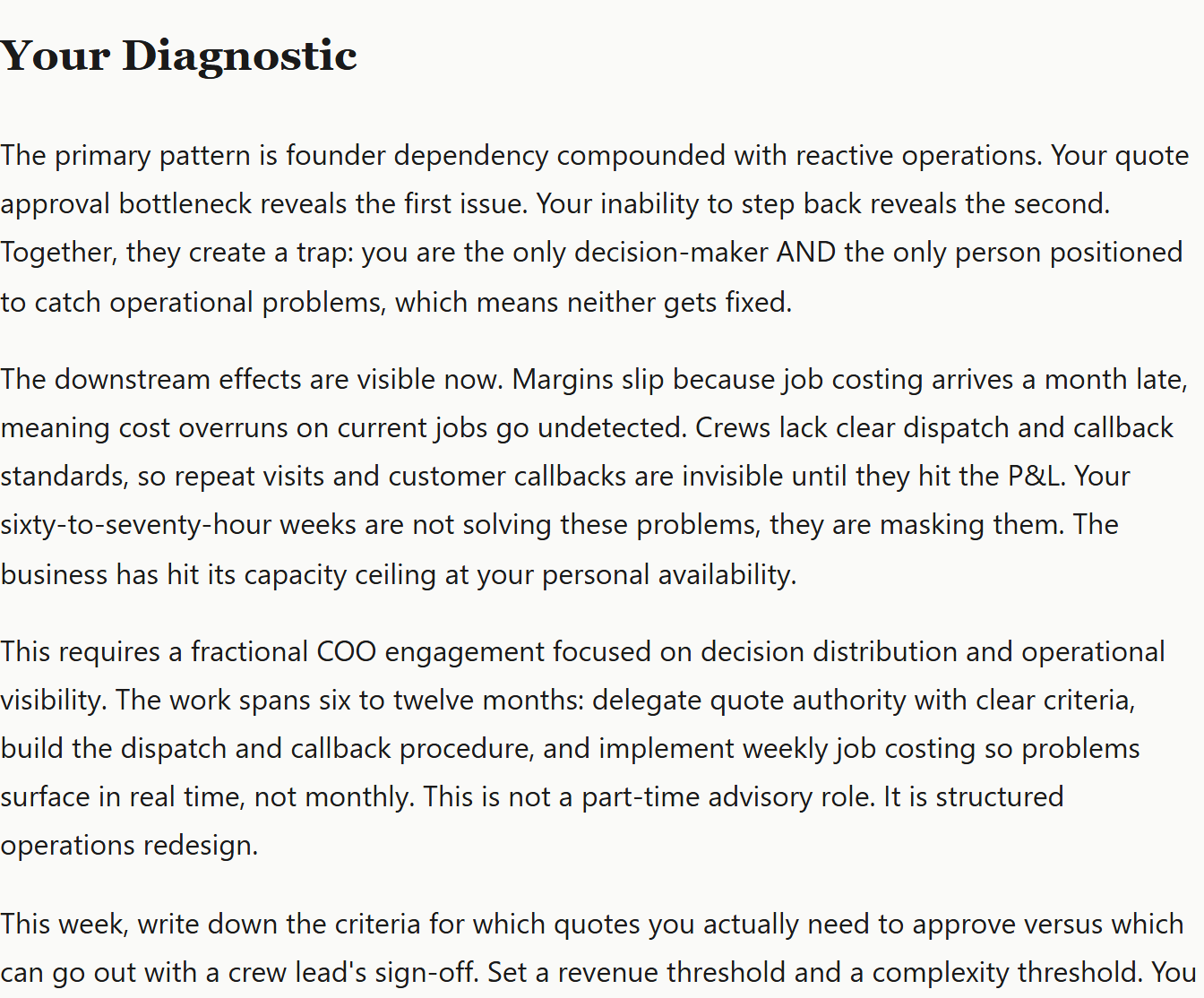
It reached the same conclusion from different inputs. The opening line reads that the primary pattern is founder dependency compounded with reactive operations. It then names the trap directly: the owner is the only decision-maker and the only person positioned to catch operational problems, which means neither is fixed.
The closing observation is the one worth pinning above a desk. Sixty to seventy-hour workweeks are not solving these problems. They are masking them. The business has hit a capacity ceiling set by the availability of one person.
Two tools, two input methods, one diagnosis. That convergence is the useful signal. A number on its own is arguable. A number that aligns with a plain-language reading of the same situation is harder to dismiss.
Ready to sequence the work? Sales Roadmaps builds the operating sequence for contractors who are stuck behind their own approval queue. Start with the operations roadmap.
Where coaching stops working
Coaching fails in two predictable situations.
The first is when the owner treats delegation as a personality trait rather than a system. Ratings do not move because someone decides to trust more. They move when a decision has a written rule and a named owner.
The second is when the constraint is genuinely a demand. That case looks different. Crews idle, quote-to-close rates fall, and the dependency score comes back low.
Running a diagnostic before hiring a coach separates those two cases. Both tools used here are free. The written one is at businessconsultant.services, and the scored fifteen-page briefing is at vwcg.app.
Contractors who prefer to start with the process rather than a score can work through ten strategies to streamline HVAC operations first.
The short version
An HVAC business coach who starts with marketing is answering a question most contractors are not asking. The constraint in a three to five-million-dollar shop with a sixty-hour owner is almost never awareness. It is that the owner is the only route to a set of decisions, and nobody has counted which ones.
Counting them is the first deliverable. Everything else is sequencing.
Want the sequence built for your shop? Sales Roadmaps maps the decisions that route through you and the order to move them. Book a working session.
Frequently Asked Questions
What does an HVAC business coach actually do?
An HVAC business coach diagnoses the constraint limiting growth, then sequences the fixes. In most contracting businesses, the constraint is decisions routed through the owner rather than lead volume. The work involves moving those decisions into documented procedures and assigning them to named people.
How is a coach different from an HVAC consultant?
A consultant typically delivers a defined project with an end date. A coach holds an ongoing relationship and enforces sequence over months. Contractors who need a one-time operational fix want a consultant. Contractors who keep reverting to old habits want a coach.
When is an HVAC company ready for coaching?
Readiness usually arrives when crews are booked, revenue is stable, and the owner has become the limit. Companies still fighting for consistent demand have a different problem. A diagnostic separates the two cases before money is committed.
What is a founder dependency score?
It is a measure of how much decision-making authority is held by one person. It draws on empowerment self-ratings and on the risks an owner writes into a business assessment. A high score indicates the business cannot operate or scale without that individual.
Can an HVAC owner fix owner dependency without a coach?
Yes, when the owner is willing to write procedures and enforce thresholds. The common failure is treating delegation as a decision rather than a system. Documented dispatch, quote authority thresholds, and weekly job costing address most of it.
How long does it take to reduce founder dependency?
Movement on the first documented procedure takes weeks. Meaningful change in an empowerment rating takes quarters, because it requires the team to make decisions and the owner to leave them alone. Ninety days is a reasonable window for the first two items.