
Job costing tracks the true cost of each project against what it was bid at. When costing is reconciled only after a job closes, the loss is already locked in. Contractors who move to a weekly cost-to-complete can correct a job while it still has weeks of labor left to influence.
What job costing measures actually
Job costing is not accounting for its own sake. It answers one question: Is this job going to finish at the margin it was sold at?
Three inputs make that answer possible. Committed cost, meaning what has been bought or subcontracted. Cost incurred to date, including labor burden rather than base wage. And the cost to complete, which is an estimate that the field has to supply.
Most contractors track the first two. The third is the one that turns a ledger into a warning system. Without it, there is no forecast, only history.
Construction management is not a small population. The U.S. Bureau of Labor Statistics counted 550,300 construction manager jobs in 2024 and projects 9 percent growth through 2034. The discipline is widespread. Real-time cost visibility is not.
Why does the monthly reconciliation arrive too late?
A job that runs for 12 weeks and is reviewed monthly gets 3 data points. The first arrives when a third of the labor is spent. By the second, the crew mix, the sequence, and the buyout are all fixed.
Margin fade usually does not come from a single large error. It accumulates through small ones: an extra day of labor, a substitution, a rework that nobody logged. Each is correctable in the week it happens and permanent by the time a monthly close reveals it.
That is the mechanism behind the phrase every contractor recognizes. The job was bid at twenty-two and finished at fourteen, and nobody can say exactly where the eight went.
A worked example, run through a real tool
The company described below is fictional. It was invented for this article and run through two free assessment tools to show what the output looks like. No real client, company, or person is described. The figures are tool output on invented inputs, not market data or benchmarks.
The simulated profile is a commercial electrical and specialty trade contractor. Revenue between eight and fifteen million, thirty-one to sixty staff, ten to twenty years in business. The owner works 50 to 60 hours a week and has set margin improvement as the goal.
This profile was deliberately designed to be the opposite of an owner bottleneck. Delegation is healthy: field supervisors run jobs without daily direction, and empowerment was rated 5 out of 10 against a target of 8.
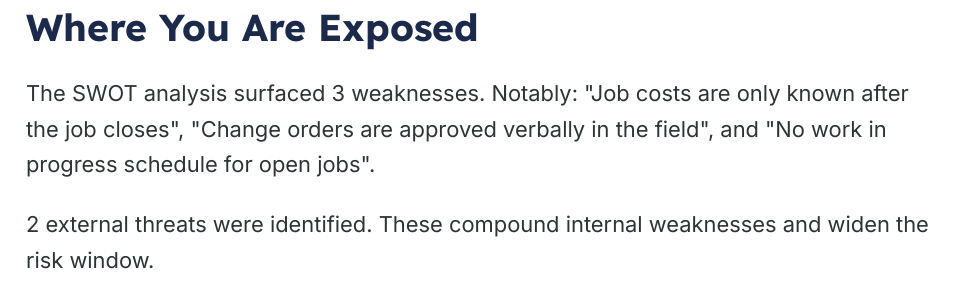
The three weaknesses entered at the highest confidence were all measurement problems:
- Job costs are only known after the job closes
- Change orders are approved verbally in the field
- No work-in-progress schedule for open jobs
What the assessment returned
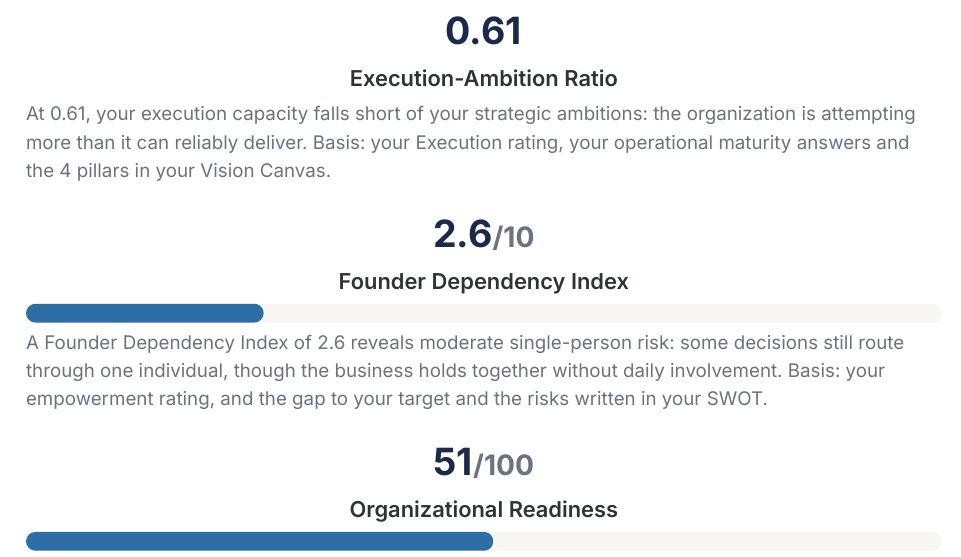
Execution to Ambition Ratio: 0.61. The briefing reads that execution capacity falls short of strategic ambitions, and that the organization is attempting more than it can reliably deliver.
Founder Dependency Index: 2.6 out of 10. Moderate, with the note that the business holds together without daily involvement.
Organizational Readiness: 51 out of 100.
That combination is the interesting part. Low founder dependency and low execution-to-ambition are a different diagnosis from an owner bottleneck. The people are capable. The instrumentation is missing.
Cost to complete and the work-in-progress schedule
The two assessment points that are fixed are the two most contractors defer.
A work-in-progress schedule lists every open job with contract value, cost to date, cost to complete, percent complete, and earned revenue. It converts a pile of open jobs into a single page that shows which ones are bleeding. It takes an afternoon to build and a weekly habit to maintain.
Cost to complete is the harder half, because it cannot come from accounting. It has to come from the person who knows what remains to be installed. That makes it a field discipline, not a finance discipline, which is why it fails when delegated to a bookkeeper.
Contractors comparing their own numbers can start with construction company profit margins before building the schedule.
Want the weekly cost to complete routine built for your shop? Sales Roadmaps installs the operating cadence that keeps jobs from running dark. Start with the operations roadmap.
Labor burden is where the number goes wrong
The most common costing error is not missing data. It is charging labor at the wrong rate.
A crew member billed at the base wage for a job understates the real cost by a wide margin. Payroll taxes, workers’ compensation, general liability, vehicle, small tools, holiday, and any benefit all belong to that hour. Workers’ compensation alone varies enormously by trade classification, which is why a rate borrowed from another contractor is worse than useless.
A shop that costs labor at base wage will see healthy margins on every report and thin margins in the bank account. The gap between those two observations is the burden that was never applied.
The fix is a single burden multiplier, calculated once a year from the actual payroll and insurance figures, applied to every hour on every job. It is not precise. It is far closer to the base wage, and it makes job-level margins comparable for the first time.
One consequence worth expecting: applying burden honestly will make historically profitable jobs look worse. That is not the number breaking. That is the number starting to work, and it is the moment most contractors quietly abandon the exercise.
Percent complete and earned revenue
Percent complete should be derived from cost, not from opinion. Cost to date, divided by the total forecast cost, yields a defensible figure. Asking a supervisor how far along a job feels does not.
Earned revenue follows from it. Contract value multiplied by percent complete shows what has actually been earned, revealing whether a job is overbilled or underbilled relative to its progress. Overbilling looks like healthy cash until the job closes and the correction arrives all at once.
Change order management as margin protection
Verbal change orders are the most expensive habit in the list, and the easiest to justify at the time. The general contractor asks, the foreman agrees, the work proceeds, and the paperwork follows if anyone remembers.
Every unwritten change order is unbilled work that still consumes labor. It does not appear as a loss. It appears to be a job that came in under the margin, which is why it has survived for years without being named.
The fix is procedural rather than technical. A change is not a change until it has a number, a price, and a written approval. Field supervisors need the authority to say that sentence without calling the owner, which is a delegation question rather than an accounting one.
A written change order does not have to be a formal document. A numbered entry with scope, price, and a signature photographed on a phone satisfies the requirement. What matters is that the number exists before labor is spent and that it lands in the job cost record in the same week. General guidance on tightening this kind of process sits in the operations consultant overview.
The sixty-second version
The same situation was typed, in plain language, into a second free tool that returns a written diagnosis rather than scores.
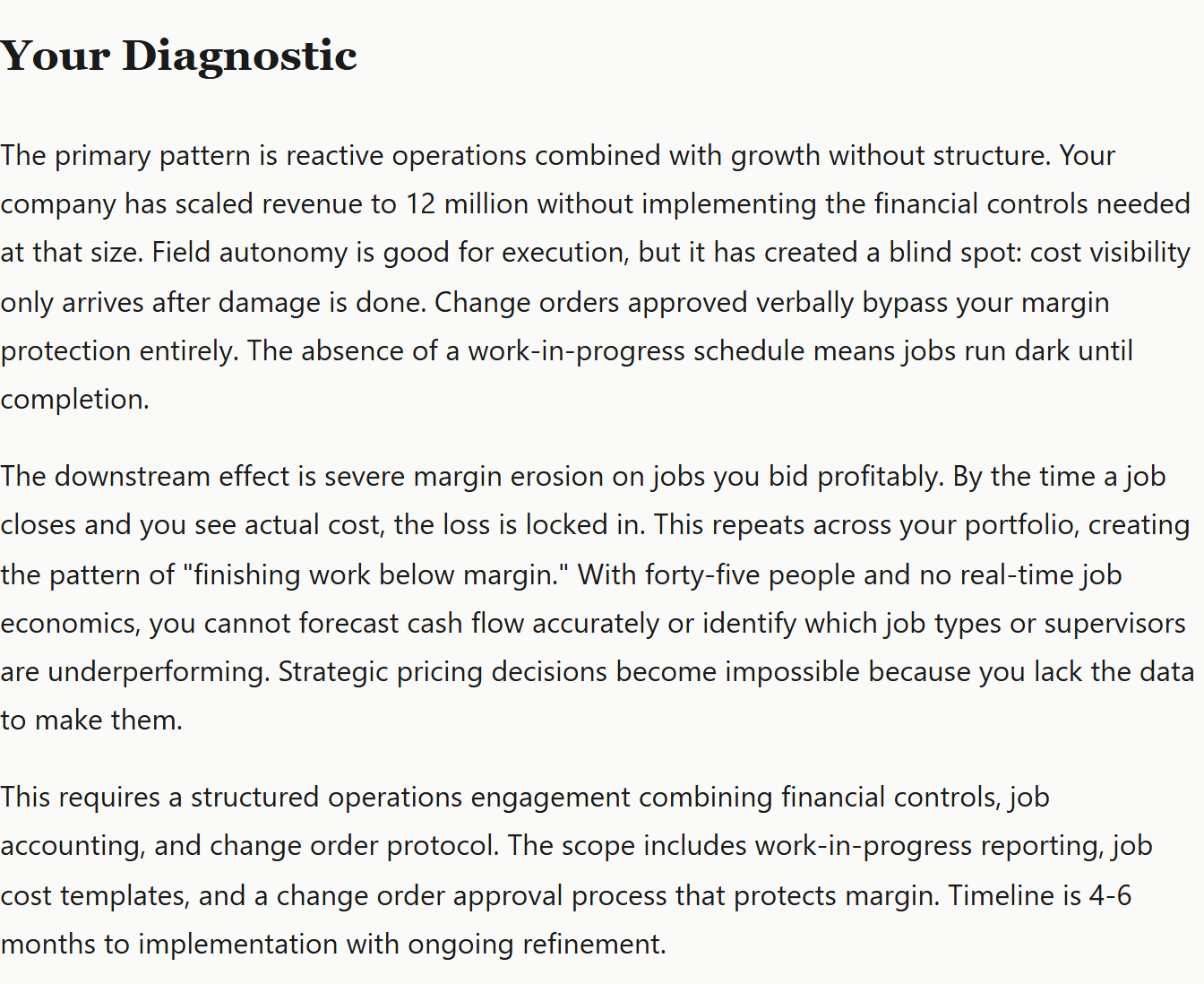
It is named the same pattern from different inputs. Field autonomy is good for execution, but it has created a blind spot: cost visibility arrives only after damage is done. Change orders approved verbally bypass margin protection entirely, and without a work-in-progress schedule, jobs run dark until completion.
The consequence it draws is sharper than the scores. Strategic pricing decisions become impossible because the data required to make them does not exist yet.
Where better job costing does not help
Two situations where this is the wrong first fix.
The first is a bidding problem wearing a costing costume. If jobs are estimated below cost, better tracking measures the loss faster without reducing it. The tell is that the fade is consistent across all supervisors and job types.
The second is a cash timing problem. Jobs may be profitable while collections are slow. Weekly costing will show healthy margins, and the account will still be empty. That is a receivables-and-terms conversation.
A structured diagnostic separates those before money is committed. Both tools used here are free. The written one is at businessconsultant.services, and the scored briefing is at vwcg.app. The broader operational context lies within the construction company’s management.
The short version
Job costing is only useful when it arrives while the job can still change. Monthly reconciliation is a record. Weekly cost to complete is a control.
The sequence is a work-in-progress schedule, first, then written change orders, then supervisor-level cost review. None of it requires new software.
Not sure whether the problem is costing, bidding or collections? Sales Roadmaps maps the constraint before recommending the fix. Book a working session.
Frequently Asked Questions
What is job costing in construction?
Job costing tracks actual costs against bid values for each project. It combines committed cost, cost incurred to date including labor burden, and an estimated cost to complete. Together, those produce a forecast of the final margin rather than a record of past spending.
How often should job costing be reviewed?
Weekly for any job running longer than a month. Monthly review on a twelve-week job produces only three data points, and the first arrives after roughly a third of labor is already spent. Weekly review leaves time to change crew mix or sequence.
What is a work-in-progress schedule?
A work-in-progress schedule lists every open job with contract value, cost to date, cost to complete, percent complete, and earned revenue. It shows which jobs are losing money while they can still be corrected. Most contractors can build a first version in an afternoon.
Why do verbal change orders cost money?
Unwritten changes consume labor without generating billable revenue. The cost does not appear as a loss on any report. It appears as a job that finished under its bid margin, which hides the cause and lets the habit continue unexamined.
Does job costing require new software?
No. A work-in-progress schedule works in a spreadsheet, and the hardest input, cost to complete, has to come from field supervisors regardless of the system. Software helps at scale but does not create the discipline that makes the numbers meaningful.
Who should own cost to complete estimates?
The person who knows what remains to be installed, which is the field supervisor rather than the bookkeeper. Cost to complete is a field judgment expressed in dollars. Delegating it to accounting is the most common reason the practice fails.