Pricing strategy is usually discussed as the setting of prices. In practice, most margins are decided after that, at the counter, by people making individual judgments under pressure. A business with an excellent price list and no discount discipline has no pricing strategy at all.
Realization is the number that matters
The price on the list is an aspiration. The price collected is the business’s.
The gap between the two has a name. Price realization is what was actually charged, measured against what was published. In most operations, nobody calculates it, because discounts are recorded as individual transactions rather than as a pattern.
Measured for the first time, the gap is almost always larger than the leadership expected. It is also concentrated: a few people, a few job types, a few situations produce most of it, which makes it correctable rather than cultural.
The sector is substantial. The Bureau of Labor Statistics counted 805,600 automotive service technician and mechanic jobs in 2024, with 4 percent growth projected through 2034. The fixed operations margin is where durable profit in that industry sits.
Discounting is a symptom of an absent answer
People discount because they lack something to say.
A customer questions a price. The person facing them has two options: explain why the price is what it is, or reduce it. Explaining requires knowing the reasoning, having practiced the words, and believing the number is defensible. Reducing requires none of those.
That means most discounting is a training and authority problem wearing the costume of a market problem. The competitor down the road is rarely the actual cause. The actual cause is that nobody equipped the person at the counter to hold the line.
A worked example, run through a real tool
The company described below is fictional. It was invented for this article and run through two free assessment tools to show what the output looks like. No real client, company or person is described. The figures are tool output on invented inputs, not market data or benchmarks.
The simulated profile is a franchise automotive dealership group. Revenue between thirty and fifty million, with a service and parts operation alongside vehicle sales.
The weaknesses entered describe the absence of measurement rather than the absence of capability. Departmental numbers never reconcile. Pricing is set independently in each area, and there is no visibility into margin by customer or job type.
What the assessment returned
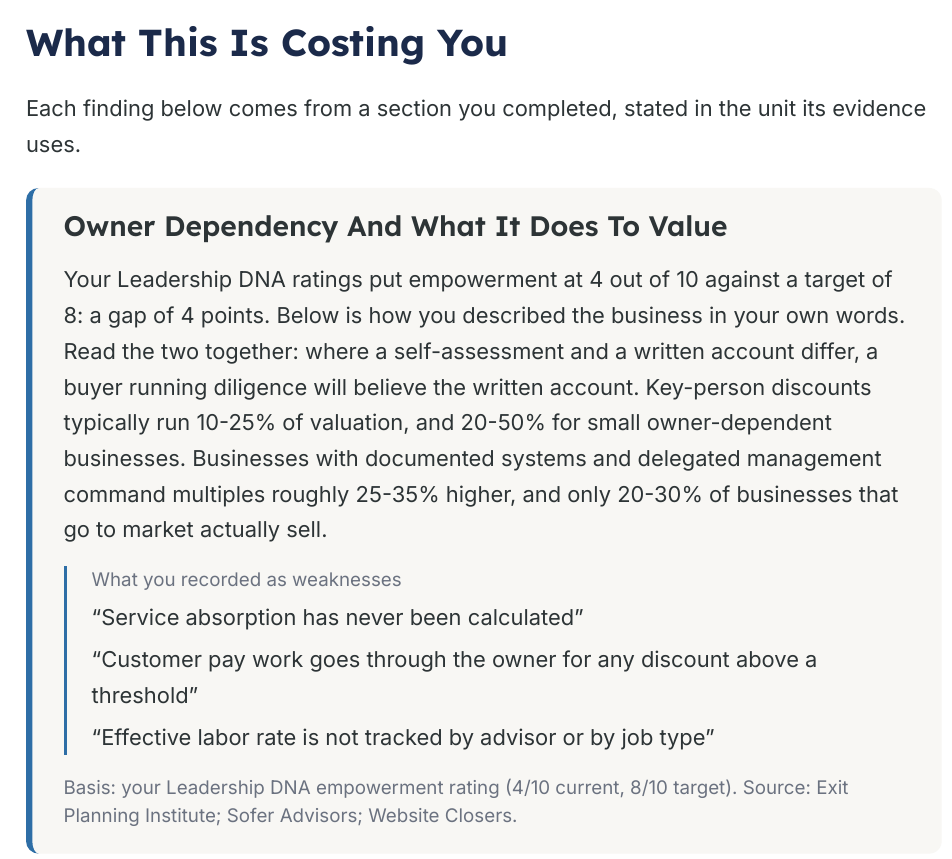
The cost section states each finding in the unit, its own evidence uses. It names which part of the assessment produced the finding rather than assigning a single headline figure.
Execution to Ambition Ratio: 0.71. Founder Dependency Index: 4.4 out of 10. Organizational Readiness: 46 out of 100.
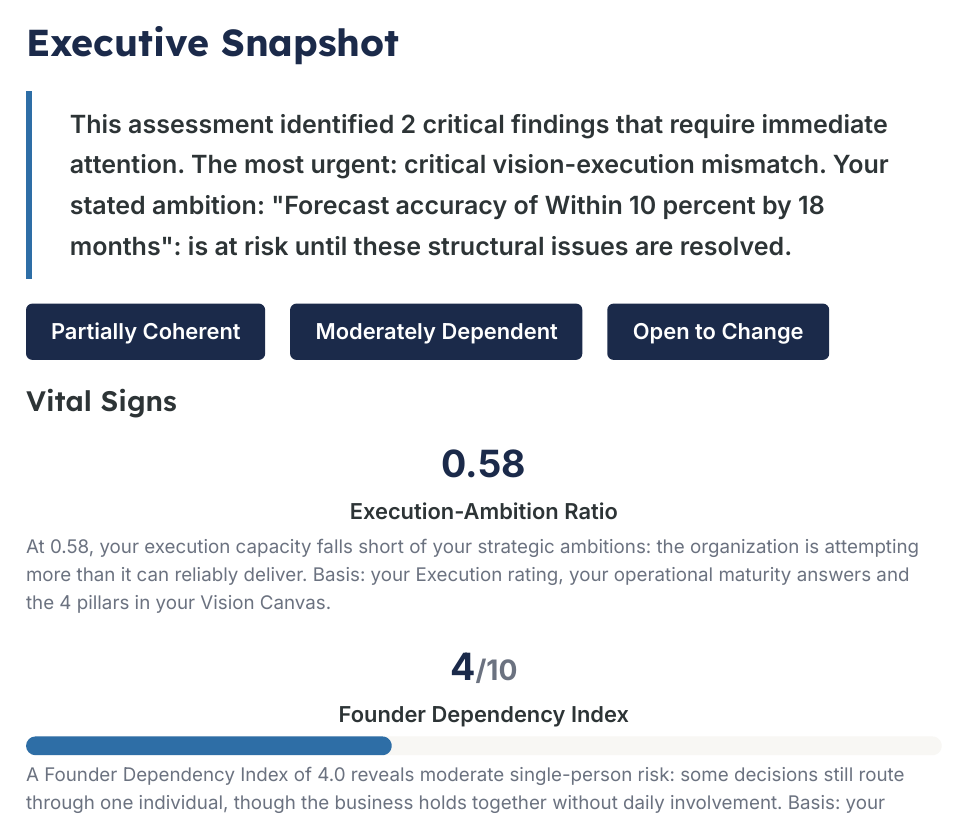
A readiness score in the mid-forties is the relevant number for a pricing change. It suggests a team that will resist a new discount policy unless the reasoning is explained and the rollout is paced.
That is worth knowing before the policy is written, because a discount rule introduced as an instruction gets worked around within a month.
Authority should be defined, not assumed
The control that removes most leakage costs nothing and is rarely in place.
Below a defined threshold, the person at the counter makes the decision. Above it, a named manager approves. The threshold can be generous. What matters is that it exists and that crossing it requires a conversation.
The effect is not primarily the approvals. It is that a required conversation makes the discount visible, and visible discounts get justified rather than reflexive. Most of the reduction happens before anyone escalates anything.
Recording a reason at the same moment costs a few more seconds and produces the data the business has been missing. Four categories are enough: competitive, goodwill, error correction, and relationship.
Dealership groups reviewing fixed operations should read operational inefficiencies in car dealerships.
Do you know your price realization? Sales Roadmaps measures the gap and closes it. Start with the operations roadmap.
Segment the price rather than lowering it
A single price for every customer forces a choice between losing sensitive buyers and undercharging everyone else.
Legitimate segmentation solves it. Price by urgency, since same-day work is worth more than scheduled work. Price by commitment, since a maintenance agreement justifies a different rate than a one-off visit. Price by scope, since a defined package and an open-ended job carry different risk.
Each of those gives the person at the counter something to offer other than a reduction. A customer who cannot pay the immediate price can take the scheduled slot. That is a sale at full margin instead of a discount.
The alternative, which is quietly matching whatever the customer claims to have been quoted elsewhere, trains the entire customer base to negotiate.
Increases work when they are specific
Across-the-board increases attract attention and invite comparison.
Selective movement rarely does. Raise the price of work where the operation is genuinely strong, where alternatives are inconvenient, or where the amount is small relative to the overall transaction. That produces a margin without producing a conversation.
The rule of thumb worth applying is that price sensitivity is highest where the customer can easily compare and lowest where they cannot. Most operations have both categories and price them with the same percentage.
Timing helps as well. Increases attached to something visible, such as an extended warranty on the work or a new service inclusion, are received as a change rather than as an extraction.
Someone has to own the number
Pricing fails quietly wherever it belongs to everybody.
In a multi-department operation, each area sets its own numbers, each has a defensible reason, and nothing reconciles. A customer receiving two quotes from the same business at different logic notices immediately, and the business finds out much later.
Having a single owner for pricing across departments resolves it. That person does not set every number personally. They own the rules, the approval thresholds, and the review, which is the part nobody currently holds.
The review matters as much as the rules. Prices that were correct two years ago are rarely correct now, and a scheduled annual pass prevents the drift that makes an eventual correction feel dramatic.
Competitor prices are worth less than they seem
The reflex on losing work to price is to survey what competitors charge, and the exercise is less useful than it feels.
A competitor price is a number without its context. It may cover a different scope, carry different warranty terms, use different parts, or represent a loss the competitor is knowingly taking to win a customer. Matching it copies a decision whose reasoning is invisible.
The more useful question is what a customer got for the difference. Where the answer is genuinely less, the price is not comparable, and the response is an explanation. When the answer is the same at a lower price, the response is a cost question rather than a price question.
Systematic surveying also invites a race that a smaller operation loses. The businesses that hold prices are the ones that can describe what they include, not the ones that check most often.
Cost is a floor, not a method
The most common pricing method in small businesses is cost plus a percentage, and it answers the wrong question.
Cost tells a business what it cannot go below. It says nothing about what the work is worth to the buyer, which is the only thing that determines what they will pay. Two jobs with identical costs can carry very different values depending on urgency, consequence, and available alternatives.
Cost plus also propagates inefficiency. A slower operation calculates a higher cost and therefore charges more, which is exactly backward and only survives where nobody is comparing.
Knowing cost remains essential. It is the input that identifies which work is being sold below the line, which is a decision worth making deliberately rather than discovering at year-end.
Broader operational framing sits in operations consultant.
The sixty-second version
The same situation was typed, in plain language, into a second free tool that returns a written diagnosis rather than scores.
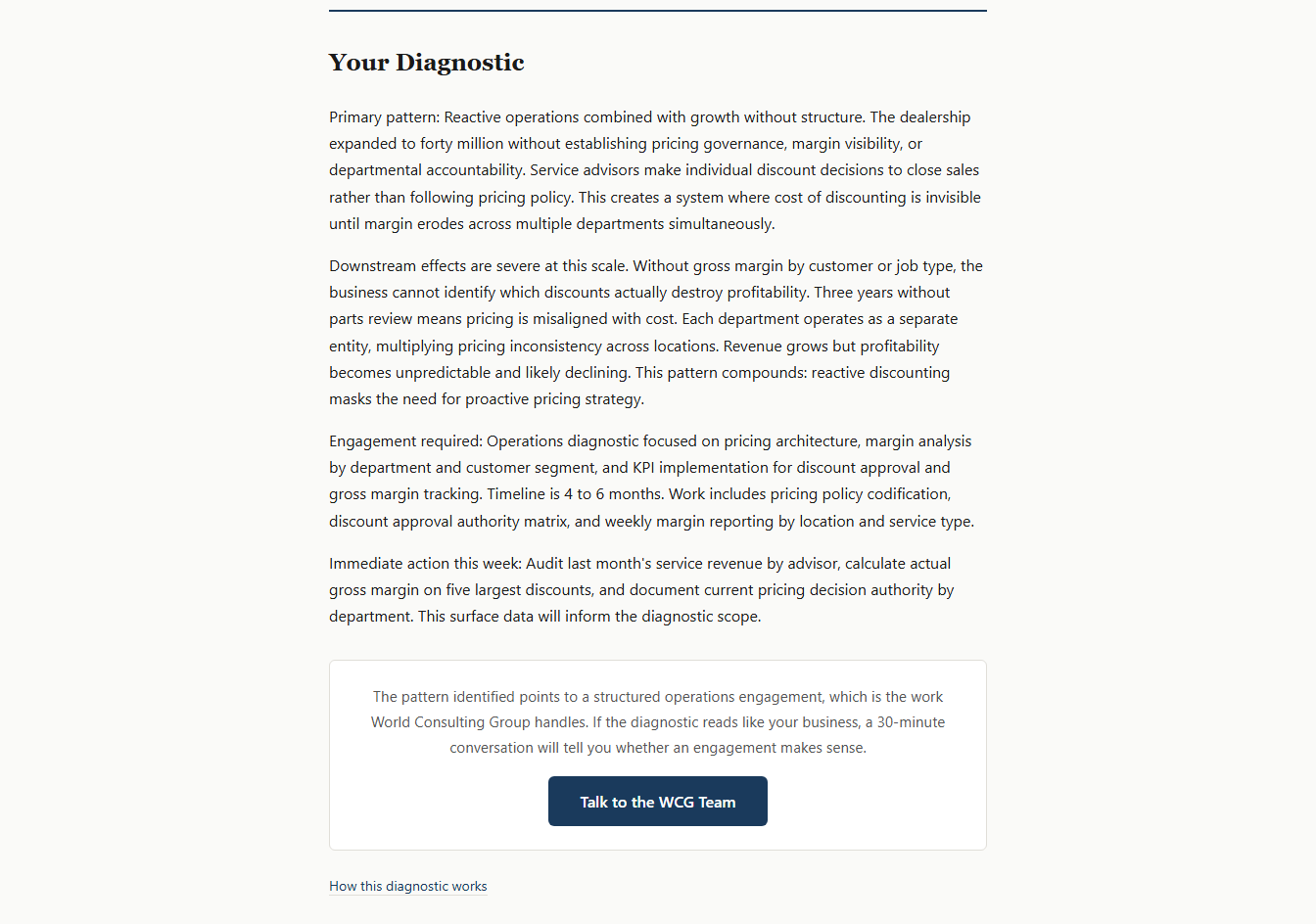
The diagnosis treats inconsistent pricing as an operational visibility failure rather than a market condition, which aligns with the assessment reading.
Visibility is the constraint. A business that cannot see margin by customer or by job type cannot tell a good discount from a bad one. It then either permits all of them or forbids all of them, and both are expensive.
Where this is not the constraint
If the operation genuinely competes in a commodity market with transparent prices, the lever is cost and mix rather than price.
If capacity is the binding constraint and the schedule is full, raising price is the correct move, and discount discipline is a secondary concern.
Both tools used here are free. The written one is at businessconsultant.services, and the scored briefing is at vwcg.app.
The short version
Most margin is decided after the price list is written, at the counter, by people with no script and no threshold. Price realization is the measurement that exposes it.
Define a discount threshold with a named approval above it and record a one-word reason on every reduction. Segment pricing by urgency and commitment so staff have something to offer beyond a cut. Move prices selectively rather than across the board.
Margin leaking one transaction at a time? Sales Roadmaps puts the threshold in place. Book a working session.
Frequently Asked Questions
What is price realization?
The price actually collected is measured against the price published. Most operations never calculate it because discounts are recorded as individual transactions rather than as a pattern, so the gap stays invisible until the margin is reviewed.
Why do staff discount?
Because they lack an alternative response. Explaining a price requires knowing the reasoning and having practiced the words. Reducing it requires neither, so most discounting is a training and authority gap rather than a market condition.
How does a discount threshold help?
Its main effect is not the approvals but the visibility. A required conversation above a defined figure makes discounts deliberate rather than reflexive, and most of the reduction happens before anyone actually escalates.
What is legitimate price segmentation?
Pricing by urgency, commitment, and scope. Same-day work is worth more than scheduled work. An agreement justifies a different rate than a one-off, and a defined package carries a different risk than an open-ended job.
Should prices be raised across the board?
Rarely. Broad increases invite comparison. Selective movement on work where the operation is strong, alternatives are inconvenient, or the amount is small relative to the transaction produces a margin without prompting a conversation.
Why is cost-plus pricing inadequate?
Cost sets a floor, not a price. It ignores what the work is worth to the buyer, which is what determines willingness to pay. It also propagates inefficiency, because a slower operation calculates a higher cost and charges more.