A service agreement is a recurring contract where a customer pays for scheduled maintenance in exchange for priority response and discounted repairs. It converts demand-driven revenue into contracted revenue. Contractors without one restart their revenue at zero every year, regardless of how many customers they have served.
Why demand-driven revenue resets every January
A contractor with two thousand past customers and no agreements has two thousand strangers. The relationship exists in the memory of a technician and nowhere in the business.
That is why January feels the way it does. Nothing carried over. Every dollar has to be re-earned from a phone that may or may not ring. Whether it rings depends on the weather rather than on anything the business decided.
The population is not the problem. The Bureau of Labor Statistics counted 504,500 plumber, pipefitter, and steamfitter jobs in 2024 and projects 4 percent growth through 2034. Demand for the trade is steady. Demand for a specific company does not exist unless the company builds it.
What a service agreement actually contains
Three components make an agreement worth selling and worth buying.
Scheduled visits, usually one or two a year, at a time chosen by the contractor rather than the customer. That is the operational value: it fills the slow weeks.
Priority response: the member is seen before the non-member during a freeze or heat wave. That is the customer value, and it is the part they actually pay for.
A repair discount is usually ten to fifteen percent. That is the part that contractors are overweight. It is the least persuasive of the three and the most expensive to give.
Recurring revenue changes what the business is worth
Contracted revenue is valued differently from demand revenue, and every buyer knows it.
A shop doing two million with no agreements is buying itself a job. The same shop with six hundred agreements has a base that survives a bad quarter, a slow spring, and the departure of a good technician. That base is what a buyer is actually purchasing.
The internal effect arrives sooner. Scheduled maintenance fills the calendar in the weeks when the phone is quiet, which is when technician utilization collapses, and payroll does not.
A worked example, run through a real tool
The company described below is fictional. It was invented for this article and run through two free assessment tools to show what the output looks like. No real client, company, or person is described. The figures are tool output on invented inputs, not market data or benchmarks.
The simulated profile is a residential plumbing and drain service company. Revenue between one and three million, six to fifteen staff, five to ten years in business, owner working fifty to sixty hours a week. The stated goal was predictable revenue.
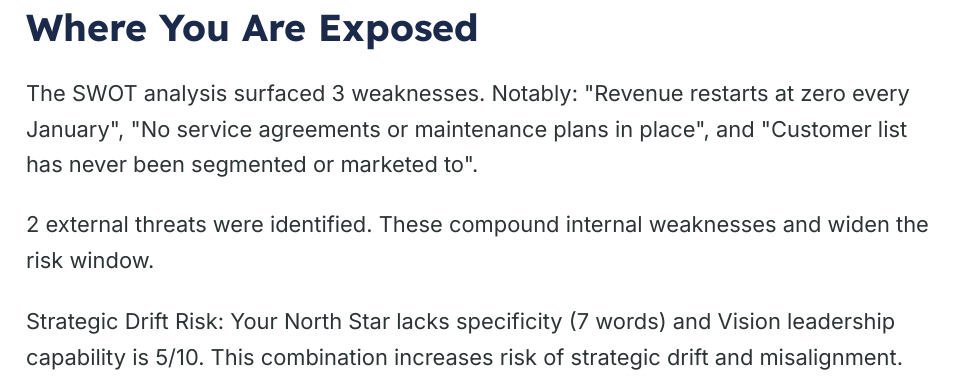
The three weaknesses entered at the highest confidence describe one problem from three angles:
- Revenue restarts at zero every January
- No service agreements or maintenance plans in place
- The customer list has never been segmented or marketed to
What the assessment returned
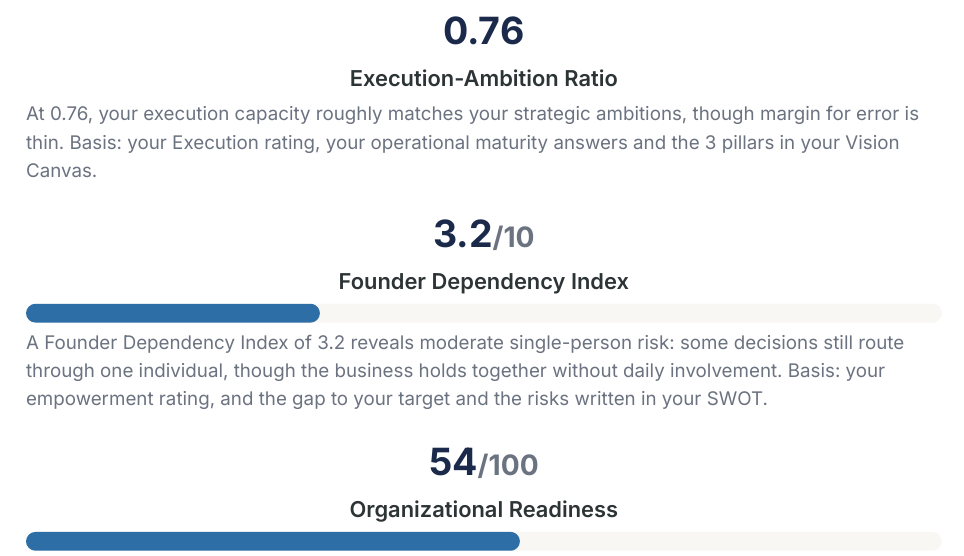
Execution to Ambition Ratio: 0.76. Execution capacity roughly matches ambition, with a thin margin for error.
Founder Dependency Index: 3.2 out of 10. Moderate, with the business holding together without daily involvement from the owner.
Organizational Readiness: 54 out of 100.
Note what did not appear. This is not an owner bottleneck. Delegation is adequate, and the crew is capable. The constraint is that nothing the business has already earned is retained in a form that produces revenue next quarter.
Pricing a maintenance plan without giving margin away
The common failure is pricing the agreement against the cost of the visits. That produces a plan priced at roughly the labor involved, which is a break-even product sold with effort.
The agreement should be priced against what it protects. It secures the customer against a competitor, it fills a slow week, and it earns the repair work that follows the inspection. The visit is the delivery mechanism, not the product.
A second failure is discounting too deeply. Fifteen percent off repairs for a member who calls three times a year is expensive. Priority scheduling costs nothing and is valued more highly by the customer who has just lost hot water.
Contractors working through the broader growth sequence can start with how to grow an HVAC company, which applies to plumbing, with the trade names changed.
Want a maintenance plan built and priced properly? Sales Roadmaps designs the agreement, the pricing, and the sales motion that fills it. Start with the operations roadmap.
Selling agreements without a sales team
Agreements are sold at the kitchen table, by the technician, at the end of a completed job. That is the only moment when the customer is both grateful and present.
Which means the constraint is not marketing. It is whether technicians have a two-sentence explanation, a price that needs no apology, and a way to enroll a customer in under a minute without calling the office.
Technicians who resist selling are usually resisting the discomfort of an unclear offer. Give them a clear one, and the resistance mostly disappears.
Compensation matters less than most owners expect. A modest per-agreement spiff works. A large one produces enrollments that cancel in month three, because the technician optimized for the signature rather than the fit.
Technician utilization and the slow week
The financial argument for agreements is usually made on recurring revenue. The operational argument is stronger.
A residential service company has predictable dead periods. Mild weeks in spring and autumn, the stretch after the holidays, any period without temperature extremes. Payroll does not pause during those weeks. Utilization does.
Scheduled maintenance is the only work for which a contractor controls the timing. Everything else is dictated by failure. That control is what lets a dispatcher fill a Tuesday in April that would otherwise have two calls and four technicians.
The compounding effect is that maintenance visits generate repair work. An inspection finds a water heater at eleven years, a shutoff valve seeping, a pressure regulator out of range. None of that is an emergency, and all of it is revenue, discovered during a week that had none.
That is why agreement economics should never be evaluated solely on the plan fee. The fee buys access to the property at a time the company chooses, and the access is worth more than the fee.
Measuring whether the program is working
Two numbers tell the whole story, and neither is revenue.
Attachment rate is the share of completed jobs that end in an enrollment. It measures whether the offer and the technician conversation are working. A rate that sits near zero is an offer problem, not a customer problem.
Retention at renewal is the share of members who continue into a second year. It measures whether the visits actually happened and whether they felt worth paying for. Renewal is where neglected programs reveal themselves, usually twelve months after everyone stopped paying attention.
Track weekly and monthly by technician. Averages hide the fact that attachment is almost always concentrated in two or three people, and those people are the training material.
What to build before selling one
Three things have to exist before the first agreement is sold.
A defined scope, written plainly enough that a customer understands what a visit includes, and a technician knows when it is complete. A vague scope produces disputes at the second visit.
A renewal mechanism, ideally a card on file with automatic renewal and clear cancellation. Agreements that require an annual re-sell decay quickly and consume office time.
A tracking method that shows who is enrolled, when they are due, and whether the visit happened. A spreadsheet is adequate at first. Nothing is, and forgotten visits are the fastest route to cancellation.
The sixty-second version
The same situation was typed, in plain language, into a second free tool that returns a written diagnosis rather than scores.
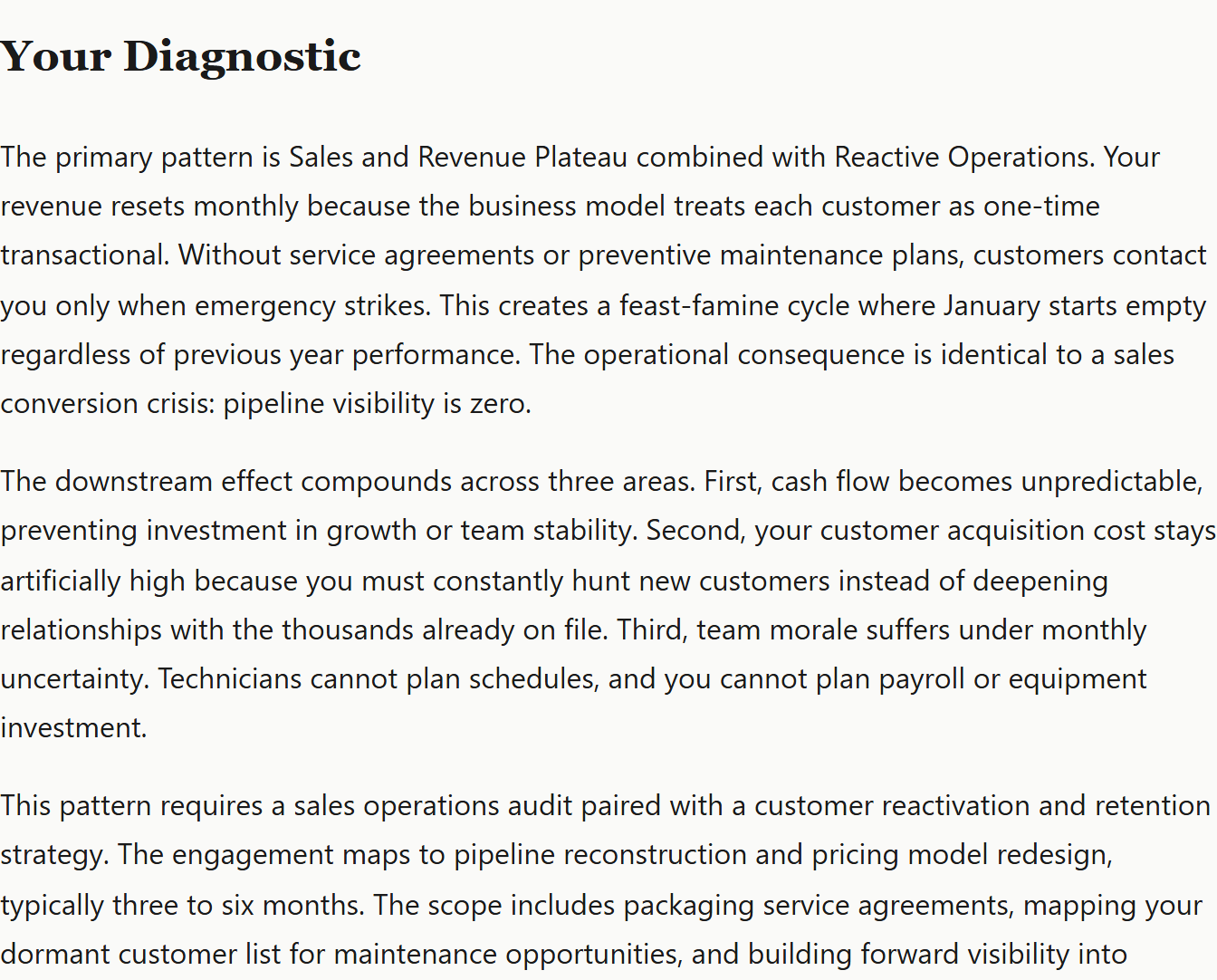
It reached the same conclusion from different inputs, namely, sales and revenue plateau, combined with reactive operations. The mechanism it identifies is that the business model treats each customer as a one-time transaction.
That phrase is the useful one. The problem is not the number of customers. It is the model that discards them after payment.
Where service agreements do not fix anything
If the technicians are not trusted in the home, agreements will not sell and should not. A recurring relationship amplifies whatever the service experience already is.
If the shop cannot reliably schedule the maintenance visits it has sold, agreements convert into a liability, and a complaint queue. Capacity has to exist before the obligation does.
A structured diagnostic separates a retention problem from a delivery problem before money is committed. Both tools used here are free. The written one is at businessconsultant.services, and the scored briefing is at vwcg.app. Operational groundwork sits in ten strategies to streamline operations.
The short version
Service agreements are not a discount program. They are the mechanism that turns work already completed into revenue that arrives again without being re-won.
Build the offer first, price it against what it protects, and put it in the technician’s hands at the end of the job. The customer list is the asset. An agreement is what makes it one.
Not sure whether the constraint is retention or capacity? Sales Roadmaps identifies which before recommending a fix. Book a working session.
Frequently Asked Questions
What is a service agreement in the trades?
A service agreement is a recurring contract where a customer pays for scheduled maintenance in exchange for priority response and discounted repairs. It converts unpredictable demand revenue into contracted revenue that arrives regardless of whether the customer has an emergency.
How much should a maintenance plan cost?
Price the plan against what it protects rather than the cost of the visits. Costing it at labor produces a break-even product sold with effort. The agreement secures the customer against competitors, fills slow weeks, and earns the repair work that follows inspection.
Do service agreements increase business value?
Contracted revenue is valued differently by every buyer than demand revenue. A base of agreements survives a bad quarter, a slow season, and the loss of a strong technician. That durability is what an acquirer is actually purchasing.
Who should sell service agreements?
Technicians, at the end of a completed job, are in the home. That is the only moment the customer is both grateful and present. It requires a two-sentence explanation, a defensible price, and enrollment that takes under a minute.
What discount should a service agreement include?
Less than most contractors offer. Repair discounts of fifteen percent are expensive for frequent callers and are not the reason customers join. Priority scheduling costs nothing to provide and is valued far more highly during a freeze or heat wave.
When are service agreements the wrong fix?
When service quality is inconsistent, or when the company cannot reliably schedule the visits it has already sold. Agreements amplify the existing experience and convert into complaints if capacity does not exist before the obligation is created.